Thailand outlines process for release of 18 Cambodian soldiers as border tensions ease
 Thailand outlines process for release of 18 Cambodian soldiers as border tensions ease
Thailand has confirmed that the release of 18 Cambodian soldiers currently detained as prisoners of war will proceed in accordance with established legal and diplomatic procedures, as part of recent progress in reducing tensions along the shared border.
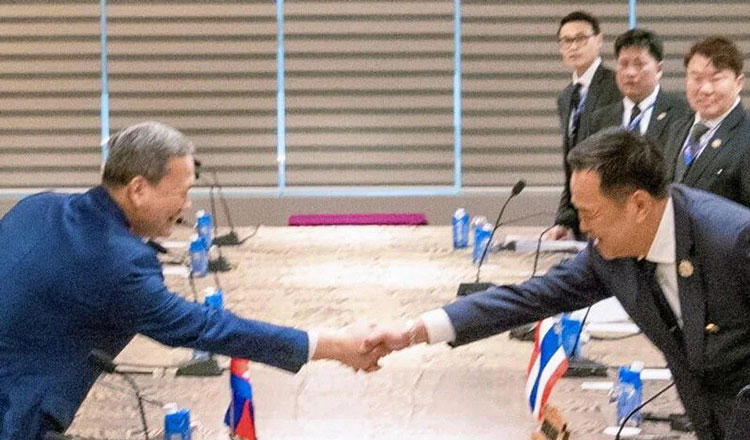
As reported by Thai media, That Prime Minister and Interior Minister Anutin Charnvirakul said that Thai authorities would assess each case individually in coordination with Phnom Penh to determine the appropriate course of action. He dismissed reports that the detained soldiers had sought political asylum, saying such claims were not part of the bilateral declaration recently signed between the two governments.
“If the 18 officers are deemed to be of no further use to Thailand, they will be repatriated,” Anutin said, adding that the process would be handled under international regulations.
Deputy Defence Minister Lieutenant General Adul Boonthamcharoen provided further details, explaining that the release of the Cambodian soldiers formed part of a three-stage disarmament and de-escalation framework agreed by both countries. In the first 21 days, Cambodia is required to withdraw high-impact weapons—including BM-21 rocket launchers and 155mm artillery—to their bases, with Thailand implementing the same. The process is being jointly monitored by the ASEAN Observer Team (AOT) to ensure transparency and neutrality.
Lt Gen Adul said further steps, including the repatriation of the detained soldiers, would depend on Cambodia’s compliance with the withdrawal and ongoing landmine clearance along the border.
The agreement follows last week’s signing of a bilateral declaration that both sides called a “positive start” toward long-term peace. Anutin said that military leaders on both sides remained in constant communication to ensure the responsible withdrawal of heavy weaponry and to coordinate mine-removal efforts, which are “essential for the safety of those living along the border.”
He added that both Thailand and Cambodia were adhering to the joint declaration “under the world’s scrutiny,” signalling their shared commitment to easing tensions.
Turning to public concerns over the disputed Ta Krabei Temple area, Anutin reaffirmed that the two nations would continue to address border issues through established mechanisms such as the Joint Boundary Commission (JBC), the Regional Border Committee (RBC), and the General Border Committee (GBC). He stressed that diplomacy, not confrontation, would be the path forward.
Anutin also addressed domestic criticism over claims that the Thai military was relying on privately donated equipment. He rejected the notion, stating that the Defence Ministry’s budget remained among the country’s largest. Donations, he said, were a “reflection of unity and patriotism,” not a sign of inadequate funding.
Regarding speculation about reopening border checkpoints with Cambodia, the prime minister said no such discussions had taken place. “If I remain in government, no border checkpoint will reopen without public consent,” he emphasised, assuring that national security would not be compromised.
Anutin expressed gratitude to security agencies, local authorities, and residents in Sa Kaeo province for helping maintain peace during a sensitive period of Thai-Cambodian relations. He apologised for a previous interview in which his remarks were misinterpreted as an admission of Thai territorial encroachment, saying he accepted full responsibility and would seek to avoid similar misunderstandings in future.
“Thailand will never surrender its territory, sovereignty, honour, or dignity,” he said, reiterating that the safety of Thai citizens remains his top priority.
-Khmer Times-