Cambodia’s response to Thai aggression: Diplomacy, law, truth, and national resilience
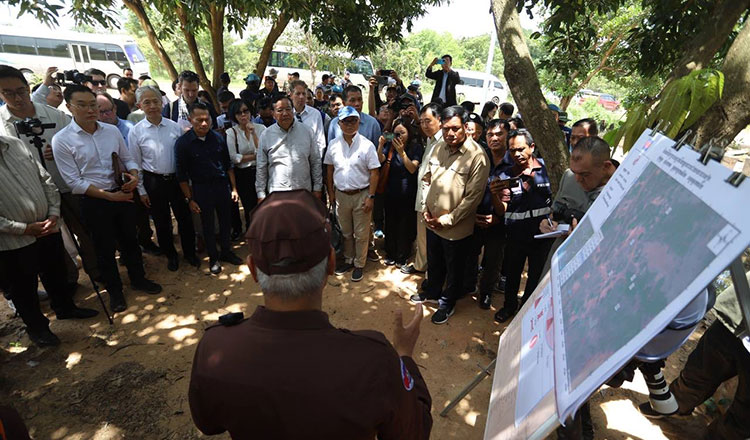 Diplomats visit a border area that came under Thai bombardment and airstrikes on civilian targets in August last year. Ministry of information
#Editorial
When a ceasefire is violated and sovereignty is challenged, a responsible state faces a defining choice: whether to respond through impulse and escalation, or through law, legitimacy, and disciplined statecraft. Cambodia’s response to Thai invasion has been driven by diplomacy and international law.
Cambodia’s strategy is not measured by how loudly it reacts, but by how credibly it defends its territorial integrity, protects its civilians, and mobilises international support through lawful and transparent means.
There are four mutually reinforcing pillars: diplomacy, law, strategic communication, and national unity.
Diplomacy: Building legitimacy, not escalation
The first and most immediate task lies in diplomacy. Cambodia must clearly and formally document Thailand’s violations of ceasefire agreement and the principles of sovereignty and territorial integrity that underpin the international system.
An official diplomatic note, grounded in facts rather than rhetoric, should form the backbone of Cambodia’s engagement with the international community.
This message must be delivered swiftly and consistently to key audiences: the United Nations Secretary-General and certain UN departments, the ASEAN Chair and Troika, and major partners including the EU, the United States, China, Japan, Australia, and India.
The purpose is not to internationalise the conflict irresponsibly, but to internationalise truth—to ensure that facts, not narratives of convenience, shape global understanding.
Equally important, Cambodia should repeatedly reaffirm its commitment to restraint and peaceful settlement. In moments of tension, credibility belongs to the party that demonstrates both resolve and responsibility.
Proposing de-escalatory mechanisms—such as military hotlines or incident-prevention arrangements—signals that Cambodia seeks stability, not confrontation.
Law: Turning evidence into accountability
Diplomacy gains strength when it rests on law. Cambodia’s second pillar must therefore be a rigorous legal strategy built on evidence, not accusation.
This begins with the establishment of a national evidence task force to systematically collect, verify, and preserve all relevant material: satellite imagery, videos, shell fragments, GPS data, medical records, and standardised witness testimonies.
Such documentation is not merely for public messaging. It is essential for preserving future legal options.
Cambodia must anchor its legal position in established instruments, particularly the Franco–Siam Treaties of 1904 and 1907, which define foundational boundary principles, and the 2000 Memorandum of Understanding, which provides agreed procedural guidelines for border demarcation.
Crucially, legal pathways must be separated with care. State responsibility for violation of sovereignty is distinct from issues of international humanitarian law compliance, which in turn differ from individual criminal responsibility.
Conflating these categories weakens credibility. A disciplined legal approach strengthens it.
In due course, Cambodia should consider publishing a legal white paper summarising its position, evidence, and treaty foundations. Transparency is not a weakness, it is a strategic asset when the law is on one’s side.
Strategic communication: Winning trust, not noise
In modern conflicts, information is a domain of contestation. Cambodia must therefore control not propaganda, but accuracy.
A single, authoritative information hub—issuing daily verified updates—can prevent rumour, reduce panic, and deny space to disinformation.
Fact sheets should clearly show where incidents occurred, how civilians have been affected, and what humanitarian assistance is being delivered.
Maps and timelines are especially powerful tools for pre-empting false claims before they spread. In this context, “pre-bunking” misinformation is more effective than chasing it after the fact.
International media engagement should be structured and credible. Controlled access for reputable journalists and observers reinforces transparency and confidence.
At the same time, Cambodian communities abroad should be engaged with disciplined messaging that emphasises legality, restraint, and civilian protection—not anger or hatred.
Patriotism: Unity without hatred
Finally, no external strategy can succeed without internal cohesion. Patriotism, in this context, must be defined not by hostility towards others but by solidarity among Cambodians.
Public messaging should emphasise calm, unity, and trust in institutions, while making it clear that the dispute concerns state actions, not people.
Rapid humanitarian assistance to affected civilians is not only a moral duty, it is also a strategic imperative.
Visible care for citizens strengthens national morale and international credibility alike. Equally important is firm guidance against hate speech and rumour-mongering, which can fracture unity and undermine Cambodia’s moral standing.
Over the longer term, this moment should feed into a broader resilience agenda: improved border governance, stronger crisis-management systems, and more professional strategic communication capacity.
National unity is strongest when linked to long-term development and national resilience. How to transform the pain, the suffering and the injustice into a national strength and resilience is the way forward.
A test of statecraft
By prioritising diplomacy over provocation, law over impulse, truth over noise, and unity over division, Cambodia can defend its sovereignty while strengthening its standing as a responsible member of the international community.
In times of crisis, restraint backed by resolve is not weakness. It is statecraft.
Next steps: Turning Crisis into national renewal
The Thai invasion has become more than a security challenge, it has emerged as a powerful catalyst for national renewal. It has compelled Cambodia to confront, with urgency and clarity, the need to modernise its state institutions, strengthen its defence capabilities, enhance economic security, and reinforce social cohesion, national unity, and resilience. Rarely in recent history has Cambodian society demonstrated such a high degree of unity in the face of foreign aggression.
This moment serves as a wake-up call—not only for the state, but for all national stakeholders—to build strong, credible, and adaptive institutions. National strength is not measured solely by military capacity, but by the quality of governance, the effectiveness of leadership, and the depth of social trust that binds citizens to the state.
Moving forward, Cambodia’s next steps must focus on institutional modernisation that is agile, transparent, and people-centred. Defence reform should be integrated with broader national resilience, ensuring that deterrence is credible while remaining firmly anchored in international law and peaceful coexistence. Economic security must be treated as a strategic pillar, reducing vulnerabilities and strengthening self-reliance without closing the door to regional and global cooperation.
Equally important, the spirit of unity witnessed during this crisis must be preserved and institutionalised. National cohesion cannot be episodic; it must be sustained through good governance, social justice, equitable development, transformative leadership and strategic communication between the state and its people.
Leadership at all levels must rise to this responsibility—calm in crisis, principled in decision-making, and resolute in defending the nation’s sovereignty and dignity.
The war on corruption must begin now. Without decisive action, corruption will continue to hollow out state capacity, weaken public trust, and leave the country vulnerable to external pressure and foreign aggression.
Corruption is not only a moral failure or an economic inefficiency; it is a national security threat. It diverts resources from defence and public services, undermines institutional discipline, and erodes the credibility of leadership at critical moments. A state burdened by corruption cannot mobilise effectively in times of crisis, nor can it command the full confidence and cooperation of its people.
-Khmer Times-