Hun Manet rejects Thai claim UNCLOS process shut door to border talks
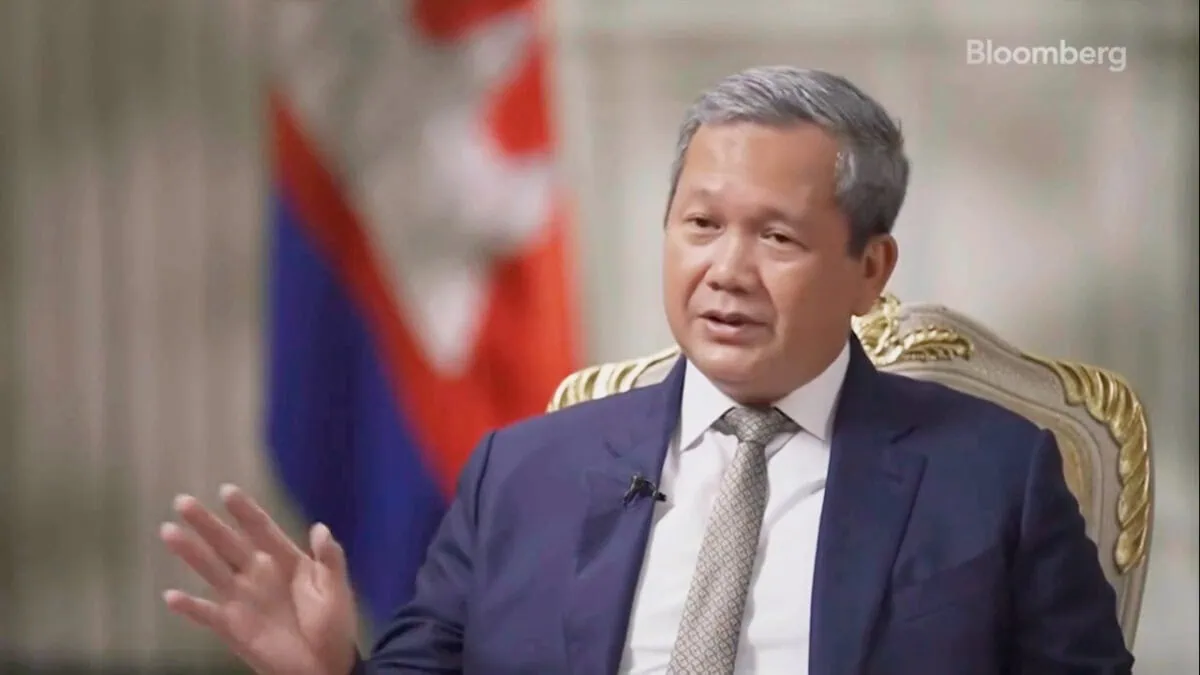 In an exclusive interview with Bloomberg, Prime Minister Hun Manet covered a wide range of subjects, including maritime disputes with Thailand and the Kingdom’s ongoing efforts to suppress cybercrimes. Bloomberg
Prime minister says Cambodia turned to UN maritime conciliation only after Thailand withdrew from the 2001 bilateral agreement, while insisting land boundary negotiations remain separate.
Prime Minister Hun Manet has rejected Thai assertions that Cambodia’s decision to pursue compulsory conciliation under the UN Convention on the Law of the Sea (UNCLOS) has effectively ended bilateral negotiations on broader border issues, calling the claim “inaccurate” and “unfair”.
Speaking in an exclusive interview with Bloomberg Television aired on July 24, Manet said Cambodia remained committed to resolving both maritime and land boundary disputes peacefully, but had been left with “no choice” but to invoke the UNCLOS mechanism after Thailand unilaterally terminated the 2001 Memorandum of Understanding (MoU) governing overlapping maritime claims.
“I heard the Thai leadership, especially the foreign minister of Thailand, state that because Cambodia went to UNCLOS, that closed the door for the land boundary. This statement, I’d like to say, is a little bit inaccurate and a little bit unfair,” Hun Manet said.
He argued that Cambodia’s move was a direct consequence of Thailand’s decision to cancel the MoU 2001, which had served for years as the only bilateral framework for addressing overlapping maritime claims in the Gulf of Thailand.
“The reason why we went to the UNCLOS compulsory conciliation is because Thailand decided to cancel the only existing bilateral agreement between Cambodia and Thailand on maritime issues, the MoU 2001,” he said.
Manet noted that successive Cambodian governments and more than a dozen Thai administrations had spent years attempting to find mutually acceptable solutions under the agreement, including discussions during the tenures of former Thai prime ministers Srettha Thavisin and Paetongtarn Shinawatra.
According to the prime minister, Cambodia had repeatedly urged Bangkok not to terminate the agreement, but Thailand proceeded regardless, leaving Phnom Penh to seek an alternative legal avenue under UNCLOS.
The remarks come after Thai foreign minister Sihasak Phuangketkeow argued that Cambodia’s initiation of compulsory conciliation had complicated broader bilateral dialogue on border issues.
Manet maintained, however, that the maritime conciliation process and negotiations over the land border were separate matters and should not be conflated.
He also disclosed that the UNCLOS conciliation process was progressing procedurally.
“We have nominated two judges each side, and now we are working on the chairman, the fifth judge,” he said, adding that both countries should first focus on moving the legal process forward before discussing the precise scope of the conciliation.
When asked whether Cambodia might narrow the discussions to maritime boundary delimitation instead of also pursuing joint development of overlapping areas, Hun Manet described the decision as premature.
“We have already submitted our proposals on delimitation and also joint development for consideration. But at this stage, let’s focus on getting the process moving,” he said.
Cambodia formally initiated compulsory conciliation under UNCLOS after Thailand withdrew from the 2001 MoU, arguing that the bilateral framework which had governed maritime negotiations for more than two decades no longer existed.
The conciliation mechanism does not produce a legally binding ruling but establishes an independent panel to help both parties seek a mutually acceptable settlement in accordance with international law.
During the interview, Manet also reiterated Cambodia’s commitment to combating transnational online scam operations through international cooperation rather than geopolitical rivalry.
He said Cambodia would host an international conference on combating online scams, bringing together law enforcement agencies from multiple countries, including China and the US.
“I invited the delegation from the FBI to join, and director Kash Patel said he will send a senior delegation,” Manet said, arguing that organised cybercrime affects all nations, regardless of political alignment.
“Criminal networks can attack both the US and China at the same time. These are common challenges that require multinational cooperation,” he added.
The prime minister also sought to reassure investors over concerns that criminal syndicates could exploit Cambodia’s special economic zones (SEZs).
He said he had instructed security agencies, provincial authorities and SEZ regulators to ensure that industrial zones were not used to facilitate online scam operations.
“If any SEZ is found to be covering for criminal scams, they will be liable under the law just like anyone else,” he said.
Manet stressed that Cambodia had found no evidence that SEZs were being used as bases for scam operations but pledged continued vigilance.
“We will make Cambodia a place where it is not easy or worthwhile for online scam operations to stay,” he said.
Asked about US sanctions imposed on Cambodian senators over alleged links to forced labour and human trafficking, Manet declined to comment on the merits of the measures, describing them as personal legal matters.
He said both individuals had engaged legal teams to defend themselves.
However, he insisted Cambodia had already taken action against officials implicated in online scam activities.
“We have removed three-star generals, two-star generals, one-star generals, governors and provincial police commissioners where there was evidence or failure to act,” Hun Manet said, adding that further investigations were continuing.
The exclusive Bloomberg interview was conducted as Cambodia seeks to reassure international investors over governance and security while simultaneously pursuing legal and diplomatic efforts to resolve its maritime dispute with Thailand.
-Phnom Penh Post-