Thailand Is Running Out of Lies: World No Longer Blind to Its Aggression Against Cambodia
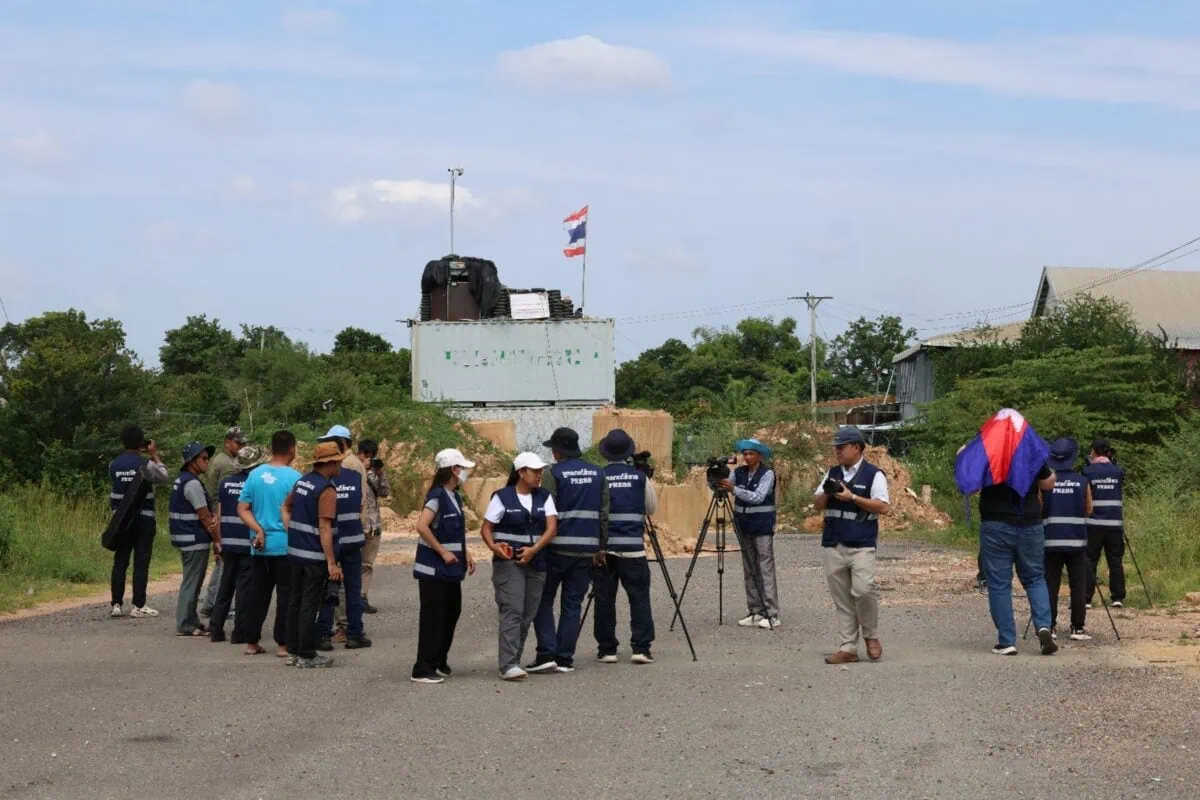 Cambodian journalists during a recent visit to the border, where the Thai military has placed shipping containers on occupied Cambodian territory. Supplied
Thailand has spent months asking the international community to disbelieve what it can plainly see.
It calls airstrikes “self-defence”. It calls military entrenchment “de-escalation”. It calls razor wire and shipping containers “security measures”. It calls Cambodian villages “disputed areas” only after Thai troops have entered them. And when Cambodian families cannot return to their own homes, Bangkok insists that there is no occupation at all.
But propaganda has one fatal weakness: it eventually collapses under the weight of visible facts.
Thailand may continue disputing who fired the first shot. It may repeat allegations against Cambodia through military briefings, diplomatic statements and a well-funded media campaign. But it cannot deny the military actions that Thailand itself has publicly acknowledged.
Thailand deployed F-16 fighter aircraft and conducted airstrikes inside Cambodia during the July and December 2025 fighting. When hostilities resumed in December, Thailand again announced that its fighter jets had struck Cambodian territory, with Thai officials saying the operations were intended to weaken Cambodia’s military capabilities. These were not claims invented by Phnom Penh. They were operations announced by Bangkok and reported internationally.
Thailand can debate the sequence of gunfire, but it cannot erase the flight paths of its fighter jets.
It can argue about battlefield allegations, but it cannot pretend that air power was never projected across an international frontier.
And it cannot bomb Cambodian territory first, consolidate military positions later and then demand that the world describe the entire operation as restraint.
A Ceasefire Is Not a Licence to Occupy
Thailand’s most extraordinary argument is that maintaining its military positions after the 27 December 2025 ceasefire somehow proves that no occupation exists.
Its own Ministry of Foreign Affairs stated that the maintenance of “current troop positions” constituted compliance with the ceasefire and should not be regarded as territorial occupation. But this is not a denial that Thai forces remain in those positions. It is an attempt to legalise their presence through carefully selected vocabulary.
A ceasefire stops shooting. It does not transfer sovereignty.
It freezes military activity for the purpose of preventing further bloodshed. It does not convert the location of an army at the hour of the ceasefire into a lawful international boundary.
If an army could seize or enter territory, remain there until a ceasefire takes effect and then claim that its position must be preserved indefinitely, every ceasefire would become a reward for the use of force. That would not be peace. It would be territorial acquisition disguised as de-escalation.
Reuters reported that Thai forces had barricaded areas with razor wire and shipping containers, leaving up to 20,000 Cambodian civilians unable to return to their homes. Cambodia’s prime minister subsequently stated that these barriers had been placed inside areas Thailand had previously recognised as Cambodian territory. Thailand rejected the accusation of occupation, but it did not make the barriers, soldiers or displaced families disappear.
A fighter jet is not a legal argument. A shipping container is not a boundary pillar. Barbed wire is not a treaty. A bunker is not proof of sovereignty. And a ceasefire line is not an international border.
Renaming Aggression Does Not Make It Lawful
Thailand’s information strategy relies on semantic substitution. Airstrikes become “defensive operations”. Military advances become “protection of sovereignty”. Permanent obstacles become “temporary security measures”. Cambodian civilian communities become “overlapping claim areas”.
The prevention of civilian return becomes “maintenance of troop positions”.
Every phrase is designed to make military coercion sound like routine border administration. But changing the label does not change the act.
Thailand’s denials have therefore reached the limits of credibility. The issue is no longer merely what Bangkok says. The issue is whether its explanations are consistent with what it has done.
If Thailand’s forces are unquestionably inside Thai territory, why resist immediate joint verification?
If the barriers are lawfully placed, why are Cambodian residents unable to return to the homes and farmland they occupied before the fighting?
If Thailand genuinely trusts the Joint Boundary Commission (JBC), why delay or suspend the bilateral talks needed to determine the boundary technically?
If Bangkok seeks de-escalation, why continue building barriers, roads and military positions in areas whose status must be determined through legal and technical mechanisms rather than unilateral force?
Thailand cannot answer these questions by simply accusing Cambodia of spreading “false information”. A denial is not evidence. Repetition is not verification. And military control is not legal title.
Thailand Cannot Demand Bilateralism While Blocking Bilateral Talks
For years, Thailand insisted that its disputes with Cambodia must be resolved through bilateral mechanisms. Yet when Cambodia initiated compulsory conciliation under the UN Convention on the Law of the Sea (UNCLOS) after Thailand unilaterally terminated the 2001, the only maritime framework, the Thai prime minister announced that Bangkok would halt other bilateral negotiations — including talks concerning the land boundary — and keep all border gates closed.
This exposes another fundamental contradiction. Thailand tells the international community that bilateral dialogue is the only acceptable path. It then suspends bilateral dialogue when that dialogue becomes inconvenient.
It claims that Cambodia is avoiding negotiation while refusing to convene the mechanisms required for verification. It criticises Cambodia for turning to international law after Thailand itself withdrew from an agreed negotiating framework.
A government cannot close the door to bilateral mechanisms and then blame its neighbour for seeking another peaceful door.
Nor can Thailand freeze the JBC while attempting to create new facts on the ground. The longer military barriers, roads, bunkers and troop positions remain, the greater the danger that a temporary deployment will be presented as a permanent status quo.
That is the logic of a fait accompli: occupy first, obstruct verification, second, normalise the occupation third and later claim that any challenge to the new reality is itself a provocation. Cambodia must not — and will not — accept that logic.
History Has Already Rejected Thailand’s Unilateral Claims
Thailand should understand better than most countries that military presence cannot overturn an established legal boundary.
In 1962, the International Court of Justice ruled that the Temple of Preah Vihear was situated in territory under Cambodian sovereignty and ordered Thailand to withdraw its military and police forces. In 2013, the court clarified that the 1962 judgment covered the whole territory of the Preah Vihear promontory and reaffirmed Thailand’s obligation to withdraw its personnel from that territory.
Those judgments do not determine every undemarcated section of the Cambodia–Thailand border. But they establish an essential principle: sovereignty is determined by treaties, accepted maps, legal obligations and agreed mechanisms — not by the unilateral deployment of armed forces.
Thailand cannot replace the legal record with a military map drawn after combat. It cannot use superior air power to revise treaty obligations. It cannot transform contested allegations into territorial rights merely by maintaining troops on the ground.
The UN Charter prohibits the threat or use of force against the territorial integrity or political independence of another state. That principle exists precisely to prevent stronger states from using military power to manufacture new borders.
The World Is Not Blind
The world does not need another Thai press conference to understand what is happening. It has seen Thailand acknowledge airstrikes inside Cambodia.
It has seen the destruction caused by the fighting. It has seen barbed wire and shipping containers obstructing Cambodian communities. It has seen thousands of families prevented from returning home. It has seen Thailand defend its military positions while denying that those positions constitute occupation.
And it has seen Bangkok suspend negotiations while claiming that negotiations are the only legitimate solution.
No serious observer needs to accept every statement made by Cambodia to recognise the contradictions in Thailand’s narrative. The central facts speak for themselves.
Thailand used fighter aircraft inside Cambodia. Thai troops remain in areas Cambodia identifies as its sovereign territory. Physical barriers have prevented Cambodian citizens from returning home. Thailand has attempted to preserve the post-conflict military situation while delaying the technical and legal processes capable of establishing the truth.
Bangkok may reject the word “aggression”. But it cannot demand that the international community ignore the conduct that gives the word its meaning. Thailand may reject the word “occupation”. But occupation does not cease to exist merely because the occupying force objects to the terminology.
Thailand may call every Cambodian document “misinformation”. But facts do not become false because Thailand finds them politically inconvenient.
Peace Cannot Be Built on a Lie
Cambodia does not seek war with Thailand. The Cambodian and Thai peoples share geography, history, commerce and a future that should be defined by cooperation rather than conflict.
But genuine peace cannot be built on forced silence. It cannot be built on the displacement of Cambodian families. It cannot be built behind barbed wire.
And it cannot be built upon the assumption that a militarily stronger state may bomb first, occupy later and then use public relations to transform aggression into legitimacy.
If Thailand genuinely seeks peace, the path is clear: cease all unilateral activity, remove barriers placed inside Cambodian territory, permit displaced residents to return safely, resume the JBC without political conditions, accept joint and impartial verification, and resolve every outstanding question through treaties and international law.
Cambodia is prepared to defend its position with law, documents, maps, facts and peaceful mechanisms.
Thailand appears increasingly dependent on denials. But denials cannot erase airstrikes.
Public relations cannot erase occupation. Military power cannot create sovereignty.
And no lie-however loudly, repeatedly or professionally communicated-can permanently hide aggression from the world.
Roth Santepheap is described as a Phnom Penh-based geopolitical analyst. The views and opinions expressed are his own.