Thailand accused of using media tours to justify border incursions
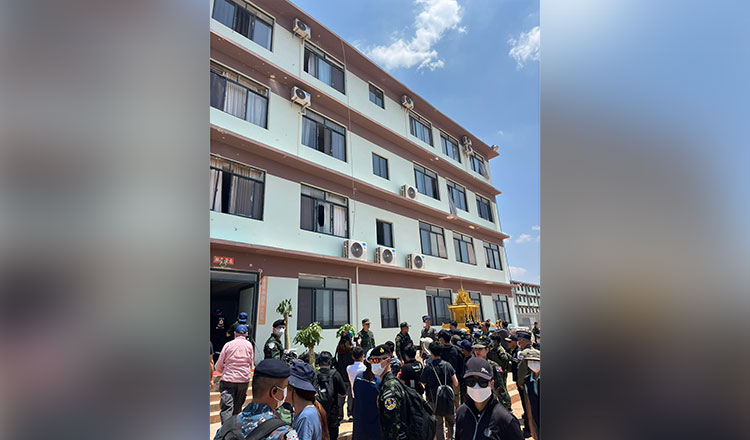
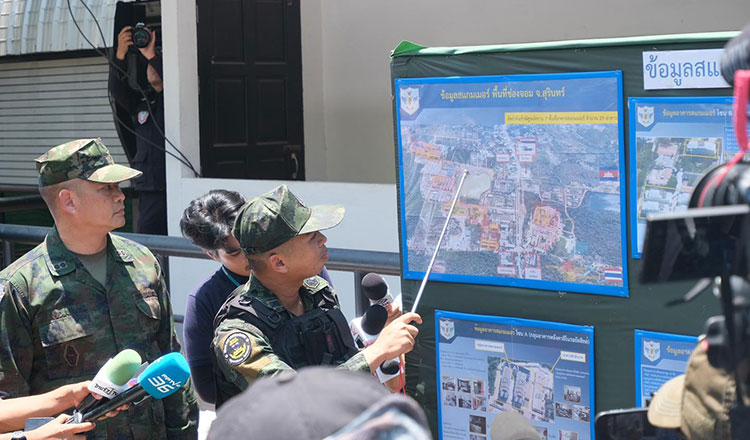 - Photo:- Thailand leads a delegation of foreign journalists on a site visit to the O’Smach area of Cambodia in March 2026. Ministry of Foreign Affairs of Thailand
Synopsis: Parliamentary figures and academics condemn military-led press trips along the frontier, warning that anti-scam narratives are a mask for territorial violations.
Lawmakers and scholars have condemned recent Thai military-led media tours within Cambodia’s territory, labelling them as a pretext to justify Thailand’s territorial invasion and sovereignty violations.
The O’Smach border area in Cambodia’s Oddar Meanchey province has been the primary flashpoint of these media tours. The Thai military, which has occupied the area following the border clash in December, has been escorting Thai and international journalists into Cambodia’s sovereign territory. The Thai side has utilised these press tours to expose scams operating out of local casinos.
Both Cambodia’s Ministry of Information and the Head of the Secretariat of the Commission for Combating Online Scams (CCOS), Chhay Sinarith, have already condemned the arrangement, describing it as a serious violation of Cambodia’s territorial integrity, given that O’Smach is recognised as an international checkpoint within Cambodia.
Speaking to Khmer Times over the weekend, Senate Second Vice-President Thun Vathana questioned the motivation behind the press tours and the so-called Thai investigations into scam operations that were the basis for attacks on Cambodia.
“A homeowner who rents out a property cannot always know everything that happens inside it. If concerns arise about a tenant’s activities, the proper response is to investigate carefully and follow the law,” he said. “No one has the right to break into, destroy, or endanger lives in that property based on suspicion or accusation.”
The same principle, Vathana added, applies between sovereign countries. He said that if Thailand has concerns about activities on Cambodian territory, it should address them through dialogue, cooperation and international law, not by violating Cambodia’s sovereignty, destroying property or endangering human lives.
“An accusation is not a verdict, and suspicion does not provide legal justification. No country is above international law and uses its own security concerns to violate national sovereignty and territorial integrity, as set out in the UN Charter,” he said.
It is obvious that Thailand is eager to judge a neighbour while turning a blind eye to its own flaws, the Senate leader said.
“Many around the world increasingly see Thailand’s unilateral accusations and security concerns as a convenient pretext for justifying military incursions into Cambodian territory,” he added.
“An ancient lesson remains relevant today: before pointing out the dust in another person’s house, we should first make sure our own house is clean,” Vathana said, referring to reports of scam cases and security concerns in Thailand, which has also been accused of supplying internet connection, electricity and more to border scam centres and casinos.
He said international law cannot be treated as a tool of convenience, followed when it is useful and ignored when it is not.
“A country cannot demand respect for its own borders while disregarding the borders and sovereignty of others,” he said. “International journalists, especially Reuters, should also investigate the sovereignty violation committed by the Thai military.”
“The Reuters article and map indicate Thai troops have entered Cambodian soil, violating UN-recognised borders,” he added.
Vathana said that genuine concerns should be addressed through peaceful diplomacy, dialogue and established legal mechanisms, never through unilateral pressure or the use of force.
International Relations Institute of Cambodia Director-General Kin Phea said that Thailand is attempting to distort the facts by using various international media organisations that have offices or headquarters in Thailand.
“We can see that Thailand is using, or leveraging, these media outlets to influence and mislead international public opinion. In other words, this is part of an information warfare campaign being waged against Cambodia,” he said.
Beyond using the media to tarnish Cambodia’s reputation, Thailand’s actions constitute a violation of its neighbour’s sovereignty and territorial integrity, the scholar said.
“International journalists may not realise that the area in question is a disputed territory because they are only receiving information from the Thai side. It is likely that Thailand has told these foreign journalists that the area is Thai territory,” he said.
Phea urged journalists to conduct thorough research before writing stories about areas they are taken to visit and report on, particularly when those areas are subject to territorial disputes.
“In the meantime, Cambodia must issue a clear response to prevent the international community from being misled by Thailand’s narrative, particularly its portrayal of those buildings or facilities as part of a campaign against online scam operations,” he added.
“In addition, we must emphasise that the suppression of online scams is a regional or international effort. No country can use the fight against online scams as a pretext to violate another country’s sovereignty and territorial integrity.”
Cambodia has rejected Thailand’s use of an anti-scam narrative at international forums like the United Nations, labelling it a misleading pretext to justify military aggression and border incursions.
While Thailand says that its military operations target massive transnational cyber-fraud networks near the border, Cambodian officials maintain that Thailand is weaponising global concern over online scams to legitimise its illegal occupation of disputed sovereign territory.
Cambodia has made efforts to combat online scams both domestically and internationally.
The government has launched a nationwide crackdown on transnational cybercrime, enacting a landmark law that imposes prison sentences of up to life imprisonment for scam ringleaders.
Authorities have arrested thousands of suspects and deported tens of thousands of foreign nationals, signalling a stern government pivot to eradicate cyberfraud operations.
-Khmer Times-