From Ceasefire to Fait Accompli: How Thailand Is Attempting to Redraw the Border by Stealth
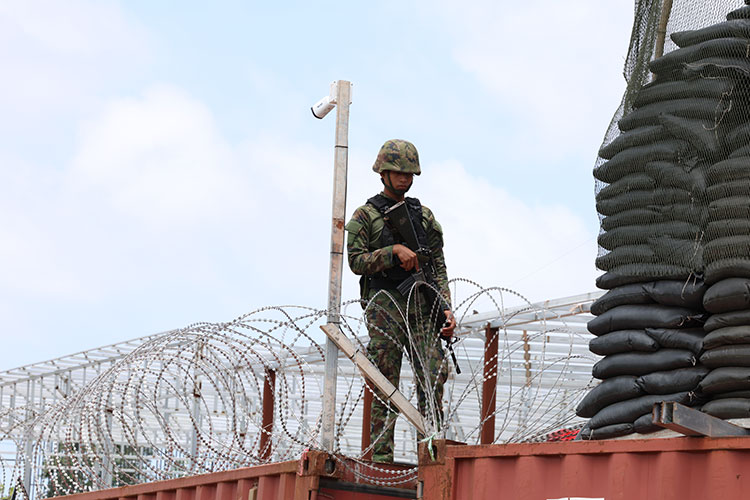 A Thai soldier stands guard on a shipping container barricade at the border area. Supplied
#Opinion
A ceasefire is more than the silence of guns. It is a commitment to preserve peace by freezing the military situation on the ground while diplomacy and lawful mechanisms are given the opportunity to work. When one party publicly professes respect for a ceasefire but simultaneously changes the facts on the ground through military activities, that commitment loses its meaning.
This is precisely the contradiction now confronting the Cambodia–Thailand border.
Since a ceasefire was agreed on December 27 last year, Thailand has repeatedly assured the international community that it remains committed to peace and stability. Such statements are welcome. Peace requires dialogue, restraint and mutual confidence.
However, peace is measured not by official statements but by conduct.
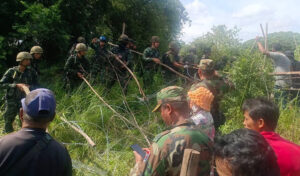
While declaring respect for the ceasefire, the Thai military has reportedly continued to reinforce its positions in areas that Cambodia regards as unquestionably falling within its sovereign territory. Reports indicate the installation of barbed wire, the placement of shipping containers and other physical obstacles, the strengthening of military positions and continued consolidation of areas occupied through military action.
These are not routine administrative measures. They are actions that alter the situation on the ground.
Such conduct raises an important question: if a ceasefire is genuinely being respected, why continue creating new military realities in disputed or occupied areas?
The answer appears increasingly clear. Rather than preserving the status quo pending a peaceful settlement, Thailand seems to be pursuing a strategy of creating a fait accompli — establishing physical conditions that it may later seek to present as political or legal realities.
This is neither a new nor an unfamiliar strategy in international affairs.
A fait accompli occurs when a state attempts to create irreversible facts before negotiations or legal processes have determined the lawful outcome. Instead of allowing international law to define the boundary, military engineering and prolonged occupation are used to manufacture a new reality. The objective is straightforward: occupy first, consolidate second and negotiate later from a stronger position.
International law rejects precisely this approach.
One of the clearest principles of the post-1945 international legal order is that territory cannot lawfully be acquired through the threat or use of force. Military occupation does not create sovereignty. Physical control does not alter an internationally recognised boundary. Installing barbed wire cannot redraw a frontier. Shipping containers cannot replace treaties. Defensive fortifications cannot transform an unlawful occupation into lawful title.
If states were permitted to strengthen occupied territory while claiming adherence to a ceasefire, the prohibition on acquiring territory by force would gradually become meaningless.
This is why ceasefires are intended to freeze-not transform-the situation on the ground.
Their purpose is to prevent either party from improving its military or political position while negotiations continue. They are confidence-building measures designed to reduce tension, not opportunities for incremental territorial consolidation.
The continued construction of barriers, military infrastructure and fortified positions during a ceasefire fundamentally undermines that objective. Even if no shots are fired, altering the physical reality of the territory risks changing the political dynamics of the dispute and eroding confidence between the parties.
Such actions also contradict the spirit of the Joint Statement adopted during the General Border Committee meeting of December 27, 2025, which reflected both countries’ commitment to reduce tensions and pursue peaceful solutions through established bilateral mechanisms.
Cambodia has consistently reaffirmed that it seeks a peaceful resolution based on international law, the relevant treaties governing the boundary and the agreed bilateral mechanisms, including the work of the Joint Boundary Commission. Cambodia has repeatedly called for dialogue rather than confrontation and for legal certainty rather than unilateral action.
That position remains unchanged. What has changed is the reality on the ground.
Each new roll of barbed wire, each additional shipping container and each new military fortification erected in occupied territory risks creating the impression that military control can gradually replace legal entitlement. That is a dangerous precedent — not only for Cambodia but for every state that relies upon international law to protect its territorial integrity.
The issue therefore extends beyond a bilateral border dispute. It concerns whether the international community will continue to uphold the principle that boundaries are determined by law, not by force; by treaties, not by military engineering; and by peaceful settlement, not by the gradual creation of facts on the ground.
History has repeatedly demonstrated that lasting peace cannot be built upon unilateral actions designed to strengthen an occupation. Genuine peace requires good faith, respect for commitments and fidelity to international law.
Thailand now faces a choice.
It can continue speaking the language of peace while allowing actions on the ground to tell a different story. Or it can ensure that its conduct matches its public commitments by refraining from altering the status quo, withdrawing from occupied Cambodian territory and returning in earnest to the agreed mechanisms for peaceful boundary settlement.
Ultimately, the credibility of any ceasefire depends not on diplomatic declarations but on observable behaviour.
If words proclaim peace while actions entrench occupation, the world will draw its own conclusions. A ceasefire cannot become a cover for creating a fait accompli. Respect for peace requires respect for the law, and respect for the law begins with respecting the boundary as it exists—not attempting to redraw it by stealth.
Roth Santepheap is described as a Phnom Penh-based geopolitical analyst. The views and opinions expressed are his own.
-Phnom Penh Post-