The water advantage
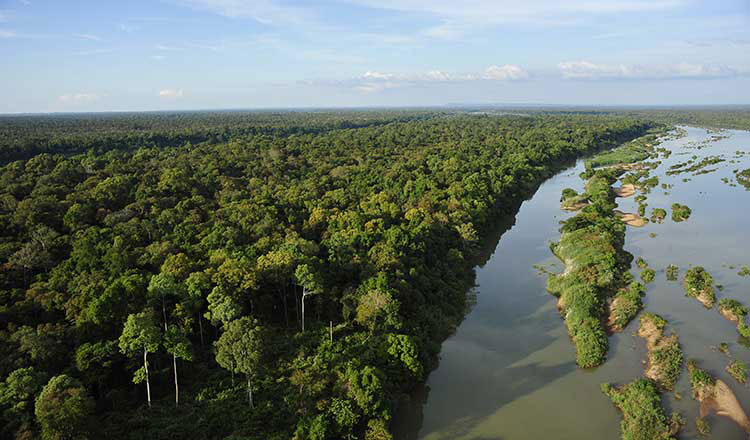 Mekong River wetlands in Stung Treng province. WWF
In a world running short of water, Cambodia has the Mekong. The question is whether it treats that as geography or as strategy.
The year 2026 has brought two crises at once. A strong El Nino is drying farmland from India to Indonesia, and the Middle East conflict has disrupted fertiliser supply through the Strait of Hormuz, sending urea prices up 81%. Thailand, Vietnam and Indonesia all face worsening water stress. Now look at Cambodia. The Mekong, the world’s 12th-longest river, runs through the country. Tonle Sap, Southeast Asia’s largest freshwater lake, operates a hydrological system found nowhere else: each wet season, the Mekong’s floodwaters reverse direction into the lake, expanding it to more than five times its dry-season size.
This is Cambodia’s third strategic asset identified in this series. Part 5 identified a manufacturing window. Part 6 identified the dollar economy. This column identifies the Mekong: a natural endowment whose value rises as climate change makes water scarcer across the region.
The structural advantage
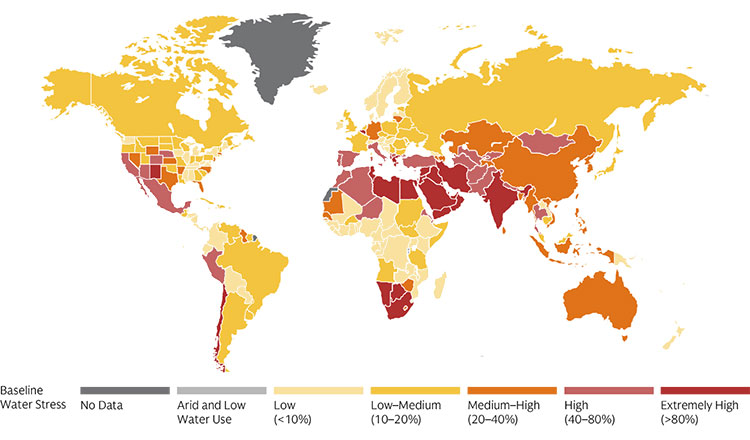
The Asian Development Bank estimates that by 2030 there will be a 40% shortfall between water supply and demand across Asia. The region accounts for 41% of global flood events, and ADB projects $4 trillion in water infrastructure investment will be needed by 2040. Thailand’s usable reserves fell to 36% of capacity in early 2026. Vietnam’s Mekong Delta has lost roughly 500 square kilometers of farmland to saltwater intrusion over the past decade. As water grows scarcer, Cambodia’s relative position strengthens geography gave it an asset that is appreciating.
Figure 1: Map of global water stress by country and (US) state
The global trend
Climate change and geopolitics are converging to make water a strategic resource. In early 2026, Iranian drones struck desalination facilities in the Gulf, including Bahrain, demonstrating that water infrastructure is now a military target. Technology is driving demand from the opposite direction: Goldman Sachs estimates that global data centre water consumption will double to 1.2 trillion litres by 2030, and water remains essential to semiconductor fabrication and power generation. Food, energy, technology and security all now compete for the same resource. In this environment, food produced where water is abundant commands a structural premium. Certified premium food markets are already growing at 9 to 12% annually.
The gap: water management without water industry
Governments and international organisations have recognised Cambodia’s water challenge, but only as a management problem. The UNDP’s Early Warnings for All initiative focuses on flood and drought alerts. The ADB’s Integrated Water Resources Management program me targets governance and resilience. Korea has built water facilities in Battambang and is constructing a smart water management system in Phnom Penh. The Mekong River Commission coordinates transboundary monitoring. All necessary, but all sharing a common frame: water as a problem to be controlled, not an asset to be deployed. No one is asking: what industries can Cambodia build on this water?
Four business models on one river
First, certification-based premium food processing. Cambodia exports raw commodities and buys back processed goods. In 2025 it exported 940,000 tonnes of rice, up 45%. The volume is there; the value capture is not. Halal, organic, kosher and clean-label certifications each open a different high-growth market. A single Battambang facility with multiple certifications can access the Middle East, Europe and the United States simultaneously.
Second, Tonle Sap aquaculture. The Mekong’s freshwater fisheries already provide roughly two million jobs, account for 12% of GDP, and supply 75% of national protein intake. Yet this is overwhelmingly artisanal. The global aquaculture market reached $260 billion in 2026. Upgraded to sustainable, ASC-certified aquaculture, Tonle Sap could become a premium protein export industry.
Third, hydropower. Sustainable small and medium-scale hydropower integrated into the national grid can help close the electricity cost gap that Part 5 identified as the largest barrier to manufacturing investment.
Fourth, river logistics. The Funan Techo Canal, a $1.7 billion project under construction, will link the Mekong directly to Cambodia’s coast, enabling exports to bypass transit through Vietnam.
Designed with dual purpose, the same waterway can connect agricultural regions to the Battambang processing hub and the deep-water port in Sihanoukville.
What the government must do
First, connect food certifications to international standards through mutual recognition with Malaysia’s JAKIM, credible organic bodies, and kosher authorities. Designate Battambang as the agriculture processing hub using the anchor strategy from Part 5.
Second, upgrade Tonle Sap fisheries into certified aquaculture. The protein is there. The certification and infrastructure are not.
Third, integrate water infrastructure with industrial purpose. Design the Funan Techo Canal and Korea-funded water systems for flood control, logistics, processing, and energy simultaneously.
Fourth, build “Mekong Clean Food” as a national brand. As water grows scarce globally, food from where water is abundant rises in value. Mekong is not a slogan. It is the underlying asset.
Conclusion
This series has now identified three strategic assets: a dollar economy, a manufacturing window and the Mekong. The first two have at least been discussed as economic strategies. The Mekong has not. Governments and donors see water as a management challenge. It is time to see it as an industrial foundation: food processing, aquaculture, energy, and logistics, all on one river.
Next in this series (Part 8): ‘The Longevity Economy’: tourist arrivals fell nearly 50% in early 2026. A tourism model built on a single attraction collapsed under a single shock. Cambodia needs a second tourism identity, one that turns visitors into residents and residences into assets: wellness, real estate, and healthcare REITs built on an ageing world’s willingness to pay for growing old well.
Author bio: Heemin Shin is a founding partner of Plateaux Capital, a private equity house based in New York, with prior roles as CFO of a Cambodian microfinance institution, managing director at Siguler Guff Company & LP, and founder of a fintech company he took to a successful exit. He writes in a personal capacity. Email: david@plateauxnewyork.com