Cambodia urges UN to monitor Thai military abuses
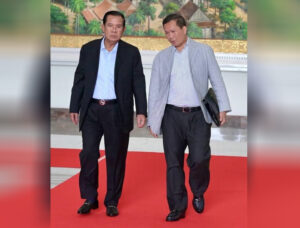
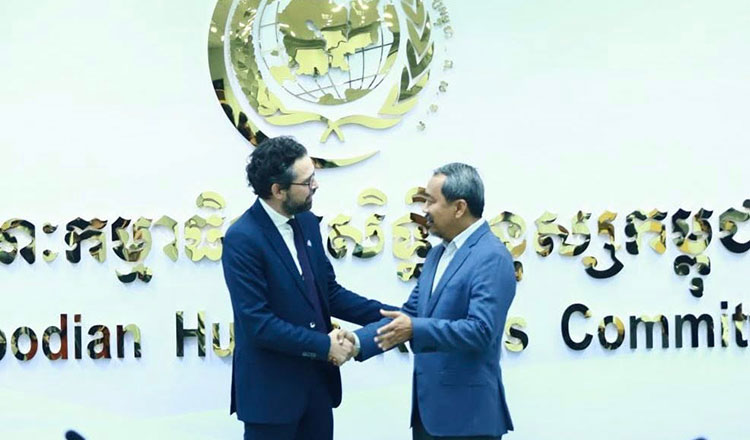 Cambodian Human Rights Committee President Senior Minister Keo Remy (R) meets Officer-in-Charge of the Office of the UN High Commissioner for Human Rights in Cambodia Benjamin Moreau, in Phnom Penh, on Wednesday. CHRC
#National
Synopsis: CHRC President Keo Remy says Thailand’s actions at the border violate human rights and Cambodian sovereignty.
The Cambodian Human Rights Committee (CHRC) has appealed to the United Nations High Commissioner for Human Rights in Cambodia (OHCHR) to monitor Thai military actions at the border, including the demolition of homes in Cambodian territory illegally occupied by Thailand. According to the CHRC, the Thai military has also erected barricades with shipping containers and barbed wire to prevent Cambodians from returning to their homes.
Senior Minister Keo Remy, President of the CHRC, made the urgent request on Wednesday during a working meeting with Benjamin Moreau, Officer-in-Charge of the OHCHR in Cambodia, in Phnom Penh.
The meeting was held to review human rights achievements in 2025 resulting from cooperation between the CHRC and OHCHR and to strengthen and expand collaboration between the two institutions in the new year.
Remy expressed deep concern over the Thai military’s actions, stating that the demolition of Cambodian homes in allegedly occupied areas, along with the blockades, constitutes serious human rights violations.
He requested OHCHR’s assistance in monitoring the situation and urged that international human rights mechanisms be employed to engage the involved parties. Remy called for respect for international human rights laws to ensure that displaced Cambodians can return to their homes safely and with dignity.
He added that Thailand’s actions violate fundamental human rights to freedom of movement, housing, property ownership, and personal security and protection.
Remy commended the progress made in 2025, particularly in raising awareness of international human rights standards, human rights recommendations and reports, and training programmes for civil servants and volunteer lawyers under the CHRC.
Benjamin hailed the strong cooperation between OHCHR and the CHRC. Both sides voiced the expectation that future collaboration will be strengthened to enhance the promotion and protection of human rights in Cambodia.
For 2026, the two institutions agreed to cooperate in five priority areas: implementing Universal Periodic Review recommendations; raising awareness of national human rights institutions; continuing the provision of human rights materials and documentation; building the capacity of civil servants; and maintaining dialogue on various human rights-related cases.
Meanwhile, the Ministry of Foreign Affairs and International Cooperation lodged another formal protest against Thailand over alleged military activities in border areas that Cambodia says remain under occupation.
In a statement issued on Wednesday, the ministry said the actions were inconsistent with de-escalation measures outlined in Item I of the Joint Statement of the 3rd Special Meeting of the Cambodia-Thailand General Border Committee on December 27, 2025, and undermined Cambodia’s sovereignty and territorial integrity.
According to the ministry, the violations occurred on January 19 at three locations along the border. These included the installation of a Buddha statue in the An Ses area of Preah Vihear province, where a statue of Lord Vishnu had previously been demolished by the Thai military; the placement of containers to block road access in the Boeng Trakuon area of Banteay Meanchey province; and the construction of bunkers using heavy machinery in the same area.
The Thai military launched fierce offensives against Cambodia in July and December last year, using artillery and airstrikes on Cambodian territory. The attacks destroyed school buildings, homes, and pagodas in civilian areas.
Seun Sam, an international policy analyst, said the CHRC’s request for OHCHR to review and monitor the Thai military’s actions was appropriate, noting that Cambodia is a member of OHCHR and hosts its permanent office. He added that OHCHR has previously reported on human rights conditions affecting Cambodians and should demonstrate similar proactivity in reporting alleged abuses committed by the Thai military, particularly in cases involving forced evictions.
Sam noted that the request was made in accordance with OHCHR’s legal framework and procedures and that OHCHR’s role is to provide accurate and objective reporting to the United Nations and the international community. He said such reporting is necessary and important for Cambodia.
He added that residents in areas allegedly invaded by the Thai military remain unable to return home, describing the situation as part of a broader strategy to control Cambodian sovereign territory. As a result, he argued that Cambodia should pursue complaints through international mechanisms, including the UN High Commissioner for Human Rights and the International Court of Justice, to seek the return of illegally occupied territory.
However, Sam added that resolving the issue would be difficult, claiming Thailand’s actions reflect long-term strategic planning and could be linked to its February elections.
He added that even if a new government were formed, domestic opposition from the military and nationalist groups could hinder any attempt to return the territory, meaning Cambodia must prepare for a prolonged and complex process.
A report released by the Ministry of Interior on Wednesday stated that Thai violations of Cambodia’s sovereignty and territorial integrity have affected the provinves of Preah Vihear, Oddar Meanchey, Banteay Meanchey, Battambang, Pursat, Koh Kong, and Siem Reap.
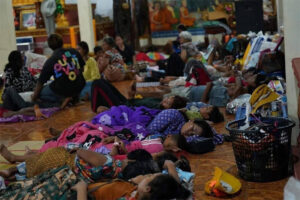
The report added that of more than 640,000 people displaced by the conflict, over 520,000 have returned to their homes, leaving around 125,000 in displacement camps.
-Khmer Times-