Cambodia’s gradual shift to medium- and high-tech manufacturing
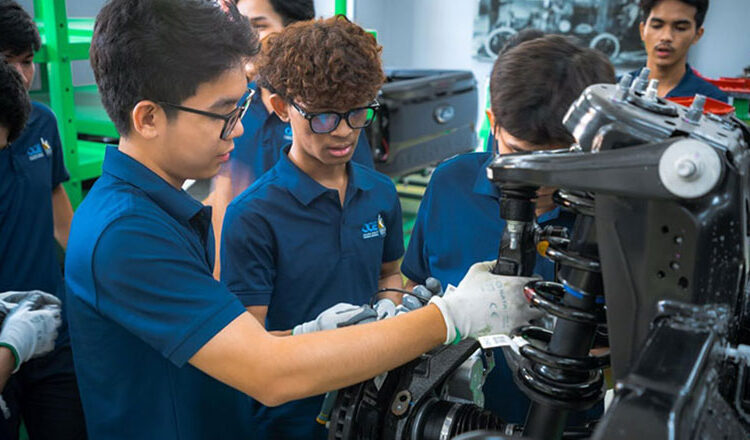 File photo of youths on a TVET training programme in Phnom Penh. MLVT
#Opinion
For decades, external observers viewed Cambodia through a predictable economic lens: a low-cost hub heavily reliant on the garments, footwear, and travel goods (GFT) sector. However, a structural shift has quietly accelerated. Moving beyond basic light manufacturing, Cambodia is positioning itself as a key strategic node for medium- and high-technology industries within the Southeast Asian supply chain.
Precision component manufacturing: Adapting beyond the ‘Plus-One’ crisis
The initial pivot into medium-technology manufacturing was modelled around a “Thailand Plus One” strategy, where global automotive and electronics giants sought to buffer their operations in Thailand by offloading labor-intensive component segments to Cambodia.
As an early anchor in the Royal Group Phnom Penh Special Economic Zone (SEZ), Japan’s Minebea pioneered high-precision machining in Cambodia by steadily moving from basic assembly to the manufacturing of advanced micro-motors, LED backlights and complex electronic components, effectively proving that Cambodia’s young workforce could adapt to tight technical tolerances.
In tandem, Japanese automotive giant Denso identified the Kingdom as a strategic manufacturing hub. Denso executives have praised the Cambodian workforce for its perseverance, teamwork and unique patience required in handling equipment-intensive vehicle and motorcycle components like sensors, oil coolers and magnetos.
Faced with an unstable land route to Bangkok, manufacturing anchors like Minebea and Denso have had to urgently re-engineer their logistics. Rather than relying on a land corridor, companies have bypassed the land border. They have redirected cargo towards maritime shipping via the Sihanoukville Autonomous Port (PAS) and utilised emergency air charters. This crisis has forced Cambodia to prove it can sustain high-tech production even when physically isolated from its immediate neighbour.
Automobile assembly sector: Driving full-scale localisation
Guided by the government’s Automotive and Electronics Sectors Development Roadmap, the country hosts 10 operational vehicle assembly plants. This targeted industrial upgrade has triggered
an employment boom, with automotive manufacturing leading national job growth and driving projected localised employment gains of up to 13%.
Global automotive legacy brands have anchored their regional strategies directly on Cambodian soil to serve the domestic market and hedge against regional supply shocks.
The domestic assembly landscape is anchored by global giants, led by Ford (RMA Group) operating a major assembly plant in Pursat province, where it has emerged as a localised sales champion delivering thousands of vehicles built directly by Cambodian technicians.
This presence is bolstered by Toyota, which tapped into the Phnom Penh SEZ to establish an assembly presence that cements Cambodia’s capability to meet the strict quality and reliability standards demanded by Japanese legacy automakers.
Furthermore, Hyundai’s coastal plant in Koh Kong and Isuzu’s facility in Kampong Speu provide vital regional diversification to the Kingdom’s industrial portfolio, collectively moving Cambodia far up the automotive value chain.
Electric vehicle revolution
Driven by the National Policy on the Development of Electric Vehicles 2024–2030, Cambodia is aggressively pivoting towards green mobility. In early 2026, the Kingdom hit a historic milestone with the delivery of its first home-assembled EVs to local consumers.
This green mobility push is spearheaded by global EV titan BYD, which established a $32 million vehicle assembly plant in the Sihanoukville Special Economic Zone to deploy a complete knock-down (CKD) mode targeting an annual capacity of 10,000 units.
Supporting this momentum, the Council for the Development of Cambodia has rapidly approved new high-tech players, including ZDG Assembly to assemble advanced Lynk & Co vehicles in Kandal province, alongside ZO Motors, which backed a $46 million EV commercial assembly project in Pursat province.
Tyre industrial boom: Transforming natural resources into Tier-1 value
The rise of vehicle assembly has occurred in lockstep with the explosive growth of Cambodia’s car tyre manufacturing ecosystem. Driven by global diversification, Chinese tyre giants have rapidly scaled up operations. With eight tyre factories now operating across five special economic zones, the industry has become a cornerstone of national economic diversification.
Firms like Sailun and Jinyu have established multi-million-dollar plants in zones like Svay Rieng and Sihanoukville. Cambodia’s tyre exports skyrocketed by 42.37% in the first quarter of 2026 alone, exceeding $472 million. Crucially, this sector links domestic agriculture with advanced chemical processing, utilising local rubber plantations to feed Tier-1 manufacturing lines.
Semiconductor value chain: Targeted downstream entry
While Cambodia does not yet have the infrastructure or capital depth to compete with the multi-billion-dollar front-end wafer fabrication plants, it has taken a pragmatic approach by inserting itself directly into the downstream semiconductor value chain. The Kingdom is specifically targeting critical niches such as printed circuit board (PCB) assembly, the production of discrete semiconductor components like diodes and transistors under HS Code 8541, and advanced testing and packaging solutions to secure its foothold in the global tech ecosystem.
Operating out of the Poipet Special Economic Zone, Sumitronics Manufacturing (Cambodia) Co Ltd focuses its core industrial operations on high-volume electronics manufacturing services (EMS), utilising specialised surface-mount technology (SMT) lines to assemble components onto PCBs.
Hana Microelectronics has strategically expanded into the coastal border corridor of Koh Kong province to establish its presence in EMS. The Cambodian facility focuses on high-volume PCB assemblies, screen printing, and final product box-builds for consumer and industrial hardware.
According to international trade intelligence data (such as the Observatory of Economic Complexity), Cambodia’s total exports under HS Code 8541 (which covers semiconductor devices, diodes, transistors, and photosensitive semiconductor devices like solar cells/modules) reached $1.4 billion in 2024. In the global semiconductor supply chain, HS Code 8541 products belong directly to downstream assembly, packaging, and testing (often called OSAT/EMS).
Digital infrastructure: Rise of data centres
Because a modern industrial economy requires physical logic gates and reliable digital backbones, Cambodia is experiencing an infrastructure boom to match its physical manufacturing capacities.
This digital foundation is anchored by a nationwide 5G network, launched on January 1, which provides the ultra-low latency required for autonomous industrial logistics and real-time factory floor quality control.
This connectivity is backed by massive advancements in hyperscale data centres, highlighted by ByteDC Solutions partnering with Huawei in early 2025 to deploy a hybrid cloud architecture in Phnom Penh at the Global Tech Exchange, creating a facility that spans over 7,500 square metres and supports up to 1,000 IT racks.
Driven by strict localised data sovereignty frameworks and the meteoric rise of national digital systems like the Bakong payment gateway and the CamDX platform, the Cambodian colocation data centre market is on track to grow significantly over the coming decade.
However, while Cambodia’s modern industrial landscape is highly strategic, sustaining this momentum requires addressing key structural bottlenecks along the path forward.
First, the country must bridge a critical talent gap by aggressively shifting its educational focus towardd STEM fields and technical vocational training, as precision manufacturing and data centre management require specialised technicians and systems engineers rather than traditional assembly line operators.
Additionally, as top-tier manufacturing anchors like Denso have noted, Cambodia has to continually work to optimise logistics infrastructure to ease localised disruptions and mitigate rising transport costs to protect the Kingdom’s competitive edge. In light of ongoing cross-border trade frictions, successfully scaling maritime alternatives at major ports is no longer optional – it is critical to survival.
Finally, ensuring energy reliability through a stable, cost-effective power grid is vital because high-tech data centres and automated manufacturing lines cannot tolerate power fluctuations.
Ultimately, Cambodia has proven its capability to handle precision technology, and by serving as an agile, politically stable, and logistically adaptive alternative in a volatile global market, the Kingdom is steadily cementing its place in the high-tech supply chains of tomorrow.
Sim Vireak is a civil servant, observer/writer. The opinions expressed are his own.
-Khmer Times-