Echoes from Kazan: The Potential of Great Benefits that Peace in ASEAN Can Bring
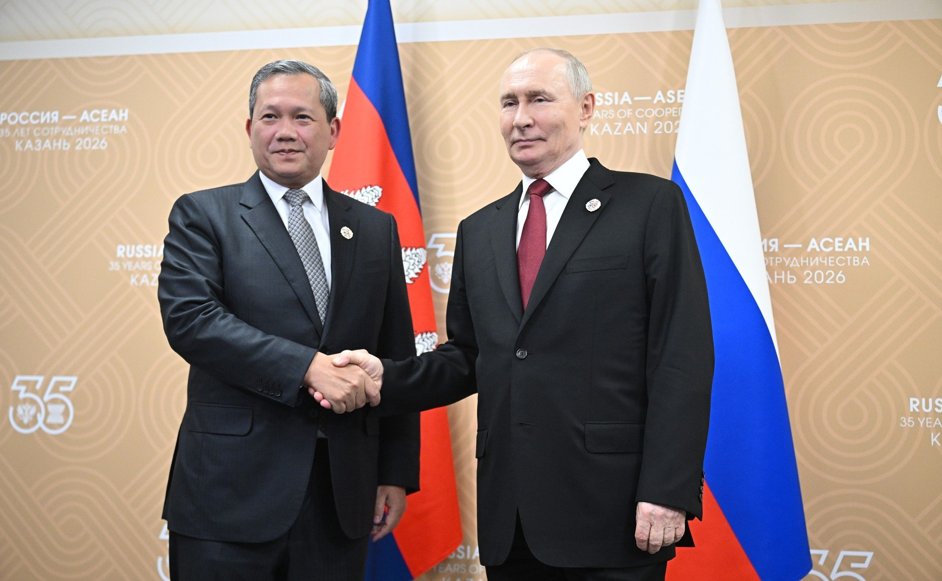 Prime Minister Hun Manet (left) shakes hands with Russian President Vladimir Putin in Kazan, Russia, last week. Russian president’s office
The successful conclusion of the 35th ASEAN-Russia Commemorative Summit in Kazan, Russia, marks a defining chapter in contemporary Eurasian diplomacy. Staged against a backdrop of sweeping global geopolitical transformations, the summit converged with another historic milestone: the 70th anniversary of diplomatic relations between Cambodia and Russia. For two days, the historic city of Kazan — traditionally viewed as a cultural and geographic bridge between East and West — served as the epicentre of intense diplomatic deliberations.
The event brought together Russian leadership and Southeast Asian delegations to chart a course for the future, demonstrating that despite shifting global dynamics, the avenues for institutional cooperation remain not only open but fundamentally expanding.
High Expectations and Concrete Achievements
In the months leading up to the Kazan summit, international observers and Western media outlets routinely projected a pessimistic outlook. Sceptics argued that growing global pressures and the threat of secondary sanctions would compel the Association of Southeast Asian Nations (ASEAN) to distance itself from Moscow, reducing the commemorative gathering to a purely symbolic exercise in protocol. There were expectations that the summit would yield little more than generic platitudes regarding historical ties, failing to produce actionable policies or meaningful strategic consensus.
The reality of what was achieved in Kazan thoroughly dismantled these sceptical assumptions. Rather than a hollow ceremonial event, the summit proved to be a highly substantive, outcomes-oriented forum characterised by intense plenary sessions and a dense schedule of bilateral meetings between Russian President Vladimir Putin and visiting heads of delegation. The ultimate testament to this success was the adoption of four foundational documents that establish a comprehensive roadmap for future engagement.
Foremost among these is the Kazan Declaration, a sweeping joint statement that outlines a shared vision for a democratic, equitable and multipolar world order anchored in international law and the central role of the UN. Alongside the Declaration, leaders adopted the Comprehensive Plan of Action (the 2026–2030 Program), a meticulous five-year strategy designed to translate political goodwill into tangible economic, technological and developmental projects. Two additional specialised documents were ratified, focusing on deepening cultural ties and energy cooperation. These achievements underscore a mutual recognition that the relationship between Russia and ASEAN has evolved from historical sentimentality into an indispensable modern partnership.
Russia’s ‘Turn to the East’ and the Reality of a Multipolar World
From the perspective of Russian state media and leading Moscow-based analytical centres, the successful execution of the summit in Kazan offers definitive proof of the efficacy of Russia’s “Turn to the East” (Povorot na Vostok) policy. For years, Western foreign policy architectures have sought to enforce the diplomatic and economic isolation of the Russian Federation. However, the high-level representation and active engagement of ASEAN states in Kazan signal that such isolation strategies are fundamentally ineffective when confronted with the realities of an emerging multipolar world.
At the heart of the plenary and bilateral agendas were several interconnected pillars: economics, energy, security and humanitarian ties. Russian analysts emphasised that the global economic centre of gravity is continuing its inexorable shift toward the Asia-Pacific region, making ASEAN a premier strategic partner for Moscow. A critical element of this shift discussed at the summit is the transition toward trade in national currencies. By bypassing Western-dominated financial clearing systems, Russia and ASEAN aim to insulate their commercial transactions from external geopolitical vulnerabilities and unilateral sanctions regimes.
Furthermore, the summit served as a powerful vehicle for integrating Russian-led economic and political frameworks with Southeast Asian markets. Russian policymakers advocated for a deeper alignment between ASEAN, the Eurasian Economic Union (EAEU) and the Shanghai Cooperation Organisation (SCO). This convergence aims to create a seamlessly interconnected Eurasian economic space characterised by lowered trade barriers and harmonised regulatory standards.
For Russian corporate entities and state enterprises, the summit opened critical pathways to vital new markets. Industrial giants such as GAZ are poised to expand their footprint in Southeast Asia, providing commercial vehicles and manufacturing expertise tailored to developing economies. Simultaneously, amidst severe volatility in global energy markets, Russia successfully leveraged the summit to secure and diversify its energy export destinations, presenting itself as a stable, long-term provider of energy and energy technologies.
ASEAN’s Collective Pragmatism and Institutional Relevance
For the ASEAN bloc, the Kazan summit provided a crucial platform to reaffirm its institutional relevance and strategic neutrality in an increasingly polarised global landscape. By engaging robustly with Russia, ASEAN demonstrated that it refuses to succumb to zero-sum bloc politics or external pressures to choose sides in great-power competitions. Instead, the bloc practiced a sophisticated form of collective pragmatism.
In an era defined by fluctuating commodity prices and supply chain disruptions, it was highly important for participating Southeast Asian nations to reassess Russia as a reliable, predictable partner, particularly within the critical energy sector. Securing steady energy inflows is a fundamental prerequisite for maintaining the high economic growth trajectories of ASEAN member states. The commitments secured in Kazan provided these nations with essential guarantees of resource security.
Moreover, the summit illustrated the vital internal utility of ASEAN’s diplomatic model. While the primary focus remained on ASEAN-Russia relations, the gathering offered a timely opportunity for regional leaders to conduct informal, face-to-face consultations on the sidelines. These intra-bloc interactions are essential for maintaining ASEAN centrality, allowing leaders to synchronise positions on regional security, economic integration and institutional solidarity away from the immediate pressures of domestic theatre.
Cambodia’s Strategic Options and the 70-Year Bedrock
Nowhere was the synthesis of historical gratitude and forward-looking pragmatism more evident than in the diplomatic strategy deployed by Cambodia. Led by Prime Minister Hun Manet, the Cambodian delegation utilised the Kazan summit to advance a sophisticated multi-vector foreign policy. For Phnom Penh, broadening relations with a diverse array of global partners is not an ideological choice, but a calculated strategic necessity aimed at protecting national interests, diversifying economic dependencies and expanding its strategic options on the world stage.
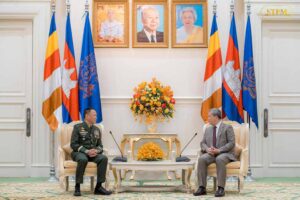
The timing of the summit carried deep historical resonance for Cambodia, occurring as Phnom Penh and Moscow commemorate the 70th anniversary of their diplomatic relations. During his high-level bilateral meeting with President Vladimir Putin on Thursday, June 18, Prime Minister Hun Manet delivered a clear and powerful message: despite the rapidly evolving and increasingly complex global geopolitical landscape, Cambodia’s traditional position regarding its relationship with Russia remains entirely unchanged.
Addressing Putin, the Cambodian premier conveyed warm greetings from King Norodom Sihamoni and Senate president Hun Sen, while offering congratulations on Russia’s recent National Day and the flawless hosting of the summit. Reflecting on seven decades of shared history, Prime Minister Hun Manet expressed the deep, enduring gratitude of the Cambodian people for the invaluable assistance provided by the former Soviet Union during the country’s most agonising historical trial — the period immediately following the collapse of the genocidal Pol Pot regime in 1979. When much of the international community isolated Cambodia, Soviet aid and advisors provided a vital lifeline that helped rebuild a shattered society. This historical bedrock has fostered an enduring sense of political trust and mutual respect that continues to define the relationship today.
However, the discussions between Manet and Putin were firmly fixed on the future. While Putin noted with satisfaction that bilateral trade between the two nations grew by 2 per cent in 2025, both leaders frankly acknowledged that this figure remains modest relative to the true economic potential of the partnership. To bridge this gap, the idea of pursuing a comprehensive Free Trade Agreement (FTA) between Cambodia and the Eurasian Economic Union (EAEU) was met with profound enthusiasm.
The human and educational dimensions of the relationship also received significant praise. Over the past several decades, more than 8,000 Cambodian citizens have graduated from Russian and Soviet universities, returning home to form the administrative, technical and intellectual backbone of modern Cambodia. Today, approximately 160 Cambodian students continue to pursue higher education in Russia under state-sponsored scholarship programmes, ensuring that the people-to-people connectivity between the two nations remains strong for generations to come.
Charting the Path Forward: Hun Manet’s Four Priorities
The broader Cambodian vision for the future of ASEAN-Russia relations was systematically articulated by Prime Minister Hun Manet during the summit’s plenary sessions. As later detailed by minister delegate attached to the Prime Minister, Jean François Tain, and Royal Government spokesperson So Naro, the premier underscored four critical priority areas for future cooperation:
- Enhancing Political and Security Cooperation: Cambodia called for intensified joint efforts to combat the evolving threats of transnational organised crime, human trafficking and the proliferation of cross-border online scams and cyber-fraud networks that jeopardise regional social stability.
- Unlocking Economic Potential: This priority emphasises driving greater trade volumes, stimulating foreign direct investment and enhancing business-to-business connectivity, utilising frameworks like the proposed Cambodia-EAEU FTA to open new market opportunities.
- Deepening Collaboration on Energy Security and Sustainable Development: Phnom Penh seeks to leverage Russian technical expertise in power generation, grid infrastructure and agricultural technologies to facilitate a stable, sustainable energy transition.
- Expanding People-Centred Initiatives: Cambodia advocates for a robust expansion of cultural exchanges, educational partnerships, youth forums and targeted tourism promotion to deepen mutual understanding at the grassroots level.
Commenting on these initiatives, Naro noted that Manet strongly emphasised that in an increasingly fragmented global environment, “unity and solidarity remain indispensable to overcoming shared challenges and seizing new opportunities”. The premier expressed absolute confidence that the steady growth of ASEAN-Russia relations would yield long-term, tangible benefits for their respective populations while fostering a resilient, peaceful and prosperous global future.
Sideline Diplomacy and the Golden Rule of ASEAN Peace
Perhaps the most poignant and illustrative manifestation of the summit’s overarching value occurred not within the formal plenary halls, but during an informal sideline interaction on Friday, June 19. On the margins of the commemorative events, Prime Minister Hun Manet held an informal chat with Thai Prime Minister Anutin Charnvirakul.
The meeting took place against a backdrop of complex, long-standing sensitivities along the Cambodia-Thailand border. While it would be unrealistic to expect the full resolution of deeply entrenched boundary disputes at a summit held thousands of miles away in Tatarstan, the Kazan gathering provided an invaluable, neutral space for both leaders to engage in direct, high-level crisis management and de-escalation.
In a public message released following the interaction, Manet transparently reiterated Cambodia’s principled, four-point position regarding the border issues with Thailand:
- Adherence to International Law: Cambodia remains unswervingly committed to achieving a peaceful, negotiated resolution to all outstanding border questions in strict accordance with established international legal frameworks.
- Maritime Boundary Delimitation: Regarding overlapping maritime claims, Cambodia maintains that both nations should continue to proceed through the mechanism of Compulsory Conciliation under the UN Convention on the Law of the Sea (UNCLOS), an international framework to which both kingdoms are already signatories.
- Land Border Demarcation: For the land border, Cambodia firmly prefers the utilisation of the existing bilateral mechanism — the Joint Boundary Commission (JBC). The Premier explicitly urged the Thai government to appoint its new JBC chairperson as soon as possible to resume vital joint survey and demarcation works, in strict alignment with Point 3 of the Joint Statement signed by both nations on December 27, 2025.
- Border Openings: With respect to opening additional land border checkpoints, the Premier decisively stated that there is “no need to talk at this time”, prioritising technical clarity and legal consensus over premature political gestures.
This high-stakes sideline interaction underscores a fundamental truth that serves as the philosophical core of contemporary Southeast Asian diplomacy: the immense, transformative potential of great benefits that peace in ASEAN can bring. By choosing the path of structured dialogue, institutional mechanisms and international law over nationalist rhetoric or military posturing, Cambodia and Thailand demonstrated the profound utility of the ASEAN spirit.
Conclusion
The 35th ASEAN-Russia Commemorative Summit in Kazan will be remembered as far more than a routine diplomatic anniversary. It served as a functional microcosm of the emerging international order. For Russia, the summit validated its strategic pivot to the Asia-Pacific and proved the resilience of its diplomatic architecture against Western containment strategies. For ASEAN, it reinforced its indispensable role as an independent, non-aligned pole of global stability and economic cooperation.
For Cambodia, Kazan provided a stage to manifest a sophisticated multi-vector diplomacy —honouring a 70-year bond of deep gratitude with Russia, exploring lucrative new economic frontiers through the EAEU, and proactively managing sensitive regional border issues with Thailand. Ultimately, the lessons of Kazan illustrate that when nations prioritise sovereignty, institutional dialogue, and mutual economic benefit over zero-sum geopolitical alignments, they unlock the true potential of great benefits that peace in ASEAN can bring to the region and the wider world.
Dr. Bulat Akhmetkarimov is an associate professor of International Relations, based in Phnom Penh. The views and opinions expressed are his own.
-Phnom Penh Post-