India needs social discipline for progress
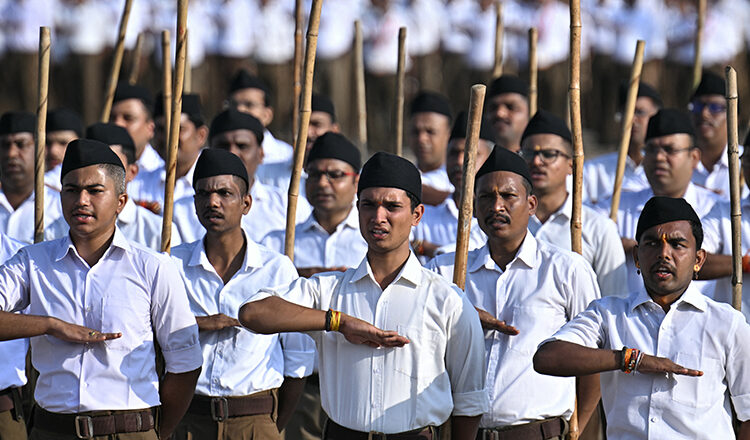 -(Rashtriya Swayamsevak Sangh volunteers take part in the Hindu nationalist organisation’s centenary celebrations at Reshimbagh Ground in Nagpur on October 2, 2025. AFP
#opinion
I was on my fourth visit to China recently. But it was the first time I stayed in the country for five consecutive nights. Undoubtedly, China has successfully transitioned from a developing country to the second most powerful nation on the planet over the last couple of decades.
Today, its per capita income stands at $14,875. This is a threefold increase in the last five years. So, you shouldn’t have been surprised if US President Donald Trump — who usually breathes fire and threatens everyone — was unusually restrained and demure during his visit to China.
The detractors of this scintillating economic success keep harping on the fact that China has no democracy. They reap the benefits of an authoritarian government. These detractors should know better. From the dawn of civilisation until 1772, China was the world’s leading economy, while India was number two. After their liberation from the colonial yoke, both countries pursued their unique paths of progress. But China has taken an unassailable lead. The reason is, since 1972, driven by the lure of cheap labour, the US has invested phenomenal resources in China’s industrialisation. American and European investments of $123 billion and $1 trillion, respectively, are powering the Chinese economy.
During the infamous Cold War era, India was perceived as an ally of the erstwhile Soviet Union. Moscow stood by us during the 1971 Indo-Pak War, with arms and ammunition and a veto in the UN Security Council. Pakistan’s forces, meanwhile, were backed by US tanks and fighter planes. Nevertheless, they suffered a crushing defeat on the Eastern Front and more than 90,000 of the country’s soldiers surrendered in front of India’s forces. In those days, US President Richard Nixon would openly air his dislike of Prime Minister Indira Gandhi.
However, before the war began, an epoch-making incident happened in secret. A deal between US Secretary of State Henry Kissinger and Chinese Premier Zhou Enlai laid the foundation for China’s miraculous progress. Kissinger is known as the modern-day Chanakya. But his foresight was flawed. Kissinger failed to realise that he was unwittingly creating a Frankenstein that would pose the greatest existential threat to his own country in a matter of decades. Did Kissinger feel grateful towards Pakistan, a country that facilitated the US-China détente? (It was the Pakistani dictator Yahya Khan who brought the US closer to China and provided its own bases and resources for the mission.
After the 1971 Indo-Pak war, had the US moved away from Pakistan during those tumultuous times and helped India instead, today’s geopolitics would look very different.
During the COVID-19 pandemic, the entire global supply chain came to a grinding halt. At the time, people were discussing why, though China was a factory for the world, the world needed a China+1 policy. India was the obvious choice for the global manufacturing giants. But the idea fizzled out the moment the pandemic ended.
Those who cite China’s success to criticise India should pause and take a moment to look around. Things aren’t as bad as they are made out to be. The Dragon opened its doors to the world after Kissinger’s visit in 1972. In this regard, India lagged behind by two decades. PV Narasimha Rao and Manmohan Singh initiated India’s economic perestroika (liberalisation and reconstruction) in 1991. The results have been encouraging.
Over the last 25 years, India’s economy has grown at an average rate of 6.5-7%. The 2008 global economic meltdown, the pandemic, and now, the hazards of Hormuz have failed to deter it. During the same time, only China surged ahead of us with a growth rate of 8-9%. Many experts believe that once we achieve a growth rate of 7.5%, we will be able to overcome every difficulty we face.
As I mentioned earlier, people credit the dictatorial Chinese government for the country’s success. That’s partially true. Chinese cities are saturated with cameras every few metres. You can find monitoring stations at regular intervals, minutely observing people on the streets in real time. These control rooms are connected to the mobile cellular network’s big data centre in Beijing. The belief is, not only will a person indulging in crime be met by police personnel within minutes, but even a person looking a bit hassled will also be.
Another important fact is that even today, Chinese citizens’ access to information is severely regulated, and they receive only the information that their government deems kosher. During my most recent stay, I asked many Chinese youngsters about what they knew about India. Their answers were always the same: We don’t know much about the outside world; we know what our government wants us to know.
I would like to mention apps such as Deepseek here. They don’t just turn the users into scrollers but also empower them. I found drivers using their local app for routes because it was more accurate than Google Maps.
But let me make a distinction. Lack of global exposure isn’t making their youth intellectually poor. Actually, there’s some merit in the control. Years of discipline and increasing prosperity have made their focus progress-oriented. There’s a lesson for India. Our roads, railway stations, airports, and other public places look chaotic compared to those in China.
We have made progress but still need to develop social conduct and discipline to move ahead quickly.
This is why every time China succeeds, it also appears to challenge us.
The author is editor-in-chief of Hindustan Times.
-Khmer Times-