Reading the global supply chain
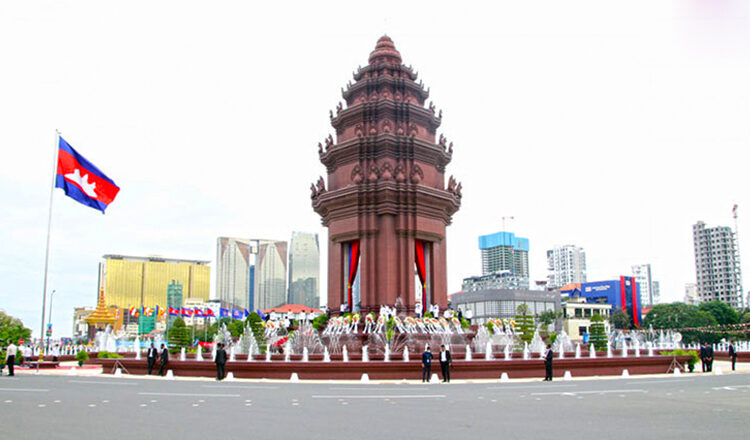 The Independence Monument is a majestic structure dominating the Phnom Penh city centre. AKP
#Opinion
Before Cambodia can choose which industries to build, it needs to understand where it currently sits in the global flow of goods, money, and value.
The first two columns of this series showed why Cambodia cannot close the gap between its current GDP per capita of $2,870 and the $3,896 upper-middle-income threshold on garments, tourism and agriculture alone. The structural limits are real. But a diagnosis without direction is just complaint. The question that follows is: where does the growth come from? The answer depends on understanding the global supply chain and being honest about where Cambodia currently sits within it.
Every product you use today crossed multiple borders before it reached you. The cotton in a shirt may have been grown in the United States, spun in China, woven in Vietnam, cut and sewn in Cambodia, and sold in a Paris boutique. Each of those steps represents a node in the global supply chain. And each node captures a different share of the final sale price.
[Figure 1: Smile curve]
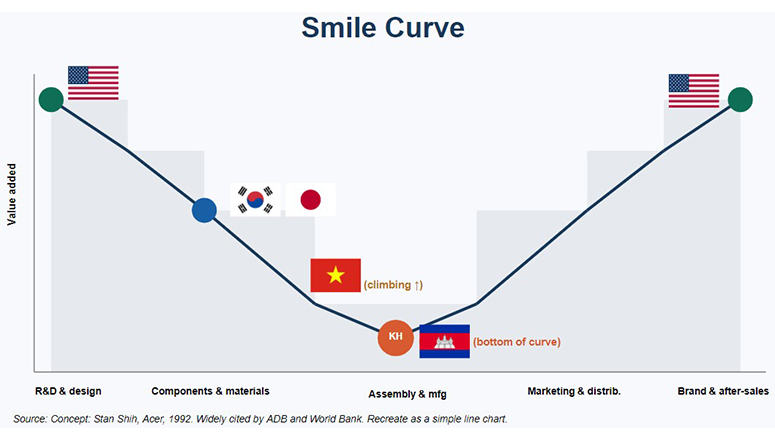
The pattern of how that value is distributed follows what is now called the smile curve: a graph that dips sharply in the middle at the assembly stage and rises steeply at both ends. At the left end sits research, design and intellectual property. At the right end sit branding, marketing and distribution. In between, where the physical work of cutting, sewing, and assembling happens, margins are thin and competition is brutal.
Garments are a form of assembly. Cutting fabric and sewing it into finished goods places Cambodia at the assembly node which is the lowest point on the smile curve. This is precisely why the garment sector, despite generating $15.7 billion in exports, has not been enough to lift Cambodia’s per capita income at the pace the 2030 target demands. Cambodia adds hands. It does not yet add knowledge or capital. According to AMRO’s 2024 analysis, 65% of Cambodia’s exports are domestic value-added, but most of that value comes from labour in final assembly, not from components, design or proprietary processes.
A chain being redrawn
[Figure 2: Global supply chain]
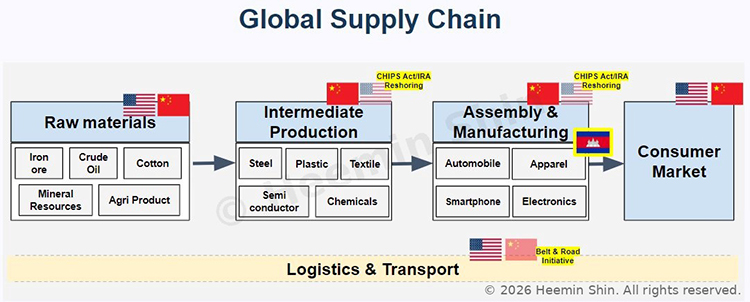
Figure 2 maps the full structure of the global supply chain, from raw materials through intermediate production, assembly and on to the consumer market, with logistics running beneath every stage. It also shows where Cambodia currently participates in that chain. The country has a foothold in one node: assembly. Every other node, from raw material access to consumer market reach to logistics infrastructure, is controlled by others. That is the map Cambodia needs to read before deciding where to move next.
The global supply chain is not static. It is being redrawn at speed, and the United States is the primary force doing the redrawing. America has long dominated both ends of the curve: raw materials through its commodity markets and dollar-denominated trade, and consumer demand as the world’s largest end market. What ceded to Asia was the middle. Through the CHIPS Act, the Inflation Reduction Act, and a sweeping tariff regime, the US is now actively attempting to reclaim the intermediate production and assembly nodes it previously offshored. The strategic goal is to control the entire chain.
For Asia, this creates a specific opening. South Korea, Taiwan, Japan, and China are each facing the same pressures: rising wages, ageing workforces and the drive to move up the technology ladder. The manufacturing work they are shedding, including mid-tier component processing, light industrial assembly, export-oriented food and materials processing, is actively looking for a new home. Vietnam absorbed the first wave of this relocation, growing garment exports from $11 billion in 2010 to $46 billion in 2025. But Vietnam’s wages are rising and its premium industrial zones are filling up. The next destination has not yet been decided.
Cambodia’s window
The countries that built their middle class fastest did so by catching outbound manufacturing at the right moment. South Korea caught Japan’s overflow in the 1970s. China caught everyone’s overflow in the 1990s. Vietnam caught China’s overflow in the 2010s. Cambodia has a window now. The question is whether the conditions exist to walk through it.
Unreliable power, infrastructure gaps, skills shortages and limited domestic supply chains mean that most relocating factories are currently passing Cambodia by. But none of these are permanent conditions. They are policy choices.
The remaining columns in Part II examine where Cambodia’s opportunities lie across two distinct layers. The first is the supply chain itself: manufacturing one step above pure assembly, and logistics through Sihanoukville’s underused deep-water port. The second is the service layer that supports the chain: finance built on Cambodia’s dollarised economy, digital infrastructure and business services that can serve regional supply chains without competing in manufacturing directly. Both layers matter. Together, they offer Cambodia a path towards the upper portions of the smile curve and towards the $3,896 that the 2030 target requires.
Next in this series (Part 4): ‘The factory floor Cambodia needs’: Why manufacturing is the fastest path to a middle class, and what it would take for Cambodia to capture the wave of industrial relocation now looking for a new home.
Heemin Shin is a founding partner of Plateaux Capital, a private equity house based in New York, with prior roles as CFO of a Cambodian microfinance institution, managing director at Siguler Guff Company & LP, and founder of a fintech company he took to a successful exit. He writes in a personal capacity. Email: david@plateauxnewyork.com
-Khmer Times-