UNCLOS can rebuild Cambodia-Thailand trust, pave way for lasting peace, says Manet.
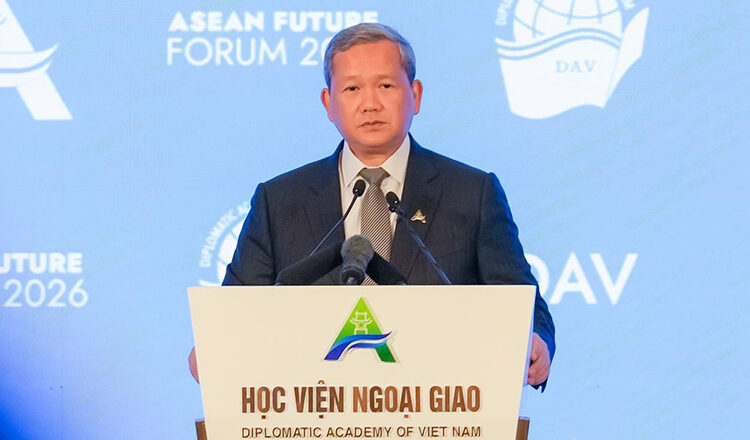 Prime Minister Hun Manet addresses the ASEAN Future Forum in Hanoi, Vietnam, on June 9. STPM
Prime Minister Hun Manet has framed Cambodia’s decision to pursue a compulsory conciliation process under the UN Convention on the Law of the Sea (UNCLOS) as a pathway not only to resolving a long-running maritime dispute with Thailand, but also to restoring trust, safeguarding regional peace and allowing communities affected by past conflict to rebuild their lives.
Speaking at the ASEAN Future Forum in Hanoi, Vietnam, on June 9, Manet reaffirmed Cambodia’s commitment to maintaining strong relations with Thailand despite recent tensions, stressing that both countries share a responsibility to preserve peace and prosperity in the region.
“Cambodia continues to attach great importance to its relationship with Thailand, our close neighbour, with a shared commitment to maintaining peace and prosperity in our region,” he said.
His remarks follow years of border tensions, which culminated in last year’s armed clashes, the collapse of a bilateral framework governing maritime negotiations and Cambodia’s recent move to invoke a UN-backed dispute settlement mechanism under UNCLOS.
The prime minister said respect for international law, existing treaties and agreements, good-faith dialogue and mutual respect remain essential principles for ensuring that sovereignty, territorial integrity and international boundaries are respected.
According to Manet, adherence to those principles is necessary not only to address legal disputes but also to rebuild confidence between neighbouring countries and create conditions for long-term peace.
He said peaceful solutions would ultimately benefit ordinary citizens, particularly those whose lives have been disrupted by conflict.
“Trust must be restored so that displaced people can safely return home and rebuild their livelihoods with dignity,” he said.
His comments placed a human dimension on what has often been viewed as a technical, legal and diplomatic dispute over maritime boundaries and resource claims in the Gulf of Thailand.
Cambodia formally launched a compulsory conciliation process under UNCLOS on June 2 after Thailand terminated a 2001 memorandum of understanding that had provided a framework for negotiations over overlapping maritime claims between the two countries.
The disputed area, estimated at around 26,000 square kilometres, is believed to contain significant oil and natural gas reserves.
At the time, Manet said Cambodia had taken the step to protect its sovereignty and maritime rights in accordance with international law.
The latest development gained momentum after Thailand announced that it would participate in the UNCLOS conciliation process by appointing conciliators to represent Bangkok in the proceedings.
Manet welcomed the decision, describing Thailand’s willingness to engage in the process as a positive sign.
“The confirmation of Thailand’s readiness to participate in conciliation under UNCLOS is a welcome step towards the peaceful resolution of overlapping maritime claims,” he said.
He added that a fair and durable settlement would serve the interests of both nations while contributing to broader regional stability.
His comments represent one of Cambodia’s strongest public endorsements of the UNCLOS process since it was initiated and suggest Phnom Penh sees the mechanism as more than a legal avenue for settling maritime claims.
Rather, Cambodia is presenting the process as part of a wider effort to prevent future conflict and strengthen regional confidence.
Manet also used his speech to call for broader international support for peaceful conflict resolution between the two neighbouring kingdoms.
The appeal reflects Phnom Penh’s effort to position the maritime dispute within a rules-based international framework rather than a purely bilateral political contest.
Beyond the Thailand issue, Manet linked peace and stability to ASEAN’s broader development agenda, arguing that sustainable economic progress cannot be separated from regional security.
-Phnom Penh Post-