Cambodia-Thailand Border Conflict Resolution Demands Sincerity
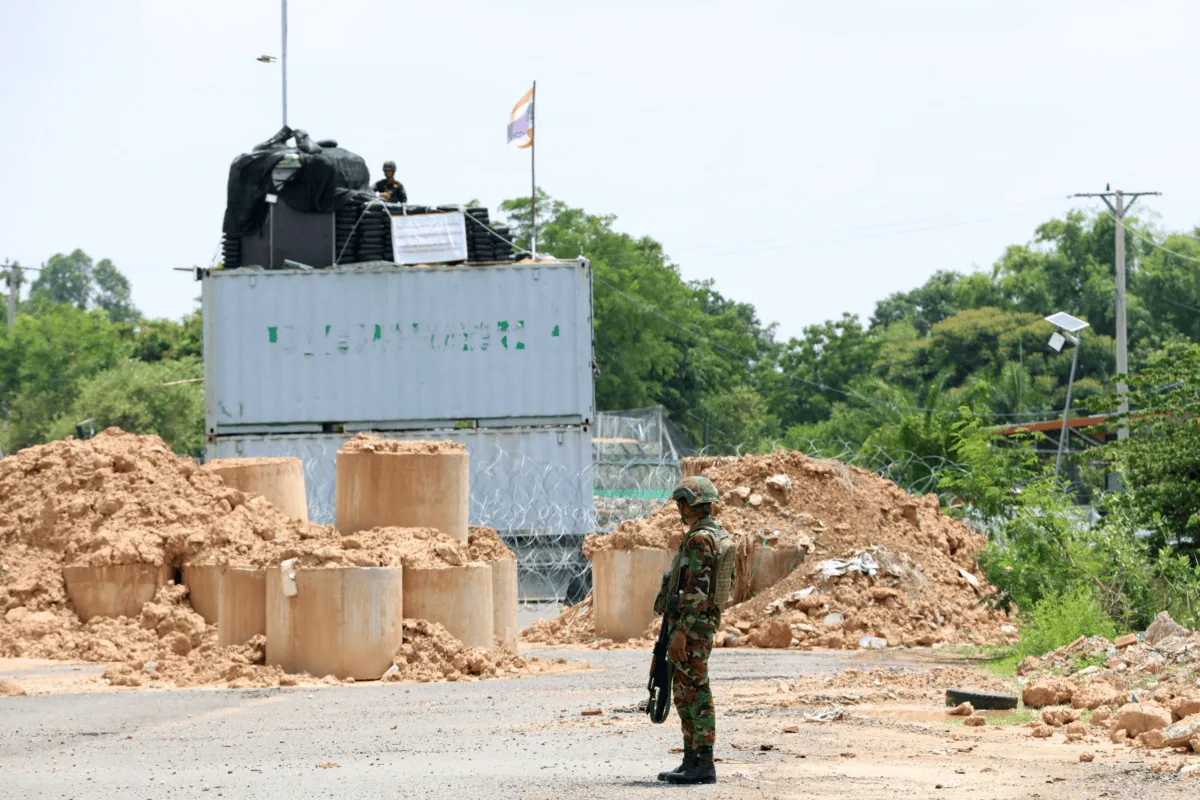 A Cambodian soldier observes a Thai shipping container barricade which stands on occupied Cambodian territory. Supplied
#opinion
Thailand’s high-level politicians love to use the term “sincerity” in its ongoing diplomatic negotiations over the Cambodia-Thailand border issue. Their careful use of terminology frames Thailand in an open, non-aggressive and diplomatic light. In practice, Thailand’s political behaviour has proven starkly different: hypocrisy and insincerity, especially in its military branch.
Thailand’s top military brass and a handful of its politicians have chosen a false flag military operation on Cambodia’s sovereignty and territorial integrity. Its war machine has caused much collateral damage far beyond the line of engagement at the Cambodian border areas. Cambodia’s infrastructure, including schools, pagodas, markets, houses and bridges, was destroyed, while civilians have been killed, displaced and victimised at the whim of the Thai military’s most recent operations.
Thailand has been particularly insincere in its appeal for a ceasefire on the condition that even when “Cambodia ceases, Thailand fires”. Thai establishments should have the reason to know how its military personnel along the Cambodia-Thailand border are illegally and arbitrarily encroaching upon Cambodia’s territorial integrity.
Their cover-up, flagrant and cunning act is nothing but an attempt to fulfil their own political power ambitions, while satisfying Thai nationalists, extremists and feudalists. In their drive for power, Thai coalitions formulate unsubstantiated claims over the potential threat posed by Cambodia’s military power, exaggerating the realities of the existing power imbalance between the two countries. Thailand’s behaviour is tantamount to shedding crocodile tears.
In October 1976, at the Plenary Session of the 31st UN General Assembly, the government of Democratic Kampuchea (1975-1979) joined the debate on the newly proposed law of the sea, commenting that: “The administration of the sea must aim at developing people’s welfare, progress, and strengthening of peace and justice. The new laws of the sea must secure the rights of all littoral states, especially those of the developing countries, and defend them against threats to their security, sovereignty, and territorial integrity.”
It was developed into the UN Convention on the Law of the Sea (UNCLOS) in 1982 and entered into force in 1994. Both Cambodia and Thailand are state parties.
Thailand may try to portray itself as an underdog in the case of its own unilateral cancellation of the 2001 Memorandum of Understanding (MoU 2001) on the maritime boundary between Cambodia and Thailand in May 2026.
Cambodia is now taking its shrewd approach to have UNCLOS adjudicate the dispute over the overlapping claims area (OCA), the 26,000 square kilometre zone of contested waters. Thailand has rebuked this move because it will extend the resolution process, as it prefers informal or bilateral negotiation. Even multilateral peace efforts, including the October 2025 US-brokered Kuala Lumpur Peace Accords, failed to appease Thailand, which renewed a 21-day aggressive military campaign in Northern Cambodia in December 2025.
The Cambodian government prefers a peaceful resolution of the Cambodian-Thai border conflict through formal negotiations to promote cooperation, stability, and peace across Southeast Asia. It has been clear and sincere in its position to tackle both land and maritime border issues through existing international laws, treaties, conventions, and other agreed-upon lawful frameworks. Thailand’s reciprocal diplomatic sincerity in seeking a formal resolution would be met with Cambodia’s full support and appreciation.
Ly Sok-Kheang is director of the Anlong Veng Peace Center, Documentation Center of Cambodia (DC-Cam). The views and opinions expressed are his own.
-Phnom Penh Post-