Entrepreneurs on India’s streets are the future of AI
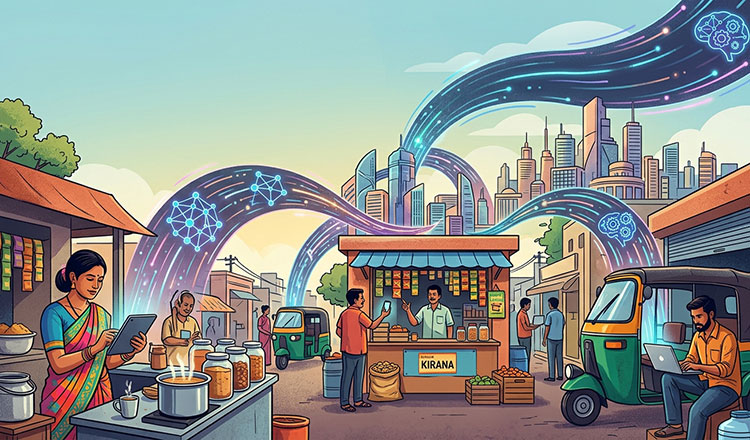 The streets of India are full of small entrepreneurs who can use AI to solve problems that matter to them, such as informal credit and local supply chains. Khmer Times/AI
#opinion
India’s conversation about artificial intelligence (AI) is dominated by two questions: How many jobs will it destroy, and how much can it raise productivity, especially in our large informal economy? Both matter. But a third question may matter more: What happens when the people closest to India’s biggest unsolved problems get direct access to AI, not just AI products?
In a recent Wall Street Journal essay, American author and columnist Kimberley Strassel describes Silicon Valley’s obsession with AI abundance, then asks a profound question: Abundance for whom, and who decides? Her point isn’t about redistributing AI’s gains. It is about which problems get chosen to be solved in the first place. She points to evidence that innovators build disproportionately for people like themselves. Female entrepreneurs create products with an 18% higher share of female customers than male entrepreneurs in the same category.
Entrepreneurs from high-income families build for high-income consumers. Venture capitalists have a name for this: founder-market fit. Strassel’s own students prove this; in nearly a decade of teaching a class on building companies around social problems, she’s never had a student propose fixing Medicaid or prison re-entry, but she does get teams building apps for 3am cookie delivery.
The point is: You cannot have founder-market fit in a market you have never met.
India’s version of this problem is larger by orders of magnitude. We need many more entrepreneurs, but the missing founders aren’t IIT or IIM alumni who have never encountered a broken system. They are the people running the smallest units of that system already, and they already have the founder-market fit. What they lack is the ability to act on it.
Consider a woman running a food-processing business who knows exactly why her sales swing month to month but has never had a business analyst to confirm what she already knows. Consider a graduate in Nagpur or Vizag who understands the local economy better than any consultant sent from Bangalore.
This is founder-market fit at a scale of tens of millions of people who have lived inside the exact problems India needs solved: informal credit, local supply chains, women’s economic participation, agricultural distress. Converting that knowledge into a business has always required engineers, designers, accountants and capital, most of which were unavailable. That barrier decided which problems got serious entrepreneurial attention. We got quick commerce as a result.
This isn’t theoretical. AI4Bharat and Microsoft Research’s Jugalbandi already let rural citizens query government scheme eligibility in their own language over WhatsApp, collapsing what once required a lawyer or a well-connected relative into a chat message. Digital Green’s Farmer Chat gives smallholders agronomic advice that once could only come from a visiting extension officer who might show up once a season. These are early, narrow examples. But they show the mechanism: AI doesn’t just make experts more productive; it lets people find routes around the absence of experts entirely.
Extend that logic to entrepreneurship. The small entrepreneur can ask an AI system to analyse her sales, identify her most profitable products, map her competitors, build a website, and draft a loan application. The unemployed graduate in a small town with an idea can research a market and prototype a model guided by AI.
AI makes information and expertise abundant. In a market where deep local knowledge was always abundant and technical capability was always the bottleneck, that shift matters enormously.
Strassel argues venture capital should seek out the founders it is ignoring. India doesn’t have to find them. They already run the shop, drive the auto, or keep the ledger. It has to make them capable.
That reframes what success should look like. Not how many people were trained on AI tools, but how many more people are starting businesses, how many existing businesses are growing, how much faster entrepreneurs are solving problems that matter to them. Call it entrepreneurial velocity; it is a number you can actually track, unlike AI abundance.
The fundamental point is this: Don’t start with how to divide AI’s gains; start with who gets to decide what it is used to build. If AI stays a tool mainly for large firms and credentialled professionals, it will deepen the already extreme inequalities we see.
If it becomes a working capability for the small entrepreneur, the woman running a microbusiness, the underemployed graduate, and the frontline official, something different emerges — not just more intelligent machines, but more capable people acting on what they already know.
India doesn’t need to wait for Silicon Valley or Bengaluru to notice its version of Medicaid that doesn’t work. The missing founders aren’t missing. They’re already there. We have to give them the capability to experiment, solve their problems, and let the results decide what scales.
Ravi Venkatesan is the former chairman of Microsoft India and founder of Global Alliance for Mass Entrepreneurship.
-Khmer Times-