Cambodia slams Thailand’s heritage listing of border temples
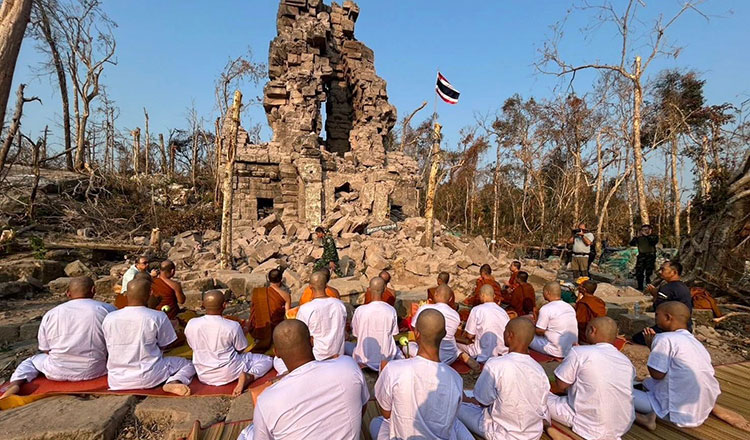 Thai monks and soldiers gather for a prayer ceremony at Ta Krabey Temple. 22nd Infantry Battalion, Task Force 2
Synopsis: Phnom Penh rejects Bangkok’s unilateral listing of ancient border sites as Thai monuments, asserting the action violates territorial integrity and lacks international legal validity.
Cambodia has strongly protested Thailand’s registration of ancient border temples as Thai national heritage, calling the act a violation of territorial integrity and demanding an immediate withdrawal.
On Tuesday, Thailand’s Fine Arts Department officially published the listing of the Ta Krabey temple and Ta Moan temple complex in the Royal Gazette, adding them to the Thai national register of ancient monuments. It cites the 1961 Ancient Monuments Act for local conservation and points out historical listings for parts of the complex dating back to 1935.
In a statement released yesterday, Cambodia’s Ministry of Culture and Fine Arts announced its absolute disapproval of the registration of both temple complexes, along with Knar Temple and other archaeological sites situated along the border and under the sovereignty of Cambodia, into Thailand’s national register of ancient monuments.
“This unilateral action is illegal, null, and without legal effect,” the ministry argued. “Such registration is entirely baseless and cannot, in any way, serve as evidence of territorial sovereignty or as an instrument for border delimitation.”
The ministry said that all matters relating to the land border dispute between Cambodia and Thailand shall be resolved exclusively in accordance with international law and other existing binding agreements and mechanisms, particularly the Franco-Siamese Treaty of 1907, the Memorandum of Understanding of 2000 (MoU 2000), the Terms of Reference of 2003 (TOR 2003), and the mandate of the Joint Boundary Commission (JBC).
“The ministry considers this registration an unlawful attempt to create an artificial legal appearance over cultural sites within the sovereign territory of the Kingdom of Cambodia,” the ministry added.
“Such action constitutes a violation of Cambodia’s sovereignty and territorial integrity and undermines the spirit of peaceful dialogue and mutual respect between the two countries.”
Cambodia’s Culture Ministry called on the Thai government to delist the aforementioned sites immediately and “refrain from any unilateral actions that undermine Cambodia’s efforts towards a peaceful settlement through bilateral mechanisms”.
“The Kingdom of Cambodia remains firmly committed to the peaceful resolution of all outstanding issues, in full respect for international law and established bilateral mechanisms,” it added.
The ancient Khmer temples of Ta Krabey and the Ta Moan complex are among the many historic heritage sites along the Cambodia–Thailand border in the Dangrek mountain region. Although less internationally prominent than the Preah Vihear Temple, these sites hold historical, archaeological, and geopolitical significance because of their location in a long-sensitive border area.
Built during the Angkorian period, possibly between the 11th and 12th centuries, Ta Krabey is a modest yet significant ancient Khmer temple.
Ta Moan Temple was part of a larger complex that served as a key stop along the Ancient Khmer Highway—a major route connecting Angkor, the capital of the Khmer Empire, to its administrative centre in Phimai (now in Thailand). The central shrine features a mandapa leading to the sanctuary, where the base and linga are carved directly from the natural bedrock.
The temple, built of laterite and sandstone during the 11th century, features a rectangular layout with a south-facing entrance. The enclosure measures 46 by 38 metres, centred around a main sanctuary made of pinkish-grey sandstone, fronted by a long, chambered hall (mandapa)and an antarala.
Both Ta Moan and Ta Krabey were severely damaged in the two-round military clashes between Cambodia and Thailand last year.
Reports from Cambodian authorities stated that Ta Krabey Temple was struck multiple times during clashes on December 8–10. The structure was described as severely damaged, with parts of the ancient sandstone architecture destroyed or collapsed. Cambodia accused Thai forces of targeting the site, calling it a violation of international heritage protection laws.
The Ta Moan Temple was among the first sites of engagement as clashes escalated, with troops exchanging fire near the temple grounds. The site reportedly became a military stronghold at different points in the conflict, with both sides accusing each other of occupying or firing from the temple area. After the fighting, reports showed visible damage and shell impact marks around the temple complex, including surrounding infrastructure and access roads.
Before the clashes, the Cambodian government had formally invited Thailand to pursue a legally binding territorial settlement over the temples through the International Court of Justice (ICJ) if bilateral talks continued to fail.
Kin Phea, Director-General of the International Relations Institute of Cambodia, said he agreed with Cambodia’s strong protest. He explained that such registration cannot be used by Thailand to claim legal validity or lawful ownership, as all these temples and archaeological sites are located within the sovereign territory of Cambodia.
“A country cannot simply register temples or archaeological sites located on another country’s territory, which is not its own, and thereby claim ownership over them,” he said.
“Secondly, I believe the Ministry of Culture’s response is absolutely correct in opposing and protesting this action, because we cannot remain silent. If the ministry does not protest, we risk losing our right to object in the future.”
-Khmer Times-