Cambodia: From national humiliation to rejuvenation
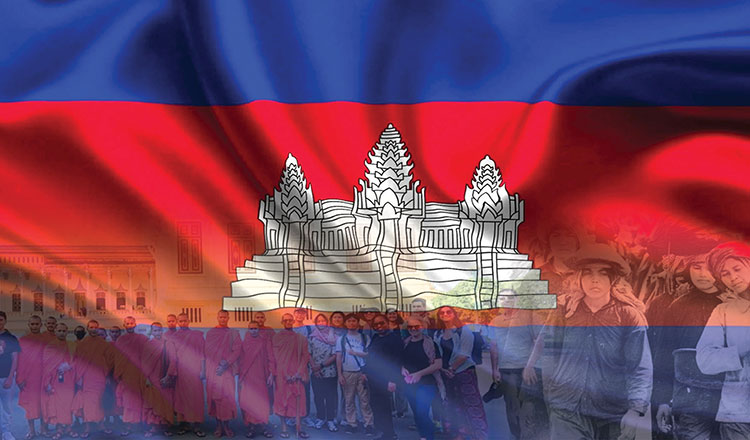 A country whose people know their history, master technology, and compete globally carries itself differently in the world. Khmer Times illustration
#editorial
Cambodia knows what humiliation means. It lives in memories of foreign invasion, coercion, occupation, territorial loss, ideological experiments, sanctions, interference, and condescension.
For half a millennium since the collapse of the Khmer Empire in the 15th century, Cambodia has been a chessboard for the ambitions and expansion of others.
The central question for Cambodia is not whether it remembers humiliation. It must.
The question is whether memory can be transformed into state capacity, social confidence, and national rejuvenation.
The experience of other nations shows that humiliation narratives can be politically powerful.
Studies on China’s “century of humiliation” show how memories of foreign coercion, territorial loss, and national weakness were turned into a long project of rejuvenation, centred on sovereignty, development, unity, and restored national dignity.
China’s pursuit of rejuvenation is built around mobilising “domestic resources” in search of “wealth and power.” It demonstrates how humiliation narratives can shape responses to perceived violations of sovereignty, territorial integrity, or national dignity.
Cambodia’s rejuvenation journey must not be exclusionary, retaliatory, or grievance-driven. It must be rooted in Khmer civilisation, anchored in sovereignty, open to the world, and focused on building a capable, inclusive, resilient, and confident nation.
Here are the six elements that need to be strengthened.
1. Political leadership
Rejuvenation requires leaders who do not merely invoke patriotism but dare to reform.
A humiliated nation is not restored by slogans. It is restored by a strong state with a clean administration, competent institutions, merit-based recruitment, excellent public service, predictable law enforcement, and a government that delivers.
Sovereignty is weakened when institutions are weak. Independence is hollow when corruption, nepotism, factionalism, and administrative inertia prevent the state from serving its people.
Cambodia needs to be a strong state but not a suffocating state. Strength means the ability to plan, coordinate, regulate fairly, respond to crises, and protect national interests.
A rejuvenated Cambodia also needs strong private institutions: competitive firms, innovative small and medium enterprises, professional associations, universities, research centres, media institutions, and civic organisations that contribute to national resilience. The state alone cannot carry the nation. Society must be organised, capable, and productive.
2. Social harmony
National humiliation often creates the temptation to define unity against an enemy. That is too easy.
Real unity is harder. It requires social inclusion, trust across classes and generations, respect for diversity, and a shared belief that every Cambodian has a place in the national future.
A rejuvenated Cambodia must therefore invest in people. The most powerful deterrent against humiliation is not only military hardware but also national cognitive power.
We need a skilled, healthy, disciplined, and creative population. In this regard, education reform is national defence.
A country with a productive workforce cannot easily be intimidated. A country whose youth know their history, master technology and compete globally carries itself differently in the world.
3. Economic strength
Poverty invites dependency. Weak production invites vulnerability.
Cambodia must move beyond a narrow growth model based mainly on low-cost labour, real estate cycles, and external demand.
The next phase must be built on innovation-led growth with a focus on productivity, value-added manufacturing, agro-processing, clean energy, smart logistics, and tourism quality
A water-energy-food security nexus and supply-chain resilience are national security.
Here, the concept of “comprehensive national power” is useful.
Research on strategic deterrence notes that deterrence is not only military; it includes economic power, diplomatic influence, scientific and technological capabilities, and political and cultural unity.
For Cambodia, this means national defence must be understood broadly. A resilient economy, trusted institutions, social cohesion, credible diplomacy, and technological capability are all part of a country’s protective shield.
4. Smart diplomacy
Cambodia cannot change its geography. It sits in a region shaped by larger powers, strategic competition, and territorial expansionism.
But it can survive and prosper through diplomatic skill, principles-based foreign policy, diversified partnerships, and strategic patience.
Cambodia must be a friend to all, enemy to none. It must deepen relations with neighbours, proactively engage major powers, and use international law and diplomacy as a shield for sovereignty.
Smart diplomacy also means narrative diplomacy. Cambodia must tell its story better. It must explain its history, defend its legitimate interests, promote its culture, and correct misperceptions.
Silence allows others to define us. Anger makes others dismiss us. Strategic communication gives Cambodia voice, dignity, and influence.
5. Credible deterrence
Cambodia should not seek conflict. War would destroy the very future the country is trying to build. But peace without preparedness and combat readiness is fragile.
A sovereign state must have the capacity to monitor its borders, protect its territory, defend its people, respond to hybrid threats, secure cyberspace, and coordinate civil-military readiness.
Deterrence for Cambodia should be defensive, lawful, and proportional. Its purpose is not aggression. Its purpose is to make coercion costly and peace sustainable.
6. National identity
Cambodia cannot rejuvenate if Cambodians forget who they are. Khmer civilisation is a living strategic resource.
Khmer identity, community solidarity, and the memory of survival through tragedy all form the moral foundation of national renewal. But identity must not become nostalgia. To know the past is not to live in it. It is to draw strength from it.
Cambodia’s young generation must learn history seriously: the greatness, the suffering, the mistakes, and the resilience. They must know how foreign aggression and interference damaged the country as well as how internal division weakened it.
Towards national rejuvenation
National rejuvenation is about turning pain into purpose, memory into reform, identity into confidence and sovereignty into performance. It asks every institution a simple question: does your work make Cambodia stronger, more capable, and more respected?
Cambodia has survived humiliation. That itself is remarkable. But survival is not enough. The next chapter must be rejuvenation—a Cambodia that is peaceful but not passive, open but not dependent, proud but not arrogant, modern but not rootless.
The world will not automatically respect Cambodia because of its ancient civilisation. Respect must be earned through competence, unity, and strength.
The work begins at home—by cleaning our own house first. Domestic strength defines our external influence and leverage. Drastic reform is urgently needed.
A capable state with strong, clean and smart institutions, transformative leadership, a productive economy driven by innovation and technology, social trust and strong national identity are the foundations of national rejuvenation.
If we want dignity abroad, we must build capacity at home. If we want others to respect us, Cambodia must first become stronger and wealthier.
-Khmer Times-