Space between worlds: A 30-year voyage from India to Cambodia and the edge of the universe
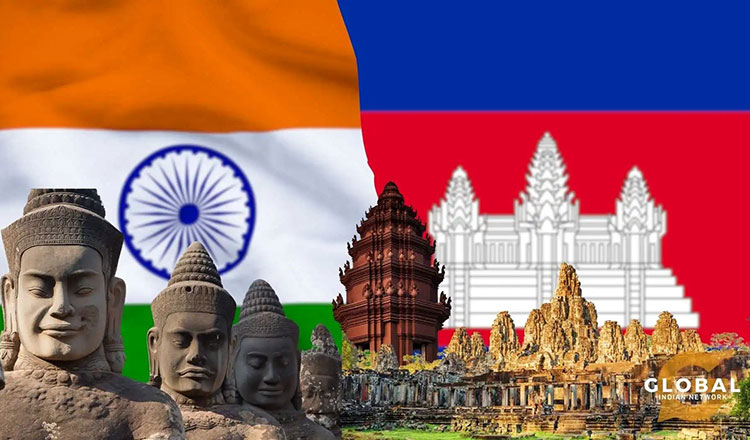 In a decades-long journey from India and Cambodia, a researcher discovers that the ‘nothingness’ of space is actually the most important ‘something’ in existence. AFP
#opinion
For over a century, we have been taught to view the universe through the lens of “space”—a vacuum, a medium, a background, or a geometric fabric where stars, planets, and celestial bodies perform. To the naked eye, this space appears as an empty void, a vast nothingness. But after 30 years of observation, experience, and theoretical research—a journey that began on the terraces of India and culminated here in Cambodia—I have discovered that this “nothingness” is actually the most important “something” in existence.
In my recently published research, “Nature of Space and Dimension of the Observable Universe and Beyond,” I reveal a revolutionary shift: Space is not just a background for matter and the universe. It is a Self-Existent Physical Entity—the fundamental substance from which all matter and the universe are born.
A journey across borders
My obsession began in 1994, during my 10th-standard year in India, while reading the final lesson of my science book. By 1997, I was taking “thought journeys” in a space shuttle, imagining myself travelling through loops of space and matter to find where existence ends. Between 2002 and 2005, during my daily train commutes in India, I filled notebooks with my own derivations of the relativity of a train’s motion, the relativity of falling rain, and gravity. My interest was evolving with every page I filled, moving from the movement of objects to the fundamental forces that hold them together.
In December 2008, I moved to Cambodia. Though my surroundings shifted from the bustling railway lines of India to the vibrant landscapes of the Kingdom, my internal compass remained fixed on the stars. From 2018 to 2022, I moved beyond the master theories of the past and began a rigorous review of the Standard Model of physics. It was during these quiet years of contemplation in Cambodia that I finally bridged the gap between my teenage “thought journeys” and formal scientific derivation.
The result is a new way to look at the “95% of the universe and beyond”—the dark matter and dark energy that scientists currently struggle to define. I discovered that these are not undiscovered particles but instead properties of the Space Entity, which I have now mapped through the fundamental framework.
Why modern science is incomplete
In my research, I reviewed the giants of physics to identify exactly where current models reach their limits. General relativity tells us space curves, but the math “breaks down” inside black holes.
String theory treats space like a passive background. Even the Higgs Field does not explain where the field itself comes from.
Currently, scientists are searching for “invisible particles” to explain dark matter. I believe the search has failed because they are looking for new “stuff” rather than the space itself. Whether history has labelled it a vacuum, an empty void, the fabric of spacetime, or the quantum foam, my work reveals that these are simply different names for the various transformed states of the one, constant, and fundamental Space Entity that exists beyond them all.
Volume I: The laws of space transformation
In the first volume of my framework, I establish the Fundamental Space Entity as the starting point for all existence. From this foundation, I introduce two principles: the First Law of Space Transformation and the Second Law of Space-Matter Transformation.
Imagine my teenage space shuttle journey again. If you keep travelling, you don’t find “nothingness”; instead, you find a continuous transformation. These laws provide the fundamental framework for how “space elements” transform into “matter elements” and back again. Just as ice is a different state of water, matter is simply a different state of the Space Entity.
To map this, I derived a dual framework comprising the P-space and Q-space planes. This explains how the Space Entity exists in distinct states: in the Q-plane, it becomes our measurable universe, and at its fundamental state, it exists as the infinite P-plane. These two cannot coexist. When the Space Entity transforms into our world, the infinite P-plane ceases to be. It finally provides a logical map for the “Beyond,” showing that our observable world is just part of a larger, unified system.
Volume II: The GODEYE Model
In the second volume, I apply these laws to the “Big Four” mysteries: dark matter, dark energy, the unification of gravity, and the quest for a Theory of Everything. By breaking space down into fundamental unit elements—namely Space Unit Elements (PSUE, ISUE, VSUE, CSUE, and MSUE)—we can bridge the gap between general relativity and quantum mechanics.
Through the GODEYE Model, I describe the behaviour of the entire cosmos as a unified system. Instead of viewing gravity as a force of attraction or the curvature of a stage, the model explains how the universe and the Beyond expand, contract, and transform like a living entity through the dual forces of gravity and antigravity. It proves that the “energy” scientists are searching for is an inherent property of the space unit elements themselves. The energy of the universe isn’t lost—it is simply the Space Entity in action.
From the rooftop to the global stage
Scientific breakthroughs are often portrayed as the work of massive laboratories. But discovery is also possible with a single person relentlessly questioning the nature of reality on a quiet night.
The questions I have asked since I was a teenager in 1997 are the same questions I am answering today through the fundamental framework I have developed here in Cambodia.
We are entering a new era of astrophysics where we no longer need to view the “95% of the universe and beyond” as a terrifying void. We now recognise that what once looked like darkness between the stars is actually a bridge of physical energy, connecting every electron in our bodies to the furthest reaches of the cosmos.
The boy in the space shuttle is still travelling, but now, he finally has a map.
Reference: Zenodo DOI 10.5281/zenodo.19605304
-Khmer Times-