Safe for Bulldozers, “Dangerous” for Diplomats: The Legal Paradox on the Cambodia–Thailand Border
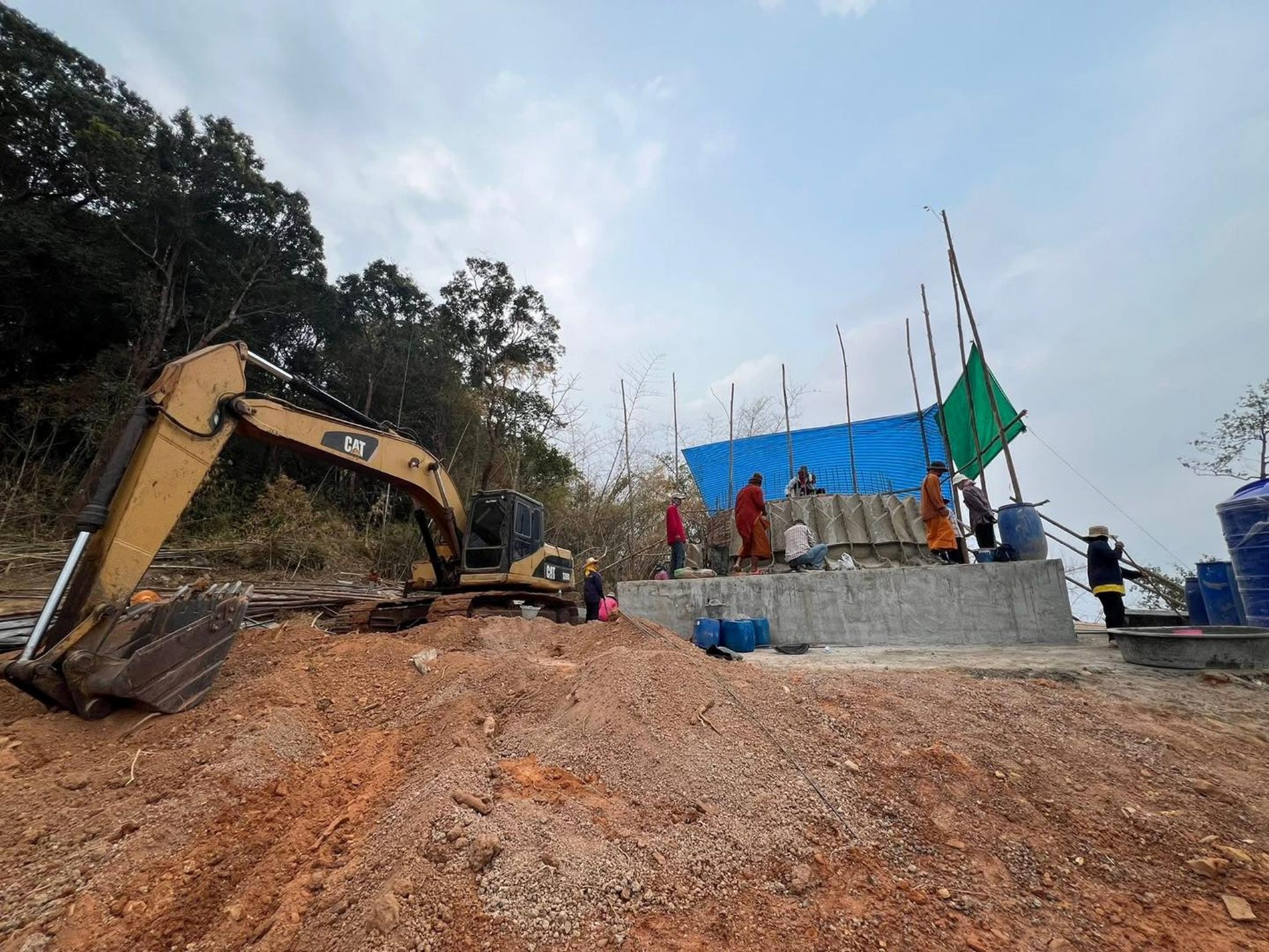 Thai forces reportedly constructed a Buddha statue in the Phnom Trop area last week, creating a new status quo on the ground. FB
#opinion
Diplomacy functions only when the legal frameworks governing interstate relations are respected in both word and practice. When those frameworks are invoked rhetorically but disregarded on the ground, diplomacy risks becoming little more than procedural theatre. Recent developments along the Cambodia–Thailand border illustrate precisely this tension. While official statements emphasise restraint and cooperation, the realities unfolding along the frontier suggest a widening gap between diplomatic assurances and physical developments on the ground.
Viewed through the lens of international law and Cambodia’s sovereign interests, the current impasse raises deeper questions about treaty compliance, the maintenance of the status quo in territorial disputes and the integrity of mechanisms established to peacefully resolve boundary disagreements.
The Evidentiary Void and the Duty of Good Faith
Thailand’s decision to suspend meetings of the Joint Boundary Commission (JBC), as outlined in a March 11 press release, was justified by an alleged grenade attack by Cambodian forces on February 24 that Bangkok claimed violated the December 27 ceasefire agreement.
Yet the evidentiary basis for this claim remains deeply questionable. According to the Cambodian Ministry of Foreign Affairs and International Cooperation, regional military liaison teams from both countries jointly inspected the alleged incident site and confirmed that no such explosion had occurred.
In international relations, the principle of good faith is not merely a diplomatic courtesy; it is a foundational norm of treaty law. Codified in the Vienna Convention on the Law of Treaties, good faith obliges states to perform their international commitments honestly and consistently. Persistently invoking an incident that has been jointly investigated and found unsupported as a justification for rejecting multiple invitations to reconvene the JBC raises serious questions about whether this obligation is being observed in practice.
The result is a troubling situation in which diplomatic engagement is formally acknowledged yet effectively postponed through the repeated invocation of a contested security narrative.
The Gradual Construction of “Facts on the Ground”
While the Joint Boundary Commission remains inactive, developments along the border suggest that the diplomatic stalemate may be accompanied by a gradual transformation of the physical and administrative landscape of contested areas.
Following the ceasefire declaration, Thai military and civilian authorities have undertaken a range of activities in areas Cambodia maintains were unlawfully taken and occupied. Cambodian diplomatic communications and statements from the foreign ministry detail a series of actions on the ground, including the emplacement of barbed wire and barricades, the deployment of heavy machinery, trench-digging and defensive earthworks, the delivery of bunker materials, and the clearing or destruction of homes and civilian property.
Such activities have reportedly occurred across multiple contested locations along the frontier, including An Ses, Prey Chan, Chouk Chey, Boeung Trakuon and the vicinity of Thma Da (Thmar Dar). In several of these areas, Cambodian authorities have raised concerns that the physical environment of the border — intended to remain unchanged under existing bilateral agreements — is being gradually altered through construction works, defensive preparations and the expansion of administrative presence.
In the context of territorial disputes, these activities cannot be viewed as neutral administrative measures. Rather, they reflect a broader pattern of territorial consolidation through administrative and physical measures. The emplacement of barriers, excavation works and the deployment of infrastructure and logistical assets in contested areas risks altering the factual situation on the ground and entrenching de facto control before the agreed demarcation process has been completed.
Construction activities have also reportedly taken place near the An Mah–An Ses point of entry, extending toward Ta Phraya district, including the development of a market, an administrative building and the Ta Om Equestrian Monument. While these projects may be presented as routine local development, their legal significance within a disputed border context is far from neutral.
In international boundary jurisprudence, the construction of permanent infrastructure in contested territory is frequently interpreted as an attempt to establish fait accompli conditions — the creation of irreversible “facts on the ground” designed to strengthen a party’s negotiating position before the legal boundary is formally determined. When such actions occur while formal demarcation mechanisms remain suspended, the risk emerges that diplomatic stalemate becomes a vehicle for incremental territorial consolidation.
Treaty Obligations and the Preservation of the Status Quo
These developments raise serious concerns under the 2000 Memorandum of Understanding on the Survey and Demarcation of Land Boundary between Cambodia and Thailand, which governs the bilateral boundary demarcation process.
The MoU explicitly prohibits either state from altering the physical environment of the frontier pending the completion of demarcation by the Joint Boundary Commission. This provision reflects a well-established principle in international boundary disputes: the preservation of the status quo ante until a mutually agreed settlement is achieved.
The purpose of such provisions is clear. By freezing the physical and administrative landscape of disputed territory, they prevent unilateral actions that might prejudice the outcome of negotiations.
The ongoing construction and defensive preparations reported along the border therefore raise questions about whether the obligations embedded in both the 2000 MoU and the December 27 ceasefire agreement are being fully respected.
The Legal Foundations of Cambodia’s Territorial Claim
Cambodia’s position regarding the boundary in the affected areas rests upon well-established legal instruments. The territories in question fall within Cambodia’s borders as defined by the 1:200,000-scale maps produced by the Franco-Siamese Mixed Commission pursuant to the 1904 Convention and the 1907 Treaty.
These maps have long served as authoritative references in determining the frontier between the two states. Conversely, Thailand’s reliance on the unilaterally produced L7011 map lacks comparable standing within international boundary jurisprudence.
For Cambodia, the legal implications extend beyond the immediate developments on the ground. Under the doctrine of estoppel in international law, prolonged silence or passive acceptance in the face of territorial encroachment may later be interpreted as acquiescence. In the context of territorial disputes, silence itself can carry legal consequences.
The Paradox of “Dangerous” Construction Zones
Recent Thai statements have cited safety concerns for the Joint Survey Team as justification for suspending the JBC process. Yet this claim reveals a striking contradiction.
A border zone described as too dangerous for diplomatic surveyors carrying measuring instruments appears simultaneously accessible to construction crews operating heavy machinery to erect markets, administrative buildings, and monuments.
The paradox is difficult to ignore. If the security situation truly prevents the work of survey teams tasked with peaceful demarcation, it raises legitimate questions as to how large-scale construction projects can proceed in the same environment.
Diplomatic sincerity cannot be demonstrated through rhetorical assurances alone. Nor can treaty obligations be indefinitely suspended pending domestic political developments such as the formation of a new cabinet. The legal obligation to refrain from altering disputed territory does not require new legislation; it requires adherence to commitments already undertaken.
Conclusion: Peace Requires Practice, Not Just Promises
Cambodia has repeatedly affirmed its commitment to resolving the border issue through established diplomatic and legal mechanisms. By consistently calling for the resumption of the Joint Boundary Commission, it has sought to preserve the rule-based framework governing the demarcation process.
Yet international agreements derive their credibility not from diplomatic statements alone but from observable compliance on the ground. If unilateral construction and territorial consolidation continue while negotiations remain suspended, appeals for bilateral “sincerity” risk becoming legally hollow.
Peace and demarcation along the Cambodia–Thailand border will ultimately depend not on promises made in diplomatic statements, but on the consistent observance of the legal commitments both states have already undertaken. Without such observance, calls for diplomatic “sincerity” risk remaining little more than rhetoric.
Panhavuth Long is founder and attorney-at-law at Pan & Associates Law Firm. The views and opinions expressed are his own.
-Phnom Penh Post-
———————