Ironclad friendship ‘unshakeable’
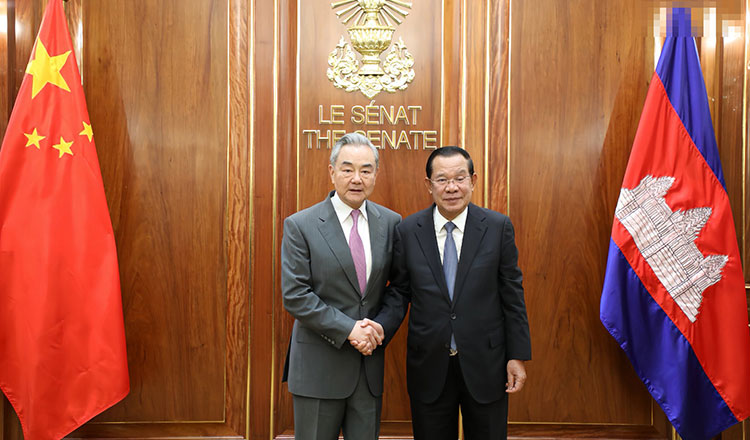 Acting Head of State of Hun Sen (R) greets Chinese Foreign Minister Wang Yi in a courtesy meeting at the Senate’s Solidarity Palace in Phnom Penh. SHS
#editorial
China is the elephant in the room. By any diplomatic measure, Cambodia’s close ties with Beijing reflect a deliberate strategic choice—one rooted in both survival and the assertion of its own agency.
Acting Head of State Hun Sen recently declared that Cambodia’s “ironclad friendship” with Beijing is “unshakeable” amid a fast changing international environment.
Prime Minister Hun Manet reaffirmed Cambodia’s commitment to further deepening comprehensive strategic partnership with China, while advancing the plan to build an all-weather community with a shared future in a new era.
This reflects solid political trust plus deeper institutional and geopolitical consolidation that is reshaping Cambodia’s foreign policy posture. In an increasingly fragmented, turbulent world, China is the most reliable strategic partner.
The launch of the Cambodia-China “2+2” strategic dialogue last week — bringing together foreign and defence ministers—marks a significant step in that direction.
This mechanism is designed to produce concrete outcomes: tighter policy coordination, enhanced defense cooperation, and more synchronised responses to regional and global challenges.
More telling is what comes next. Both sides have agreed to expand the framework into a “3+3” mechanism, incorporating internal security and law enforcement dimensions. Cambodia’s Ministry of Interior and China’s Ministry of Public Security will be included in the next round of the bilateral 3+3 meeting.
This move signals a shift from traditional diplomacy toward a more integrated approach that spans across a wide spectrum of sectors and actors. It forms the foundation to realise the “all-weather community with a shared future”.
This institutional evolution matters beyond bureaucratic design. It illustrates how Cambodia is embedding its relationship with China across multiple layers of the state, making the partnership more durable and less susceptible to political and leadership change.
The economic dimension reinforces this trajectory. Cambodia’s development strategy is increasingly intertwined with Chinese-led initiatives—from infrastructure under the Belt and Road Initiative to industrial upgrading through corridors focused on technology, agriculture, and logistics.
New areas of cooperation, including the digital economy, green development, and resilient supply chains, reflect an effort to future-proof the partnership against shifting global economic patterns.
For Cambodia, the logic is clear. China offers capital, technology, and a vast market—all essential for a lower-middle-income country seeking to climb the development ladder.
At a time when global supply chains are fragmenting and traditional development pathways are under strain, anchoring economic transformation to a reliable partner carries obvious appeal.
Deepening defence ties—including capacity building and potential defence technology transfers and development—point to a long-term effort to modernise Cambodia’s armed forces with Chinese support.
The language of an “ironclad friendship” and a “community with a shared future” emphasises mutual respect, mutual support, and mutual interests.
It is crystal clear that Chinese investment has transformed Cambodia’s infrastructure landscape and economic development, and Beijing’s political backing has provided a degree of diplomatic leverage and regime security.
As great-power competition intensifies, smaller states face increasing pressure to hedge, diversify, and maintain flexibility.
While pursuing a diversification strategy and multivector engagement approach, Cambodia’s approach leans toward consolidation—betting that a deeply institutionalised partnership with China will provide more certainty, security, and opportunities.
This is a calculated move. It may deliver accelerated development and enhanced security cooperation in the short to medium term. It may also position Cambodia as a key node in China’s regional strategy, with all the opportunities that entails.
Defence and security cooperation will gain more prominence in coming years, especially in upgrading and upscaling joint military exercises and interoperability enhancement. Military doctrine and military leadership development can be a potential area of future collaboration.
In an era defined by flux, Cambodia is anchoring itself firmly to Beijing—not just in rhetoric, but in institutions, policies, and long-term vision.
It is a trust-based, result-orientated, and people-centred cooperation and partnership building.
Closer Cambodia-China ties will also shape the evolving geopolitics and geoeconomics dynamics of Southeast Asia.
This is a defining decade—one that will shape how history judges our choices and the side we ultimately stand on.
-Khmer Times-