Justice Performed, Law Evaded: Thailand on Trial
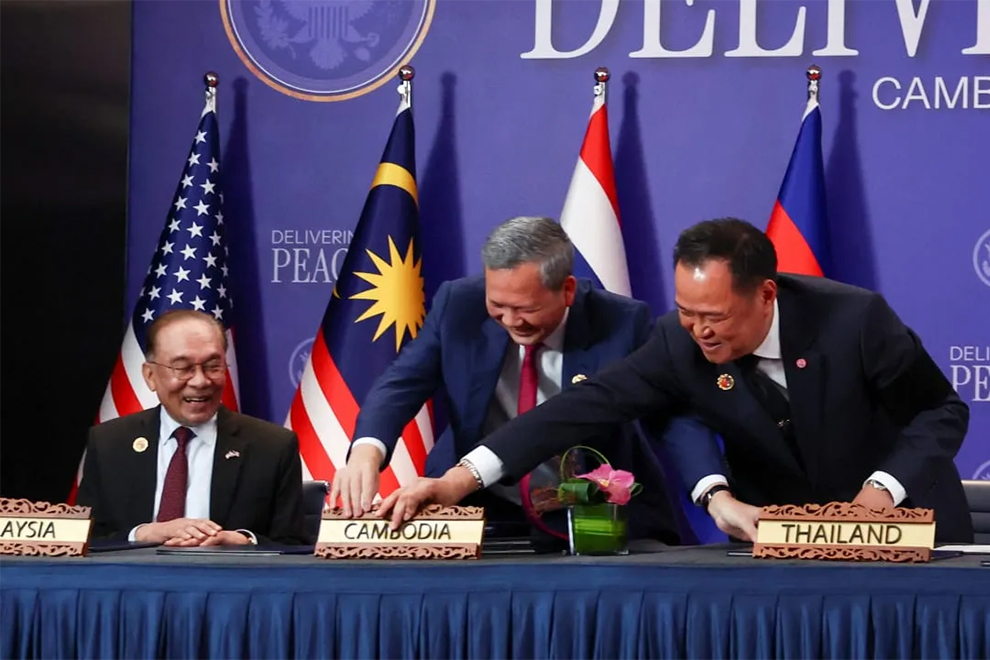 Malaysia's Prime Minister Anwar Ibrahim reacts as Thai Prime Minister Anutin Charnvirakul switches seats with Cambodian Prime Minister Hun Manet, during the Cambodia-Thailand peace deal signing, on October 26. Supplied
#opinion
International law was never intended to be decorative. It was conceived as restraint—against impulse, against myth, against power intoxicated by its own narratives. Its function is to discipline force, not to adorn it. Yet Thailand’s recent conduct toward Cambodia advances a different conception altogether: law as costume, diplomacy as stagecraft and justice as performance. In this carefully curated world, words no longer restrain power; they invert reality.
One is reminded, uncomfortably, of George Orwell’s warning that when language is corrupted, war can be sold as peace and trust dismantled long before violence begins. What follows is not confusion or error, but design — the deliberate construction of a lawless world that speaks fluently of legality while methodically rejecting its discipline.
The performance began with a pretext. Thailand accused Cambodia of planting new landmines, despite Cambodia’s sustained compliance with the Ottawa Convention and the absence of credible evidence. The allegation was never meant to be examined or resolved; it was staged as the opening charge in a self-appointed trial, calculated to manufacture urgency and moral licence for escalation. Humanitarian language became theatre, insinuations of bad faith became evidence and a treaty designed to prevent suffering was conscripted to legitimise force.
From narrative construction to legal rupture was a short step. Article 2(4) of the UN Charter — the prohibition on the threat or use of force — was treated as rhetorical rather than binding. Article 51’s narrow exception of self-defence was inflated beyond recognition, invoked in the absence of any armed attack capable of satisfying necessity or proportionality. What followed was not defence, but coercion: force deployed to instruct, intimidate and incapacitate. The Charter does not authorise wars of pretext, however carefully narrated.
What renders this episode especially revealing is the contrast it lays bare. Confronted with provocation dressed as humanitarian alarm, Cambodia did not trade narrative for narrative or grievance for grievance. It returned, deliberately, to law. It upheld ceasefires even when they were violated, honoured peace understandings even as they were eroded and engaged bilateral mechanisms in good faith. It reaffirmed the peaceful settlement of disputes, including judicial avenues long recognised as hallmarks of civilised interstate conduct. Cambodia did not fear adjudication; it submitted to it. This posture was not performative. It was juridical resolve.
Thailand, by contrast, has shown a persistent aversion to law precisely where law ceases to be pliable. Bilateral mechanisms are instrumentalised or abandoned. Judicial settlement is caricatured as destabilising, inappropriate or premature. Binding adjudication is avoided altogether. Law is welcomed as narrative, but rejected as verdict. This is not diplomacy; it is its simulation. Bad-faith engagement corrodes credibility more efficiently than open defiance ever could.
It is here that the question of civilisation must be confronted. Voltaire understood that civilisation is most loudly proclaimed where it is most insecure. States that speak incessantly of order, morality and enlightenment often do so to disguise their erosion. When legality becomes ornament rather than restraint, and diplomacy performance rather than settlement, civilisation survives only as rhetoric. It is measured not by elegance of language, but by submission to limits — especially when power is tempted to exceed them.
The human consequences of this pretextual escalation were swift and grave. Villages were encircled. Civilians were forcibly displaced. Homes and livelihoods destroyed. Cambodian soldiers were captured under conditions engaging humanitarian scrutiny. Civilians were killed and injured. Migrant workers — already living at the margins of protection — were subjected not only to harassment, but to sexual violence, including instances of joint rape perpetrated by Thai soldiers in black uniforms. Such acts constitute grave breaches of humanitarian law and flagrant violations of human rights law.
The means and methods of warfare sharpen the indictment further. Cluster munitions, toxic chemical agents and the disproportionate use of F-16s, Gripen aircraft and heavy artillery against civilian-proximate areas render invocations of precision implausible. Distinction blurred. Proportionality abandoned. Precaution forgotten. When advanced air power meets populated space, civilian harm is not an accident — it is foreseeable.
Most revealing of all were the strikes on protected cultural heritage — temples and historic sites that belong not only to Cambodia, but to humanity. These were not military objectives. They were repositories of memory, faith and civilisation, safeguarded by law precisely because they endure beyond war. To strike them is not merely unlawful; it is confessional. A state that treats humanity’s shared inheritance as expendable reveals not strategic necessity but moral collapse.
The international community has observed. Statements were issued, concerns noted and hesitation quietly took hold. This is the familiar choreography of contemporary diplomacy, where legality is acknowledged, morality lamented and interest quietly prevails. Silence is repackaged as prudence. In reality, it is acquiescence — with consequences extending well beyond this case.
Yet international law remains stubborn by design. Internationally wrongful acts carry consequences: they must cease, they must not recur and they must be repaired. Thailand’s violations are not episodic errors; they form a sustained pattern. Responsibility does not dissipate through repetition; it consolidates.
A civilised state is not one that performs justice while evading law, nor one that manufactures pretexts in the language of legality. It is one that submits to law when it constrains power and preserves trust. Cambodia has chosen law over spectacle, restraint over retaliation and settlement over intimidation. Thailand has chosen narrative over judgment. History, unlike diplomacy, does not reward performance. It records responsibility — and delivers its verdict without regard to the script.
Dara In is permanent representative of the Kingdom of Cambodia to the United Nations and other International Organisations in Geneva. The views and opinions expressed are his own.
-The Phnom Penh Post-