Cybercrime Is Global—So Why Is Cambodia Branded?
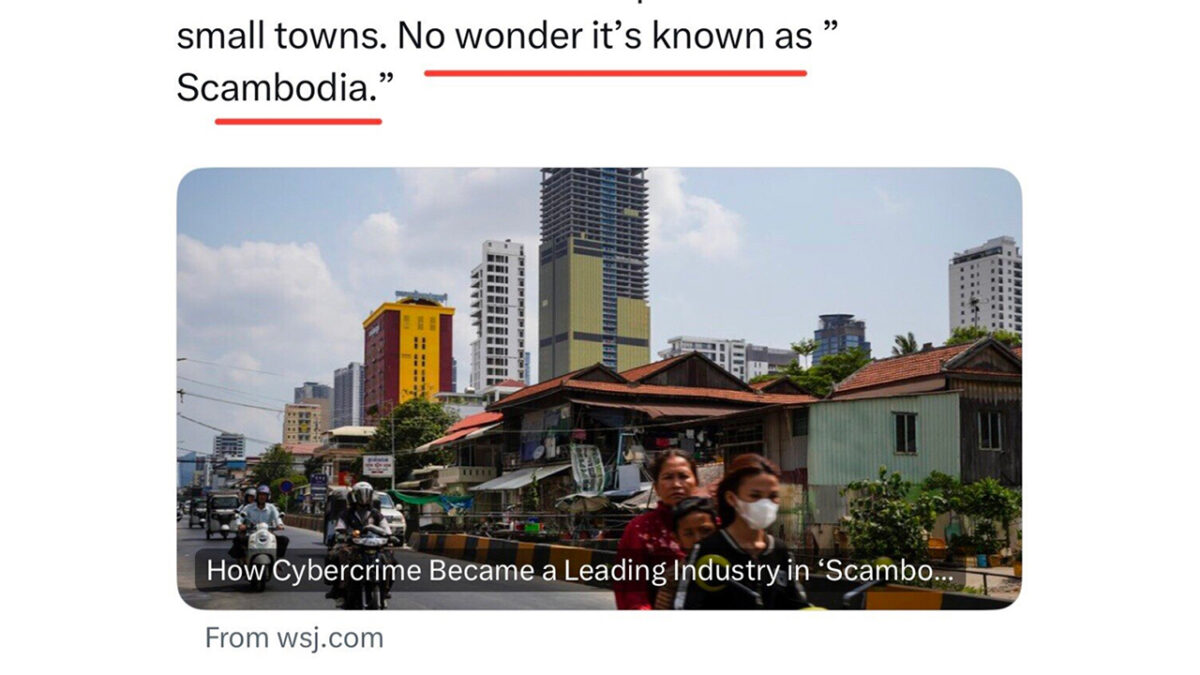 A screenshot of a Wall Street Journal post on X, describing the Kingdom as ‘Scambodia’. X
When a global publication like The Wall Street Journal chooses to label an entire country “Scambodia”, it crosses a line — from reporting into reductionism, from analysis into stigma.
This is not just a matter of tone. It is a matter of truth, responsibility and consequence.
Yes, Cambodia — like many countries in Southeast Asia — faces a serious challenge from transnational cybercrime networks. Even the WSJ acknowledges that these operations are largely run by foreign syndicates, predominantly Chinese criminal groups, exploiting trafficked labour and operating across borders.
But here is the critical point the narrative distorts: Cambodia is not the origin of this system — it is one of its battlegrounds.
A Global Crime, Selectively Framed
Cyber scams are not a “Cambodian phenomenon”. They are a regional and global criminal ecosystem, stretching across Myanmar, Laos, Thailand and beyond. International reports estimate hundreds of thousands of victims trafficked into scam networks across Southeast Asia.
Yet WSJ chooses to brand one country — Cambodia — as if it defines the entire phenomenon.
That is not analysis. That is narrative construction.
Where is the label for other jurisdictions where these networks operate? Where is the same branding for financial centres that enable money laundering?
Selective outrage is not journalism — it is framing.
The Reality They Understate
Even within its own reporting, WSJ admits several facts that undermine its own headline:
The Cambodian government has launched nationwide crackdowns, including hundreds of raids and rescues. Thousands of trafficked workers have been freed and deported. The industry is being pushed underground and disrupted, not ignored.
These are not the actions of a state that “is” cybercrime. These are the actions of a state confronting it under international pressure and evolving conditions.
Yet these efforts are buried beneath a sensational label.
From Reporting to Reputational Harm
Words matter. Especially from global platforms. Branding Cambodia as “Scambodia” does three things:
Erases complexity — reducing a sovereign nation of 17 million people to a criminal stereotype
Damages economic confidence — affecting tourism, investment, and global perception
Undermines cooperation — by alienating the very country needed to solve the problem
Even Cambodian officials have warned that this narrative is already harming the country’s image abroad.
This is not neutral reporting. It has real-world consequences.
The Ethical Failure
Serious journalism investigates. It contextualises. It distinguishes between state, society and criminal networks.
What it does not do — at least not responsibly — is rebrand a country with a slur.
“Scambodia” is not a data point.
It is a headline engineered for impact, not accuracy.
And in doing so, it risks reinforcing a dangerous precedent: That complex transnational crimes can be reduced to a single country — and a single word.
A Better Standard
Cambodia does not deny the problem. It is confronting it. But confronting cybercrime requires international cooperation, not international caricature.
If global media truly seeks solutions, it must move beyond sensational labels and toward honest analysis — one that recognises:
the transnational nature of these networks
the role of foreign criminal actors
and the ongoing enforcement efforts on the ground
Anything less is not accountability. It is distortion.
Roth Santepheap is a Phnom Penh-based geopolitical analyst. The views and opinions expressed are his own.