
Five crucial things to consider as we recall the fall of Phnom Penh
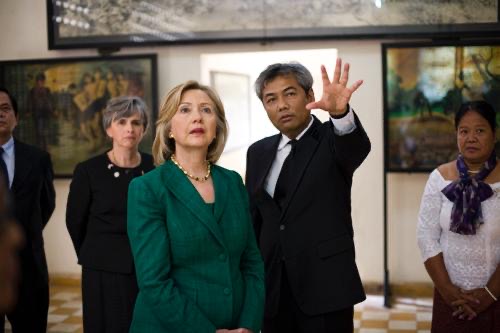 In 2010, then-US Secretary of State Hillary Clinton (left) was guided through the Toul Sleng Genocide Museum by Youk Chhang, Director of the Documentation Center of Cambodia. DC-Cam
Yesterday, April 17, marked 51 years since the Khmer Rouge took over Cambodia. As a survivor and expert witness at the Extraordinary Chambers in the Courts of Cambodia (ECCC), as well as an advocate of the processes of justice and memory, I have five reasons why we must not forget KR history and must apply the lessons we learn from it to local, regional and global contexts.
First, history tells us the story of how we have come to arrive at our present condition. We need history to show us how to improve our selves, and our family, community and nation. One cannot solve a problem unless they understand it; studying history is the beginning of all problem-solving plans.
Second, the history of the Khmer Rouge shows us the extremes of human nature, which we must also understand to improve the systems that run society. The institutions of society are essential to informing, shaping and protecting humanity not only during normal times but also under extraordinary circumstances. The history of the Khmer Rouge is a study of how a society can be destroyed, resurrected and transformed.
Third, the history of the Khmer Rouge is important for what it reveals about the human soul — both good and evil. When you listen to survivors or read about their stories, you become incredibly impacted by what they experienced. You come to understand, at least a little, why people can act so horribly with others and how heroes can emerge from hell. These stories reveal something about all of us, and what we can do on a personal level to ensure the history is never repeated.
Fourth, the history sheds light on international politics, and how the world continues to be motivated by interests and forces that are not based on the best interests of humanity. International politics and law are constantly evolving and changing, and no two events are ever caused by the same exact factors. To paraphrase Mark Twain, history may not repeat itself, but it always rhymes. We can look to the history of the Khmer Rouge as a reference to inform our strategies for current events.
Finally, the history of the Khmer Rouge is not only an educational endeavour but also an act of ensuring justice for the victims of this horrendous period. Memory precedes and supports justice. All forms of justice begin with an initial recognition of the circumstances surrounding the injustice, so in this sense teaching, sharing and studying the history of the Khmer Rouge is both an essential exercise in education but also an important act of justice.
The future of Cambodia rests on its commitment to remembering its history and for these five reasons the history of the Khmer Rouge must never be forgotten.
Youk Chhang is a survivor of the Khmer Rouge’s killing fields, director of the Documentation Center of Cambodia (DC-Cam) and ambassador to the Cabinet of His Majesty, the King of Cambodia. The views and opinions expressed are his own.
The author prepares to provide testimony to the ECCC as an expert witness, in 2012. DC-Cam
-Phnom penh Post-
In 2010, then-US Secretary of State Hillary Clinton (left) was guided through the Toul Sleng Genocide Museum by Youk Chhang, Director of the Documentation Center of Cambodia. DC-Cam