Echoes of Angkor: Decoding the Khmer Roots of Thai Provinces
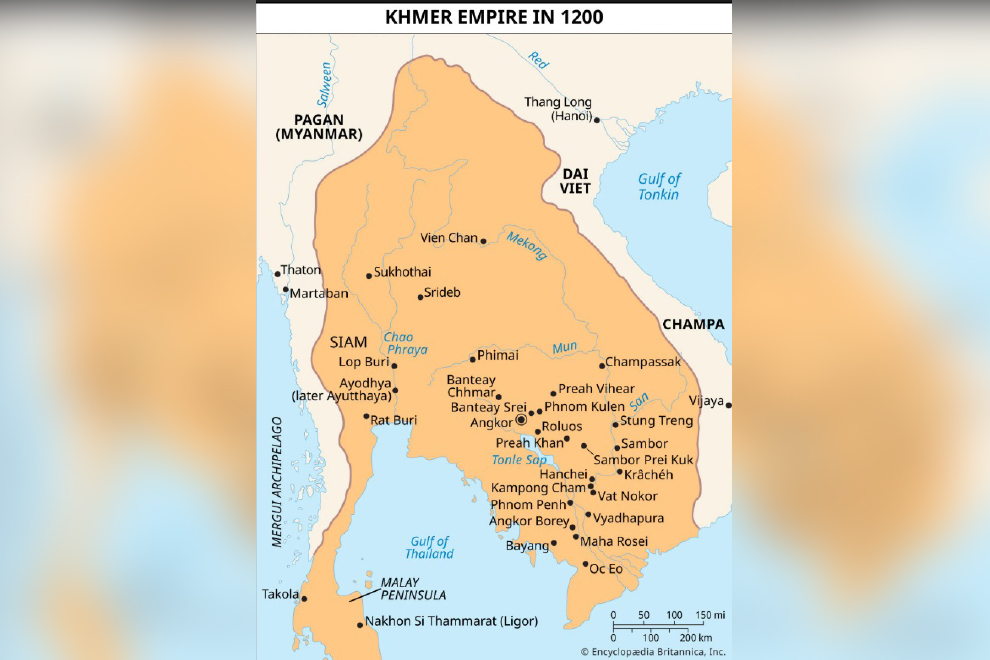 A regional map shows the extent of the Khmer Empire, in the year 1200. Britannica
#opinion
In the modern landscape of Southeast Asia, national borders often suggest sharp divides. However, beneath the surface of Thailand’s administrative map lies a linguistic “ghost map” that tells a different story. Historians and linguists estimate that between 20 to 30 Thai provinces bear names with deep Khmer roots — a silent testament to an era when the Khmer Empire was the beating heart of mainland Southeast Asia.
A Legacy Written in Stone and Soil
The prevalence of these names is no accident. During the height of the Khmer Empire (9th–15th century), vast stretches of what is now Central and Northeastern Thailand were under the direct rule or cultural hegemony of Angkor. Khmer was the language of the elite, the architects and the administrators.
When the rising Tai-speaking kingdoms of Sukhothai and Ayutthaya eventually asserted dominance, they didn’t wipe the slate clean. Instead, they adopted and adapted. These ancient titles were softened by Thai phonetics but remained structurally intact.
Decoding the Map
Many familiar Thai destinations reveal their secrets through their etymology. The linguistic DNA often follows a path from Sanskrit/Pali to Khmer, and finally into Thai:
Nakhon Ratchasima: Derived from the Khmer nokor (city).
Buriram: Rooted in borei (city/settlement).
Chanthaburi and Prachinburi: The suffix -buri mirrors the Khmer adoption of the Sanskrit pura.
Surin, Sisaket and Ubon Ratchathani: These provinces in the “Isan” region sit on the front lines of this historical fusion, where Khmer influence remained strongest for the longest period.
Two Peoples, One Shared Horizon
To understand this connection, one must look at the divergent yet intersecting paths of the two nations. The Khmer people are among the region’s oldest inhabitants, with roots in the ancient maritime power of Funan and the inland state of Chenla. By the time the Tai-speaking peoples began their southward migration from southern China (modern-day Guangxi and Yunnan) around the 13th century, Khmer civilisation had already perfected advanced irrigation and monumental architecture, epitomised by the grandeur of Angkor Wat.
As the Sukhothai and Ayutthaya kingdoms flourished, they did more than just inherit land; they inherited a sophisticated administrative and religious framework. This “cultural bridge” is why today, despite modern political boundaries, the two nations share remarkably similar traditions in dance, royalty and religion.
History as a Bridge, Not a Wall
In an era where nationalism can sometimes cloud historical clarity, scholars and responsible media outlets must emphasise the importance of accurate, balanced history.
Understanding that a province name like Lopburi or Chachoengsao is a linguistic handshake between two cultures helps dismantle old rivalries. By acknowledging these shared roots, the younger generations of both Thailand and Cambodia can view their history not as a series of conquests, but as a long-standing, interconnected journey.
Ultimately, these 30-odd names are more than just labels on a map; they are living artifacts. They remind us that while empires may rise and fall, the words we use to describe our homes can outlast the stones of the temples themselves.
Tesh Chanthorn is a Cambodian citizen who longs for peace. The views and opinions expressed are his own.
-Phnom Penh Post-
———————