Thai actions at border a ‘calculated annexation strategy’
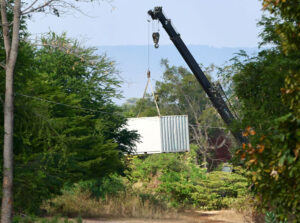
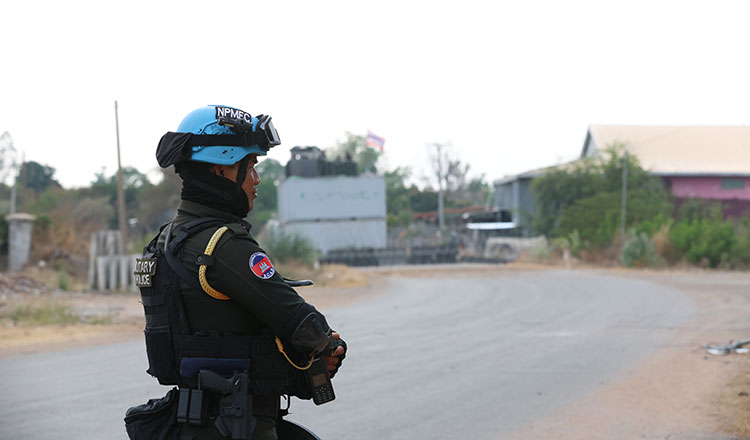 The Thai army blocks access to Cambodian villages with barbed-wire and container barricades in Banteay Meanchey province. KT/Khem Sovannara
#National
Synopsis: While over 94% of displaced Cambodians have returned home, thousands remain stuck at the camps as border tensions persist, with Phnom Penh accusing Thailand of continued encroachment and ceasefire violations.
Even though more than 94% of about 640,000 displaced Cambodians have returned home amid a fragile ceasefire between Cambodia and Thailand, experts warned that illegal Thai activities on the ground could prolong instability at the border.
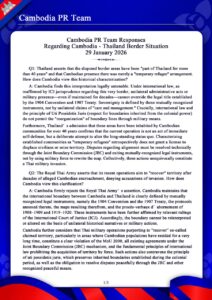
Cambodia has repeatedly urged Thailand to comply with border agreements and refrain from attempting to create “facts on the ground” after a series of delays to boundary talks. Meanwhile, Thai military and construction activities continue in areas Cambodia considers its sovereign territory.
The State Secretariat of Border Affairs has proposed convening the Cambodia-Thailand Joint Boundary Commission (JBC) five times since the start of the year. However, Bangkok has postponed each session, citing a general election and then the need to form the cabinet afterwards in February.
According to the Ministry of Interior, over 610,000 people have returned since the ceasefire took effect on December 27, 2025. However, 36,282 people remain displaced, including 18,786 women and 12,279 children, as of March 23.
The ministry reported continued disruptions to public services, with schools and health centres still closed in Oddar Meanchey, Banteay Meanchey and Preah Vihear provinces.
The ministry has accused Thailand of failing to fully adhere to the Joint Statement of the 3rd Special General Border Committee (GBC), citing continued encroachment activities.
These include the burning and destruction of homes in the Boeng Trakuon area, land clearing, road construction, and the building of concrete structures extending from the Khnar Temple area towards Ta Krabey Temple. Authorities also reported land surveying and the parcelling out of Cambodian land to Thai citizens in areas between boundary markers 46 and 47 in Banteay Meanchey province.
The government maintains that these areas fall within Cambodia’s sovereignty under the 1904 and 1907 Franco-Siamese treaties and that Thailand’s actions violate both the 2000 Memorandum of Understandiing on land boundary demarcation and the December 2025 GBC agreement.
Kin Phea, Director-General of International Relations Institute of Cambodia, said Thailand’s actions at the border reflect a calculated strategy to expand Thai presence on Cambodian soil.
“The current situation appears to be a calculated attempt to create facts on the ground. By moving military personnel into Cambodian territory post-ceasefire and subsequently settling civilians on it, Thailand is attempting a gradual annexation,” he said.
The second round of Thai military aggression against Cambodia in December saw Thai military forces occupy Cambodian territory beyond their own unilateral map, advancing deep into the Cambodian provinces of Preah Vihear, Oddar Meanchey, Banteay Meanchey and Pursat, forcing around 640,000 people to flee their homes.
As of March 23, about 5,000 people were still unable to return to their villages as their homes had either been destroyed by the Thai army or were located inside occupied areas where the Thai army has installed barricades to block their return.
Phea said the Thai military’s actions serve the domestic political interests of Thailand’s leaders, strengthening nationalist sentiment and consolidating support for the ruling Bhumjaithai Party.
Phea noted that the actions constitute a serious breach of international law.
“This is a grave violation of international law. The encroachment by Thai forces is a blatant act of aggression against Cambodia’s sovereignty and territorial integrity,” he said, noting that such behaviour contradicts the principles of the United Nations and ASEAN Charters.
He said there is no ambiguity surrounding the status of the occupied areas.
“These are not disputed zones; they are sovereign Cambodian territory,” he said, accusing Thailand of relying on unilateral maps that disregard internationally recognised boundaries.
Phea warned that the situation carries significant risks for both diplomacy and security between the two countries.
“The risk of diplomatic and military tensions remains high,”he said, adding that the border disputes are often influenced by internal political dynamics in Thailand.
To ease tensions, he called for a return to established bilateral mechanisms and legal frameworks.
To prevent further escalation, both sides—particularly Thailand—must return to the framework of existing bilateral mechanisms,” he said, referring to the 1904–1907 Franco-Siamese treaties and the 2000 Memorandum of Understanding on land boundary demarcation.
He said it is essential to maintain the status quo in undemarcated areas and halt unilateral actions to de-escalate tensions.
“The only viable and sustainable solution is for Thailand to abide by internationally recognised maps and bilateral agreements,” he said, adding that disputes should be resolved through the Joint Boundary Commission or international legal mechanisms.
Thong Mengdavid, a geopolitical analyst and Deputy Director of the China-ASEAN Studies Centre at the Cambodia University of Technology and Science, expressed caution about the new Thai government’s apparent willingness to resolve border issues.
“If we look at Thai politics now, it is more stable than during the Pheu Thai administration, and that is a good sign for both Cambodia and Thailand to resume the JBC meeting,” he said.
“However, under new Prime Minister Anutin, Thai military forces remain present in disputed areas, including villages claimed by Cambodia, reaffirming a longstanding approach aimed at asserting de facto control to strengthen Thailand’s negotiating position,” he added.
Mengdavid said such actions could improve Thailand’s position on the ground but would risk heightening tensions, complicating diplomatic mechanisms and negotiations, and further deteriorating bilateral relations.
“I am still sceptical about the new Thai government’s political will to resolve the border dispute, and it will likely remain difficult, given historical grievances, domestic nationalist pressures, and the sensitive nature of sovereignty issues, as well as Thailand’s domestic power vacuum,” he said.
Cambodia maintains its firm position on safeguarding the Cambodia-Thailand international border as established by the Franco-Siamese Boundary Commission, in accordance with international law and the principle of the inviolability of borders.
-Khmer Times-
—————-