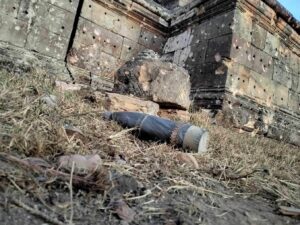
The Destruction of Preah Vihear: An Assault on International Law and Human Heritage
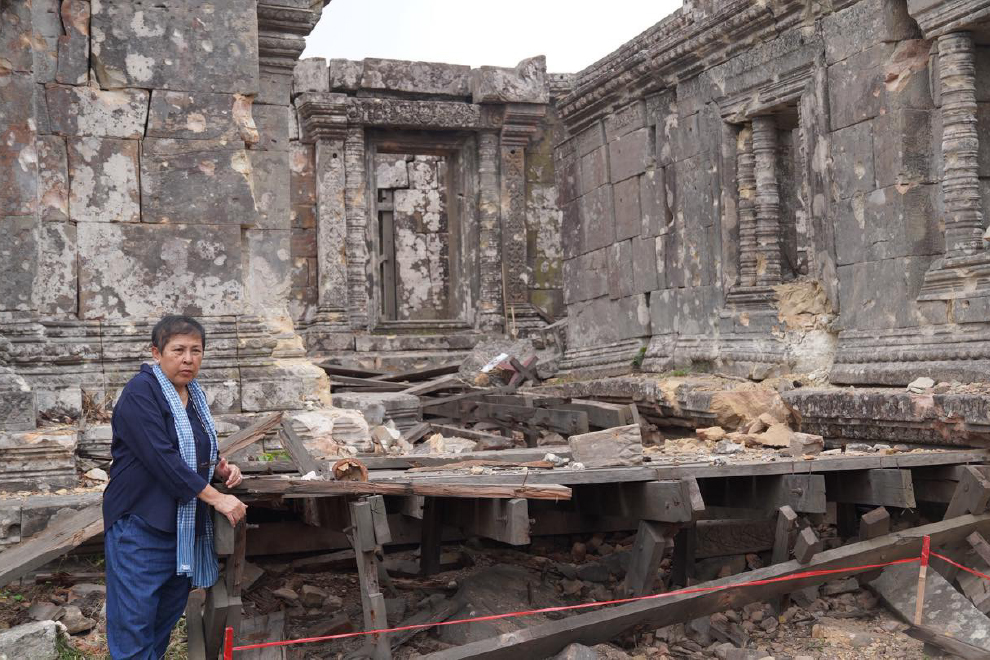 Culture minister Phoeurng Sackona visited the damaged Preah Viher Temple on March 29. NAPV
#opinion
Imagine a masterpiece that has withstood a thousand years of monsoons, shifting empires and the relentless march of time, now fracturing under the sudden, brutal weight of artillery fire. The destruction of the Preah Vihear Temple is not merely a tragic consequence of armed conflict — it is a direct violation of international law and a devastating assault on the shared cultural heritage of humanity.
Cambodia’s Minister of Culture and Fine Arts Phoeurng Sackona has recently disclosed alarming new findings that demand the immediate attention of the global community: the structural damage inflicted upon this UNESCO World Heritage site far exceeds prior assessments.
With hundreds of newly identified impact sites — surpassing the 562 locations formally recorded in 2025 — the scale of devastation is catastrophic. These are not just statistics in a heritage report; they represent shattered sanctuaries, collapsed archways and scarred masonry. This is not incidental collateral damage. It is a profound, multi-dimensional legal and cultural crisis unfolding before our eyes.
At its core, the militarisation and shelling of the Preah Vihear site constitute a material breach of binding judgments rendered by the International Court of Justice (ICJ). In its landmark 1962 decision, reaffirmed unanimously in its 2013 interpretation, the court definitively established Cambodian sovereignty over the temple and its entire promontory. It strictly mandated the withdrawal of all military and police forces from the vicinity to preserve the area as a demilitarised zone.
Under Article 94 of the UN Charter, compliance with ICJ judgments is an absolute legal obligation. The presence of armed forces and the discharge of projectiles within this judicially defined territory represent not only a violation of Cambodian sovereignty but a direct, brazen challenge to the supremacy of international law.
These hostilities concurrently tear at the fabric of international heritage law. Since its inscription on the UNESCO World Heritage List in 2008, Preah Vihear has been formally recognised as possessing “Outstanding Universal Value”, placing it under the rigorous protection of the 1972 World Heritage Convention.
This legal status imposes binding obligations erga omnes partes on states parties to ensure its safeguarding. The failure to protect the site — and, more gravely, the active targeting of it — undermines the foundation of this international legal regime, signalling a dangerous precedent where humanity’s most treasured monuments are reduced to expendable military targets.
To truly comprehend the gravity of this destruction, one must examine the architectural and historical significance of the temple itself.
Preah Vihear stands as a breathtaking masterpiece of Khmer ingenuity. Unlike typical concentric monuments, it is constructed along a staggering 800-metre north–south axis, ascending the steep cliffs of the Dângrêk Mountains.
Through a carefully orchestrated sequence of grand stairways and five monumental gopuras, the structure guides pilgrims upward, merging topography and masonry into a sanctuary perched dramatically at the cliff’s edge. The reported structural deformations, collapsed roofing and projectile damage signify the irreversible desecration of a cultural dialogue between nature and supreme human creativity that has endured for a millennium.
Because of its irreplaceable nature, such destruction irrevocably engages the severe framework of international criminal law. The intentional targeting of cultural property, when not justified by absolute military necessity, constitutes a war crime under customary international law and Article 8(2)(b)(ix) of the Rome Statute of the International Criminal Court.
Contemporary jurisprudence, grounded in the 1954 Hague Convention, affirms that the destruction of cultural heritage is not a victimless property offense. It is a calculated attack on identity, memory and dignity — an effort to erase the historical and cultural foundations of a people, with dark consequences that resonate far beyond national borders.
When military actions by Thai armed forces strike the ancient stones of Preah Vihear, they inflict a wound far deeper than physical ruin. They strike at the spiritual heartbeat of the Cambodian people. Such hostilities constitute a direct assault on their very soul, their enduring pride, and their deep ancestral love.
Yet, the tragedy bleeds beyond national borders. Preah Vihear was never intended to be a fortress of war; it is a temple for all of humanity and a sacred sanctuary of our shared history. To reduce this monument to a casualty of territorial aggression is to desecrate a universal legacy, trading the spiritual and cultural wealth of mankind for the destructive pursuits of conflict.
While international experts working within the ICC–Preah Vihear framework have rightly called for urgent stabilisation measures, structural preservation alone is an inadequate remedy for impunity. The international community must stop turning a blind eye and recognise these acts for what they objectively are: serious violations of international law demanding swift accountability.
Protecting Preah Vihear requires more than sweeping up the shattered remnants of ancient stones. It demands the rigorous enforcement of ICJ judgments, strict adherence to international treaty obligations, and a renewed, unyielding commitment to accountability under international criminal law.
The ancient stones of Preah Vihear cannot advocate for their own survival; they rely entirely on the strength of the laws we have built and the humanity we claim to uphold. If we allow the rule of law to crumble alongside these temple walls, we forfeit a piece of our collective conscience. We must stand resolute in defence of Preah Vihear, not merely as a relic of the past, but as a living testament to our enduring commitment to justice, civilisation and the sacred preservation of our shared human story.
Panhavuth Long is founder and attorney-at-law at Pan & Associates Law Firm. The views and opinions expressed are his own.
-Phnom Penh Post-
———————