Govt gathers proof to compel justice for Preah Vihear Temple damage
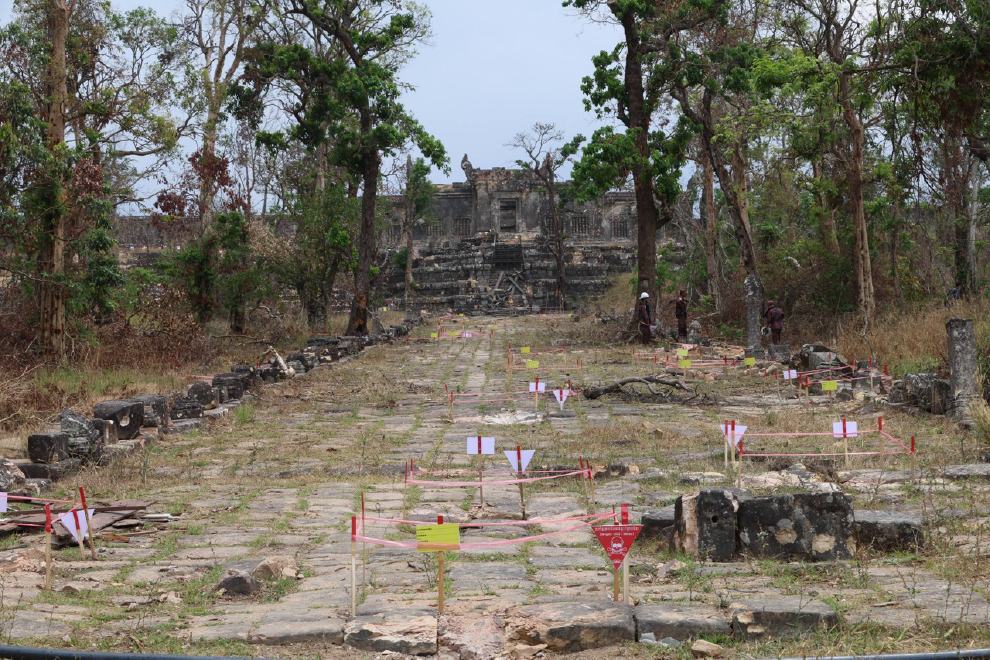 Warning markers placed at Preah Vihear Temple by CMAC deminers after the temple was heavily bombarded during the December fighting. AKP
#National
Synopsis: Experts are intensifying documentation of harm to the UNESCO World Heritage Site to support restoration and legal action, noting the effort is crucial for future deterrence and compensation.
Cambodia is intensifying efforts to document evidence of cross-border attacks by Thailand, which damaged the Preah Vihear Temple, with officials emphasising that detailed records will underpin both restoration and international legal action.
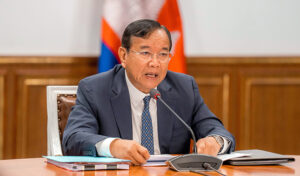
In a statement issued Monday, the Cambodia PR team said the Kingdom is prioritising evidence collection as a central pillar of its response.
“At the same time, Cambodia is implementing measures to collect, document, and preserve all evidence related to the attacks and damage caused to Preah Vihear Temple and its surrounding areas,” the statement said.
It stressed the importance of this process in both the short and long term, adding: “This evidence is crucial in supporting efforts to restore and protect cultural heritage, as well as in preventing further damage in the future.”
The statement underlined the legal significance of such documentation, noting: “It can be used to ensure accountability under international legal frameworks, including international humanitarian law and international conventions concerning the protection of cultural property.”
Cambodia framed the issue as one of global responsibility, stating: “Cambodia has affirmed that damage to a World Heritage site is a matter of global concern, as it involves the protection of the cultural heritage of humanity as a whole.”
Alongside these efforts, Cambodia has formally protested what it described as violations of its sovereignty.
“Cambodia has filed a series of formal protests against the illegal actions of Thai armed forces that have violated Cambodia’s sovereignty and territorial integrity,” the statement said.
The government said Thailand’s military actions contradicted established international rulings, saying they “run counter to the judgements of the International Court of Justice of 1962 and 2013, which clearly determined Cambodia’s sovereignty over Preah Vihear Temple and its vicinity.”
It also pointed to broader legal implications, warning that such actions are “contrary to the Hague Convention for the Protection of Cultural Property in the Event of Armed Conflict” and risk “destroying historical value and the cultural identity of all humanity”.
In reiteration, the government said it “maintains a firm stance in defending national cultural heritage and territorial sovereignty” while continuing to pursue peaceful means.
It clearly rejected the unilateral actions at the site, stating, “Cambodia does not recognise any repairs, constructions, or administrative measures carried out unilaterally and without Cambodia’s consent.”
As tensions persist along the border, Cambodia maintains that comprehensive documentation will be key not only to accountability, but also to ensuring the long-term preservation of Preah Vihear Temple.
During the armed clashes at the border last year, the 11th-century Preah Vihear Temple, a UNESCO heritage site, sustained significant damage from Thai military actions. Cambodian officials reported hundreds of affected sections and extensive damage from shelling, while Thailand claimed they were targeting Cambodian military assets positioned at the temple site.
Reports indicate 142 to 562 sections of the temple complex have been damaged. Shelling has caused structural damage to the ancient, sacred site, including impacts on stone structures and carvings. Cambodia has documented this destruction to present a preliminary assessment to UNESCO.
More recently, Cambodia filed a diplomatic complaint to protest against the “unlawful” construction activities carried out by the Thai armed forces along several sections of Cambodia’s side of the shared frontier.
The Ministry of Foreign Affairs and International Cooperation said that between February 23 and 25, Thai military personnel and workers conducted construction and excavation work on the promontory of the Preah Vihear Temple. They were reported to be building a guard post and a road leading towards the temple, an act described by MFAIC as a violation of Cambodia’s sovereignty and territorial integrity.
The ICJ ruled in 1962 and reaffirmed in 2013 that the temple and its entire promontory are on Cambodian territory, obligating Thailand to withdraw forces and protect the site.
Phnom Penh said last year’s activities were carried out of those rulings.
Thong Mengdavid, a lecturer at the Institute for International Studies and Public Policy, urged Cambodia to remain cautious even during this peaceful time, standing by its military defence while continuing to pursue diplomatic resolution and compensation.
“Bilateral mechanisms, such as JBC, must be carried on as the two countries are working on restoring their relations, but the international ones, particularly filing a case at the ICJ, must also be done to ensure justice and compensation for Cambodia,” he said.
Social Sciences and International Relations Dean at the Pannasastra University of Cambodia, Kevin Nauen told Khmer Times that while Cambodia’s compilation of evidence and documentation of events may not determine the outcome or sway Thailand’s actions, it is important for the long term, especially if Cambodia is seeking compensation
“I do think it’s important to maintain a historical record and uphold international legitimacy. In the short term, it’s unlikely to have a major effect,” he said.
Nauen said Cambodia is unlikely to be able to regain territory currently occupied by Thai forces in the short term.
“Thailand will likely establish a defensive line around the areas it controls and will not return them easily. So again, this is a long-term issue,” he said.
Still, he suggested Cambodia continue presenting its evidence, since the Kingdom needs to develop itself independently over time.
“I think Cambodia’s diplomacy is on the right track. The Prime Minister is taking a firm but measured approach,” Nauen said.
“It’s important to remember that elements within the Thai military may be looking for justification to initiate hostilities again. That would serve their interests—larger budgets and reinforcing a strong nationalist ideology within the military.”
-Khmer Times-
—————-