Cartographic Revisionism and the Erosion of Legal Frameworks: Assessing the Post-2025 Border Paradigm
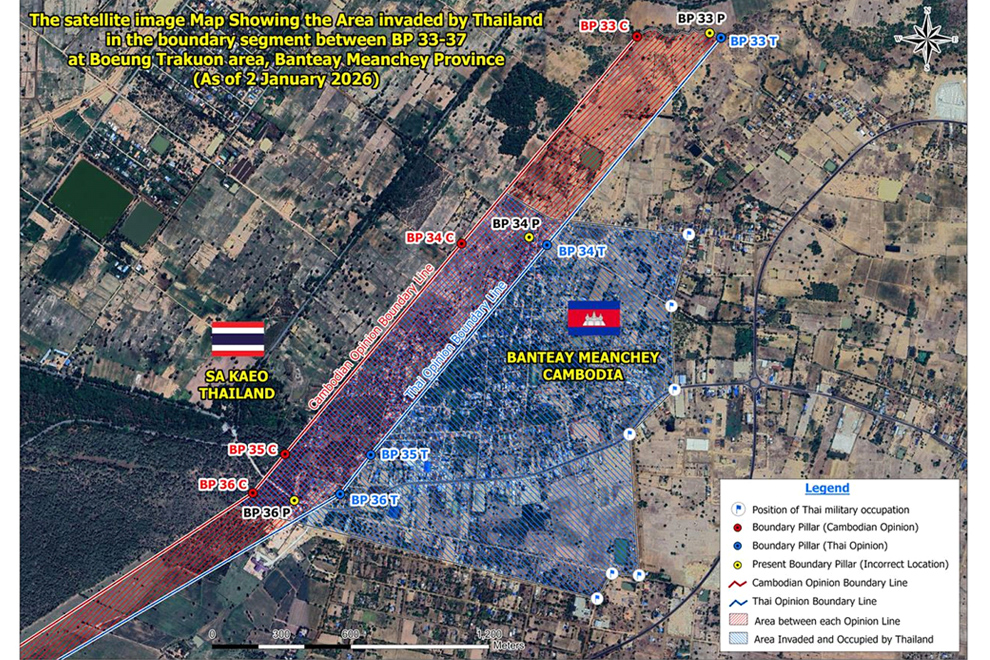 This map illustrates the contrasting claims of the two neighbouring Kingdoms, and highlights Thailand’s occupation of Cambodian land. Supplied
#opinion
The architecture of international boundary dispute resolution relies fundamentally on legal consistency, historical precedent and mutual adherence to signed agreements. For decades, the border delimitation process between Cambodia and Thailand was anchored in these principles. However, the diplomatic landscape following the December 27, 2025, Peace Declaration has introduced a concerning pivot.
By retreating from the long-established 1:200,000 Franco-Siamese maps and attempting to unilaterally impose a newly drafted bilateral map, Thailand is not merely altering its negotiating stance; it is challenging the bedrock of international legal doctrines that have historically governed the region.
Here is a legal and geopolitical analysis of this cartographic shift and its implications for bilateral stability.
The Historical Baseline: The 2000 MoU and the 1:200,000 Maps
To understand the severity of the current diplomatic pivot, one must first look at the preceding legal framework. The Memorandum of Understanding (MoU) signed in 2000 served as the definitive roadmap for boundary demarcation.
Crucially, under this MoU, both nations formally recognised the 1:200,000 Franco-Siamese maps (originally drawn between 1904 and 1907) as the binding technical documents guiding the work of the Joint Boundary Commission (JBC) and the General Border Committee (GBC).
Legal Precedent: This acceptance was not a mere diplomatic courtesy; it was a reflection of established international jurisprudence, heavily influenced by the 1962 International Court of Justice (ICJ) ruling regarding the Temple of Preah Vihear, which validated the 1:200,000 map’s authority.
Procedural Foundation: For nearly a quarter-century, the 1:200,000 maps provided a shared, objective reality. They were the singular metric by which overlapping claims were measured and resolved.
The 2025 Peace Declaration: Weaponising the “Status Quo”
The 27 December 2025 Peace Declaration, which concluded the recent border friction, was intended to freeze hostilities and establish a “status quo.” In diplomatic terms, a status quo clause is designed to prevent either party from taking actions that alter the situation on the ground while negotiations are pending.
However, geopolitical actions in early 2026 suggest a reinterpretation of this concept. Rather than maintaining the legal status quo established by the 2000 MoU, Bangkok appears to be leveraging the physical status quo of the ceasefire to discard the Franco-Siamese maps entirely.
By insisting upon and attempting to unilaterally impose a newly conceived bilateral map, the strategy shifts from mutual demarcation to cartographic imposition. This raises several immediate legal red flags:
The Principle of Estoppel: In international law, the doctrine of estoppel prevents a state from taking a legal position that contradicts its previous consistent conduct, especially if another state has relied on that conduct. Having officially recognized the 1:200,000 maps via the 2000 MoU and decades of JBC technical meetings, Thailand is legally estopped from suddenly claiming these maps are invalid or inapplicable.
Pacta Sunt Servanda: The Vienna Convention on the Law of Treaties codifies the principle of pacta sunt servanda—agreements must be kept. A unilateral withdrawal from the foundational terms of the 2000 MoU, without mutual consent, fractures the binding nature of bilateral treaties.
The Danger of Unilateral Cartography: Bilateral boundaries cannot be delimited unilaterally. The imposition of a domestic or newly drawn bilateral map that lacks the historical and legal backing of the Franco-Siamese treaties is legally void under international frameworks. It attempts to replace an objective, historically verified document with a subjective, politically motivated one.
The Chameleon State: Fractured Leadership and Domestic Drivers
To understand Bangkok’s current cartographic revisionism, one must look beyond the physical border and examine the deeply fractured nature of Thai domestic politics. Neither before nor after the 2025 conflict has Thailand exhibited a cohesive, unified leadership apparatus regarding its bilateral relations with Cambodia. Instead, the Thai state has operated much like a geopolitical chameleon, rapidly altering its diplomatic and military posture to survive internal power struggles.
The initial descent into armed conflict in mid-2025 was less a product of deliberate strategic calculus than the result of a profound domestic political vacuum in Bangkok. When the civilian leadership stumbled — highlighted by the domestic fallout and political realignments following leaked communications between former Premier Paetongtarn Shinawatra and Cambodian elites — ultranationalist factions and the military establishment quickly filled the void, weaponising border sovereignty to bolster their own institutional legitimacy.
This reactive, disjointed approach has seamlessly transitioned into the post-war era. The sudden rejection of the established 1:200,000 Franco-Siamese maps is not born from a cohesive legal strategy, but rather serves as a populist manoeuvre designed to placate domestic hardliners. When a nation’s foreign policy is held hostage by its leaders’ need for domestic political survival, international agreements become expendable, and the state’s diplomatic word becomes as changeable as its internal political climate.
Geopolitical Ramifications
The shift from mutual reliance on the 1:200,000 maps to the unilateral push for a new map creates a dangerous geopolitical precedent, extending beyond the immediate border:
Erosion of Trust: Boundary commissions require absolute trust in the foundational documents. If agreed-upon maps can be discarded post-conflict, the utility of any future MoU is deeply compromised.
Prolonged Instability: By rejecting the legal baseline, the delimitation process is thrown back to square one. This ensures that the border will remain a latent flashpoint, vulnerable to domestic political posturing in either nation.
Regional Implications: For ASEAN, which relies on the peaceful, legally sound resolution of disputes among its member states, the abandonment of established treaty maps in favour of unilateral impositions weakens the regional commitment to a rules-based order.
Conclusion
The 27 December 2025 Peace Declaration was meant to be a bridge back to the negotiating table, not a mechanism to rewrite the rules of the table itself. True “status quo” means adhering to the legal agreements and technical documents that predated the conflict.
For the work of the JBC to resume effectively and for lasting peace to take root, there must be a return to the agreed-upon frameworks. Diplomatic normalisation cannot be achieved through cartographic revisionism. The 1:200,000 Franco-Siamese maps remain the only legally viable, historically sound and internationally recognised foundation for demarcating the border. Unilateral attempts to discard them will yield nothing but legal gridlock and perpetual geopolitical friction.
Panhavuth Long is founder and attorney-at-law at Pan & Associates Law Firm. The views and opinions expressed are his own.
-Phnom Penh Post-
———————