Thai foreign minister baulks at Hun Manet’s occupation remarks
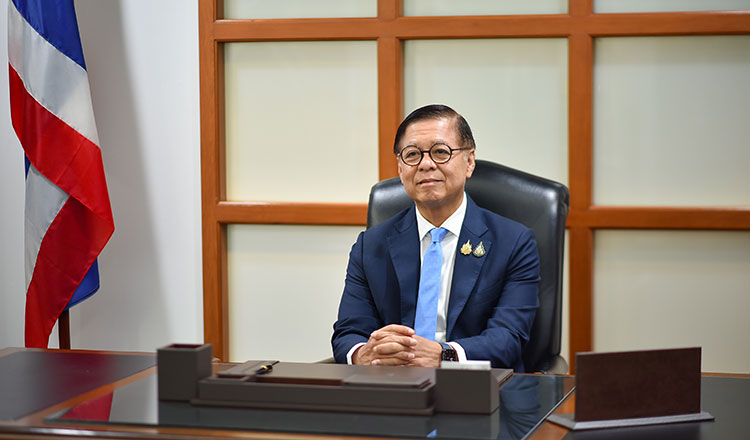 Thai Foreign Minister Sihasak Phuangketkeow says Thailand is committed to the ceasefire with Cambodia. Ministry of Foreign Affairs of Thailand
#National
Synopsis: Sihasak Phuangketkeow acknowledges fragility of ceasefire, says Bangkok is committed to de-escalation.
Thailand’s Foreign Minister Sihasak Phuangketkeow has rejected Prime Minister Hun Manet’s claims that Thai forces are occupying Cambodian land, insisting the ceasefire remains intact, while urging de-escalation and dialogue. However, Phnom Penh shot back with claims of sovereignty violations by Bangkok, which has precipitated large-scale displacement along the contested border.
Speaking in a recent interview with France 24’s flagship programme Tête-à-Tête, Sihasak said the ceasefire signed in late December remains fragile, but insisted that Thailand is committed to avoiding further escalation.
“We have reached a ceasefire agreement. But the fact is that the ceasefire is still fragile,” he said. “At this moment in time, we have to work to de-escalate the situation and try to build up trust and confidence so that we can move forward in our relationship.”
The remarks came in response to recent statements given to both Reuters and Fox News by Mr Hun Manet, who claimed that Thai troops had placed shipping containers and barbed wire inside areas previously recognised as Cambodian territory and that Thailand continues to occupy land beyond what Cambodia considers the legitimate boundary line.
Sihasak dismissed the accusations, arguing that under the terms of the ceasefire both sides agreed that troops would remain in their current positions pending further negotiations on boundary demarcation.
“The fact is that we agreed as part of the ceasefire that our troops would stay where they are,” he said. “In areas where we have placed barbed wire or containers, these are areas that are within Thai territory, areas that they have encroached into Thai territory for quite some time.”
He also pointed to historical complexities dating back to the Cambodian conflict era, when Thailand opened its borders to hundreds of thousands of Cambodian refugees. According to the Thai minister, some villagers did not return to their original areas after peace was restored, contributing to present-day disputes over land.
“I think we have to really look at the facts,” Sihasak said. “Right now, we have to work to avoid escalation, avoid acts of provocation, avoid misinformation and disinformation, and keep things calm.”
Asked about campaign promises by Thai Prime Minister Anutin Charnvirakul—including a pledge to take a strong stance on Cambodia and potentially build a border wall—Sihasak said Thailand would take necessary measures to defend its sovereignty and territorial integrity.
“We have to do what we must to defend our sovereignty and territorial integrity,” he said, adding that preventive actions in certain areas may be required “to avoid certain encroachments.”
However, he suggested that future steps would depend on Cambodia’s approach. “It depends very much on the attitude of the Cambodian side—whether they really want to pursue peace with Thailand or whether they still want to pursue the path of conflict.”
Sihasak accused Phnom Penh of “internationalising the conflict” and making claims that he said risk pushing relations backward rather than forward.
Despite the tensions, the Thai foreign minister said communication channels remain open between the two governments.
“I’m on WhatsApp with the Cambodian foreign minister,” he revealed, stressing that regular contact is crucial to avoiding misunderstandings that could ignite renewed conflict.
Thailand is currently in the process of forming a new government following recent elections, and Sihasak said some issues raised by Cambodia would need to wait until the new administration is fully established.
“In the meantime, let’s try to keep things calm,” he said. “Further conflict means more losses. I don’t think that’s in the interest of our two countries.”
The interview also touched on a recent maritime incident in which Cambodia accused the Thai navy of intercepting three of its citizens in Cambodian waters. Thailand maintains that the individuals were apprehended within Thai territorial waters.
“If they intrude in Thai territory, they have to take action,” Sihasak said, rejecting Cambodia’s version of events.
He described what he called a pattern of Cambodia portraying Thailand as the aggressor for domestic political reasons, while emphasising Bangkok’s diplomatic tradition.
“Thailand is a country that prides itself on a long tradition of diplomacy,” he said. “We believe in diplomacy.”
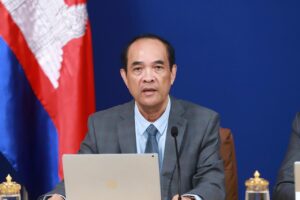
However, a Cambodian government spokesman in a press briefing yesterday defended the statement made by Prime Minister Hun Manet and other reports brought by Cambodian diplomats to foreign delegations and international organisations. He described them as part of efforts by the Cambodian government to protect its sovereignty and territorial integrity as well as its people.
“The Ministry of Foreign Affairs and International Cooperation often holds meetings with foreign missions and international organisation representatives to give updates on the situation along the Cambodia-Thailand border,” he said.
“Cambodia’s missions abroad have also been engaging actively in diplomatic activities to allow friendly countries and the international community and the legitimate stance of Cambodia for a peaceful resolution in accordance with international law.”
It is also in France where such an engagement by a Cambodian diplomat occurred. While speaking during the Governing Board Meeting of the Francophonie Fund for Women and Girls yesterday, Cambodia’s Ambassador to France Luy David highlighted the severe humanitarian impact of the border situation on civilians, particularly women and children.
The meeting was chaired by Louise Mushikiwabo, Secretary-General of the International Organization of La Francophonie (OIF), and reviewed the results of the Francophonie Fund for Women and Girls for its sixth year of implementation in 2025, while also discussing strategic orientations for 2026.
“Cambodian women are in a vulnerable situation in the context of the Cambodia-Thailand border conflict, caused by the placement of containers, barbed wire installations and the destruction of civilian homes by Thai forces in areas they have occupied within Cambodia’s sovereignty,” David said in his intervention.
He noted that more than 60,000 Cambodian displaced persons—including women and girls—have been unable to return to their homes or resume their livelihoods.
During the discussions, Cambodia urged the OIF to prioritise projects supporting displaced women and girls, with a focus on strengthening their resilience and economic autonomy.
According to a press release by the Ministry of Interior, as of February 23, more than 640,000 citizens had been displaced due to the border conflict. Of those, 66,628 people—including 35,099 women and 21,971 children—remain unable to return home.
-Khmer Times-
—————-