CMAA warns against ‘unilateral’ conclusions over border mine discoveries
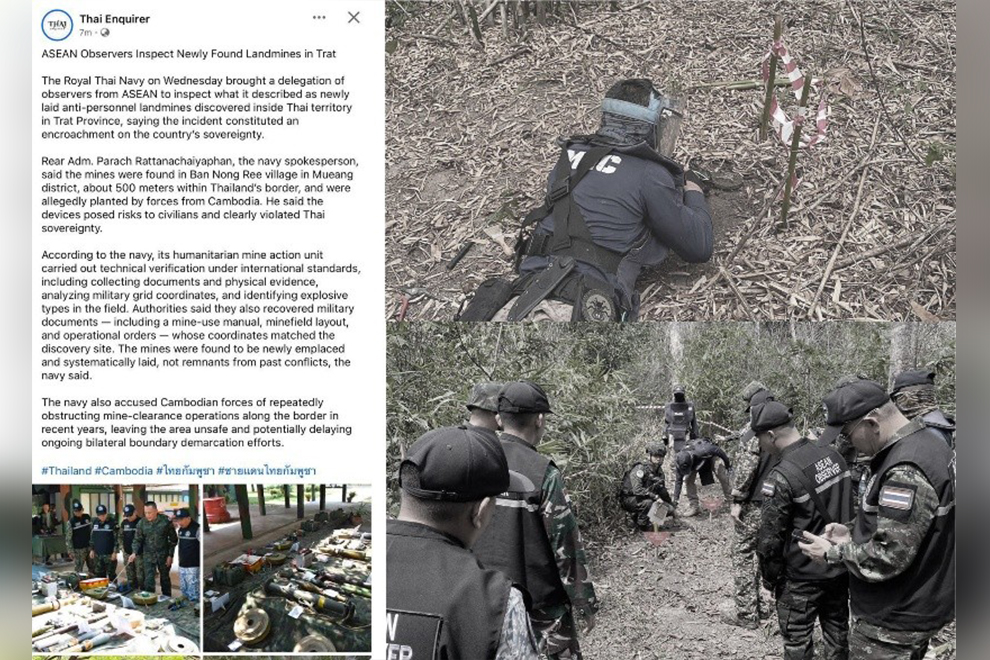 On February 26, the Cambodian Mine Action and Victim Assistance Authority (CMAA) warned against a unilateral report which named unilateral conclusions on anti-personnel mine discoveries along the Cambodia–Thailand border. FB
#National.
The Cambodian Mine Action and Victim Assistance Authority (CMAA) issued a February 26 caution against what it described as “unilateral conclusions” regarding the discovery of anti-personnel mines along the Cambodia–Thailand border, insisting that any findings must be subject to joint technical verification and handled in a transparent and professional manner.
In a statement, the CMAA stressed that reporting on newly discovered anti-personnel mines in border areas “deserving careful, objective and responsible handling”, amid heightened sensitivities following recent discoveries.
The authority reaffirmed that Cambodia remains fully committed to its obligations under the 1997 Ottawa Convention, formally known as the Anti-Personnel Mine Ban Convention, and categorically denied laying new anti-personnel mines.
“Cambodia remains fully committed to its obligations under the Ottawa Convention. We have not laid new anti-personnel mines,” the statement said, describing the government’s position as “consistent, transparent, and unequivocal”.
The CMAA noted that large stretches of the border areas between Cambodia and Thailand remain historically contaminated due to decades of armed conflict.
Legacy mines and other explosive remnants of war (ERMs), it said, continue to be discovered on both sides of the frontier.
“This unfortunate reality underscores the importance of sustained clearance efforts and constructive bilateral cooperation,” the authority stated.
Without directly naming specific incidents, the CMAA criticized what it characterised as unilateral actions by Thai authorities in preserving evidence, conducting investigations, determining findings, and publicly presenting conclusions related to the mine discoveries.
“Such actions cannot, by their nature, be considered definitive or representative of established facts,” it said.
“Matters of this sensitivity require joint technical verification conducted in a transparent, professional and cooperative manner” it added.
The CMAA emphasised that if concerns arise, the appropriate course of action would be the establishment of a jointly agreed mechanism for technical assessment and verification.
It reiterated Cambodia’s readiness to cooperate constructively to clarify any situation, with civilian safety as the top priority.
“Mine action should never be politicized. It is fundamentally about saving lives, reducing humanitarian risks and advancing peace and mutual trust,” the authority said.
Cambodia is one of the countries most affected by landmines and explosive remnants of war, a legacy of prolonged conflicts that ended in the late 1990s.
Over the past decades, the Kingdom has made significant progress in mine clearance and victim assistance, and has repeatedly highlighted its commitment to meeting international obligations under the Ottawa Convention.
The latest statement signals Phnom Penh’s determination to frame the issue as a technical and humanitarian matter rather than a political dispute, while urging cooperation to ensure a safe, stable and clearly demarcated border.
-Phnom Penh Post-
———————