Cambodia rejects Thai claim over Tamoan Temple Complex
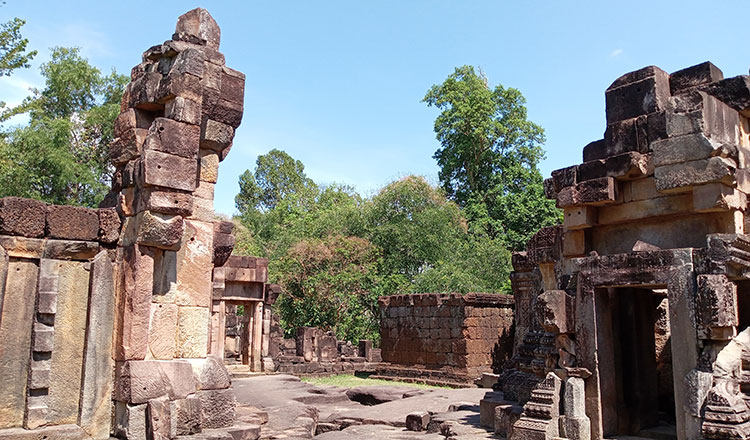 Photo: The Tamoan Temple Complex. KT/Van Roeun
#National
Synopsis: Phnom Penh declares Bangkok’s claim over the Tamoan Temples Complex void under international law, condemning unilateral territorial assertions and urging peaceful resolution through the International Court of Justice.
Cambodia has repudiated Thailand’s claim over the Tamoan Temple Complex, saying it violates international law, as tensions along the border with Thailand continue.
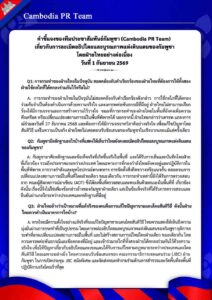
In a response on Tuesday by the Cambodia PR Team, Phnom Penh dismissed the assertions of Thailand’s Joint Information Center that the temple complex was legally registered as Thai property.
Cambodia said that any such registration holds no legal standing, as it contradicts the Franco–Siamese Treaty of 1907 and the Procès-verbaux of Abornement of 1908–1909 and 1919–1920, which definitively place the Tamoan Temples Complex within Cambodian territory.
“The claimed registration is superseded by treaty-based boundaries and therefore has no legal effect under international law,” the statement said.
Cambodia further cited the 1907 treaty-based 1:200,000 boundary map, jointly recognised historical demarcation records, and Cambodia’s official listing of the site in its National Inventory of Cultural Heritage as evidence confirming the temples’ location in Oddar Meanchey province. The PR Team rejected Thailand’s reliance on unilateral 1:50,000-scale maps, saying that they lack legal authority and cannot override internationally recognised agreements.
Phnom Penh reaffirmed its official position that the Tamoan Temples Complex falls under Cambodian sovereignty and declared all unilateral Thai claims “legally null and void”. Cambodia also called for a peaceful resolution of the row through the International Court of Justice (ICJ), stressing that the use of force or unilateral administrative measures contradict international legal principles.
“The reliance on unilateral maps and the forceful occupation of territory directly contradict international law and warrant international legal scrutiny,” the statement added, emphasising the cultural and spiritual significance of the ancient site to the Cambodian people.
On Thailand’s assertion that its troop presence near the border constitutes a “de-escalation measure” under Paragraph 2 of a joint bilateral statement, Cambodia said de-escalation cannot be interpreted as actions that entrench military positions or obstruct civilian life. The statement referred to the 1962 ICJ ruling and the doctrine of Uti Possidetis Juris, which upholds inherited colonial-era boundaries.
Cambodia accused Thai forces of erecting physical barriers, including shipping containers and barbed wire, in areas such as Chouk Chey, Prey Chan, Boeung Trakuon, and the Thmor Da International Point of Entry. According to Phnom Penh, these obstacles undermine Paragraph 4 of the joint statement, which guarantees the safe and unobstructed return of displaced civilians.
“The erection of new barriers after the ceasefire alters the status quo and prevents over 100,000 displaced persons from returning to their homes,” the PR Team said, urging Thailand to adopt a holistic implementation of existing agreements that prioritises civilian normalcy rather than military consolidation.
Cambodia reiterated its commitment to the full implementation of the July 28, 2025 ceasefire agreement, the Kuala Lumpur Joint Declaration of October 26, 2025, and the Special GBC Statement of December 27, 2025. Phnom Penh maintained that borders must not be changed by force and called for confidence-building measures, including the removal of barriers and the resumption of normal administrative functions along the border.
Kin Phea, Director-General of the International Relations Institute of Cambodia, described Thailand’s act as not only illegitimate territorial seizure but also “cultural theft”.
“When it comes to the territories, Cambodia and Thailand have to strictly follow the bilateral agreements that both nations have accepted as well as other international mechanisms,” he said.
-Khmer Times-