Khmer Rouge survivors tell their stories 47 years later
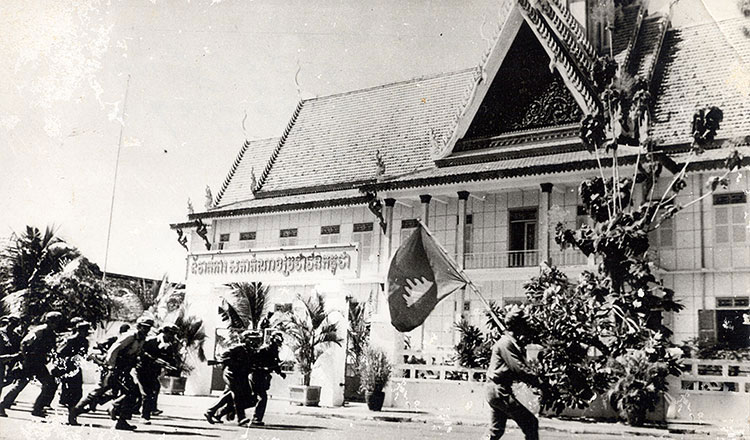 Kampuchean United Front for National Salvation holds the Cambodian flag in front of the Kampuchean People’s Representative Assembly in Phnom Penh in January, 1979. DC-Cambodia
#National
Synopsis: Survivors recall January 7, 1979: Phnom Penh’s liberation, the return of freedom, and the city’s rebirth after Khmer Rouge rule.
“Oh! Phnom Penh, Three years I’ve missed you without a moment of ease. I’ve parted from you with unbearable pain.
The enemy intended to cut off our bond…”
The song begins, and its words hang heavy —a melody of longing and pain. For Cambodians who lived through the Khmer Rouge era, Oh! Phnom Penh Euy is not just a song remembered by the elderly; it is a memory imbued with suffering. The music connects the city to the countless lives interrupted, displaced, and scarred by over three years of unimaginable hardship.
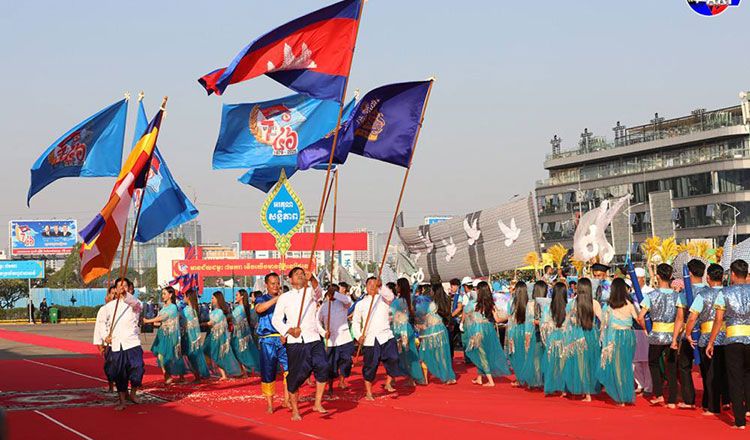
Today marks the 47th anniversary of the fall of the Khmer Rouge on January 7, 1979. For survivors of the brutal regime, it is a day of immense joy and renewal.
For Tim Many, veteran novelist, the song is more than a reminder of Phnom Penh—it is a reminder that he is alive.
“When I listen to this song,” he says quietly, “I remember how joyful life was in Phnom Penh. We were students. We were happy. Then everything turned to darkness.”
Many was born in 1946 and grew up in Phnom Penh during a period when the capital was alive with opportunities. He completed his bachelor’s degree and was preparing to pursue a master’s in May 1975. His future, like that of many young Cambodians at the time, seemed secure — until April 17, 1975.
On that day, Khmer Rouge forces entered Phnom Penh, ordering the entire population to evacuate the city. Many, along with millions of others, was forced to leave behind his home and his education. He was sent to Region 5, near the Trapaing Thmar reservoir—an area that once belonged to Battambang province and is now part of Banteay Meanchey.
“I had to pretend I had no education,” he recalls. “If they knew you were educated, you could disappear.”
“I woke up at three in the morning,” he continues. “We dug soil from before dawn until the afternoon just to earn food.”
At night, when everything was quiet, he says, “I used to always think: if one day someone comes to liberate us from this slavery, from this prison without walls, how happy it would be.”
When the Khmer Rouge regime collapsed in January 1979, that imagined and hoped-for day finally arrived.
“If there were no January 7,” he says firmly, “I would not be alive today.”
After the regime fell, he tried to survive in Thmar Puok district, Banteay Meanchey, working for others. But exploitation followed him even there. When his money was taken and the abuse became unbearable, he made a dangerous decision: in September 1979, he secretly fled back to Phnom Penh.
When he reached his old house, the city he loved felt unfamiliar.
“When we left in 1975, everything was still intact,” he says. “But when I returned at the end of 1979, Phnom Penh was silent. Empty. It was no longer the city I remembered.”
The song captures a city that endured, a nation that endured. “Phnom Penh, the heart and soul of Cambodia… preserving a rich history of bravery,” it sings.
Not everyone who remembers January 7 lived in Phnom Penh before 1975. Some arrived later, drawn by signs of life slowly returning.
Mean Samnang, now 81, sits in the hall of a pagoda in Phnom Penh, wearing a white shirt and glasses. Before the era, he lived in Kampong Cham province and frequently travelled between the province and Phnom Penh for business.
“I heard this song from the very first year it was released, right after the Pol Pot regime collapsed. When I heard it, it was amazing. It felt like we could rebuild the nation again,” he says.
In 1984, Samnang moved permanently to Phnom Penh. When he arrived, he saw that people could travel freely once more. Roads, bridges, and development had begun.
Comparing past and present, he sees dramatic change.
“Today is completely different—100 to 1,000 times more developed,” he says. “There are jobs, technology, electricity, vehicles, boats, and development we never imagined before.”
Still, his memory of January 7 is complex.
“It reminds me that Cambodia regained independence,” he says, “but not complete independence yet. The war continued because the Khmer Rouge still existed in some areas.”
Ung Sayean, 77, remembers April 17, 1975 with painful clarity. She was at home when Khmer Rouge soldiers arrived before dawn.
“It was around five in the morning,” she says. “I don’t know how long since the Khmer Rouge arrived. When I opened my door, the village was silent. They called us ‘Comrades’ and ordered us to pack a small bag and leave our homes.”
During the era, she recalls: “There was no day without work. If we pretended to be sick, we were not allowed to eat. Only by working could we have food. And when we were sick, there was no medicine.”
Yet even then, there was still a glimmer of hope. “We used to encourage each other: we won’t live like this forever. Someone will come to liberate us.”
When the regime collapsed, the feeling was overwhelming.
“I was happy and emotional,” she said. “I never thought I would see the bright world again. I thought I would live in darkness forever.”
For Ny Phally, now 75, January 7 carries mixed emotions. She lived in Kampong Cham and had visited Phnom Penh before the war. During the Pol Pot era, she remained in Chamkar Leu district and moved to Phnom Penh in 1985.
“Back then, whether in Phnom Penh or Kampong Cham, the country was developed. We had food. Life was easier.”
She lost her husband during the Khmer Rouge regime, which ruled Cambodia from 1975 to 1979.
For her, January 7 holds a simple meaning: “It is the day freedom returned.”
Oh! Phnom Penh Euy was written at the exact moment a city began to breathe again. Composed immediately after Phnom Penh was liberated on January 7, 1979, its words captured what millions of Cambodians could not yet say aloud, and grief for what was lost, longing for what was taken, and disbelief that survival was possible.
For historians of Cambodia, the events of January 7 are more than a date on the calendar.
Youk Chhang, Director of the Documentation Center of Cambodia (DC-Cam) and a survivor of the Khmer Rouge regime, says there is no Cambodian family, community, or institution that was not affected in that dark era.
Youk adds that, even decades later, the shadows of the Khmer Rouge still touch every Cambodian family.
January 7, 1979 marked the fall of the Khmer Rouge regime and the return of Phnom Penh to the Cambodian people. This day is commemorated as Liberation Day in Cambodia.
More than four decades later, Oh! Phnom Penh Euy continues to echo across generations — not just as a song, but as a memory.
Many survivors say that January 7 is not just history. It is life, returned.
“If there were no January 7, I would not be alive today,” Novelist Many says again, slowly. “January 7 is my second birthday. I remember it every year. Without January 7, I would not have children, grandchildren, or a future.”
-Khmer Times-
–
–