Borders, broken promises and the urgent need for respecting international law
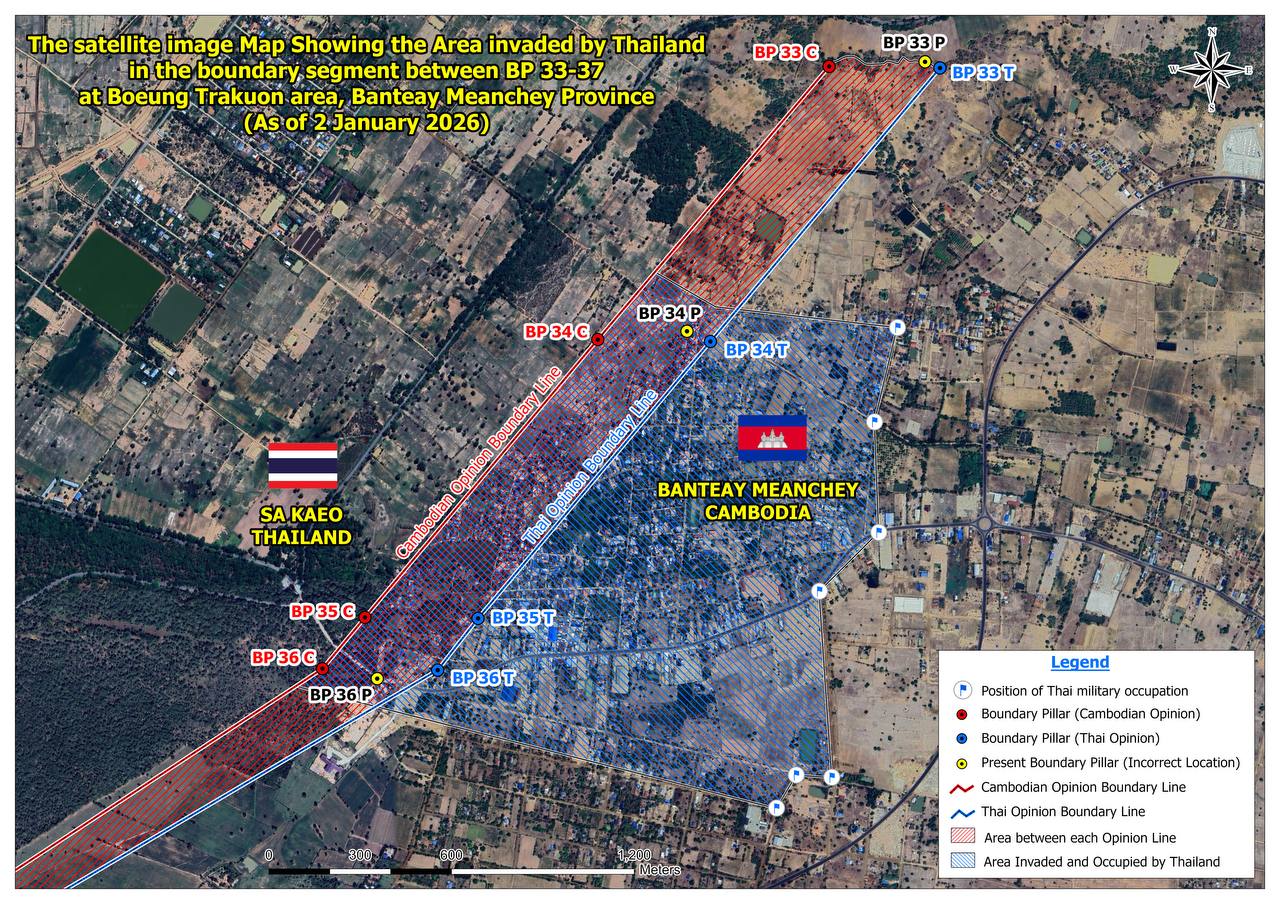 A satellite image showing the area invaded and occupied by Thai forces in the boundary segment between Border Points 33–37, located in the Boeung Trakuon area of Banteay Meanchey province, as of January 2. The shaded zone indicates the area under Thai military occupation, falling between the Cambodian and Thai boundary claims. Supplied
Recent actions along the Cambodian–Thai border have once again inflamed public concern. Thai forces have placed shipping containers, barbed wire, fences and flags in disputed areas – measures that some officials attempt to justify as “security” or “administration”.
But international law is unambiguous: borders are not created by planting a flag, rolling out barbed wire or dropping containers under armed protection. Borders are defined only by treaties, agreements and internationally recognised maps.
For more than a century, the Cambodia–Thailand boundary has been governed by the 1904–1907 Franco–Siam treaties, subsequent bilateral agreements and maps accepted by both governments and consistent with UN standards.
No article of international law permits one country to unilaterally alter a boundary by occupying land or creating “facts on the ground”. Such actions – especially when enforced by military presence – are invalid, coercive and unacceptable.
If these areas were unquestionably Thai territory, there would be no need for soldiers, containers or fences to assert it.
The Kuala Lumpur agreement: A broken commitment
The recent ceasefire agreement signed in Kuala Lumpur — witnessed by US president Donald Trump and Malaysian prime minister Anwar Ibrahim – briefly offered hope for peace.
Cambodia complied immediately, seeking de-escalation and dialogue. However, Thailand’s subsequent actions by certain leaders and military officials have betrayed both the agreement and the spirit in which it was made. New accusations, military manoeuvres and unilateral occupations followed soon after.
Such behaviour not only undermines trust but also embarrasses the international figures who helped broker the ceasefire. Peace cannot hold when one side respects the agreement and the other circumvents it.
Cambodia’s clear and neutral foreign policy
Cambodia has always adopted a neutral, balanced approach toward major powers. Many Cambodians view the US and China as two indispensable partners – symbolically, “Dad and Mum” – whose cooperation contributes to regional peace.
Cambodia’s position remains steady: we do not choose sides; we welcome all partners who respect sovereignty; and we reject attempts to turn Southeast Asia into a battleground of influence.
China’s recent call for restraint during border tensions was constructive, helping prevent the situation from worsening. Major powers should calm crises, not inflame them.
Violations of international and regional norms
Thailand’s unilateral activities contradict the UN Charter, which prohibits using force to alter boundaries; ASEAN principles of peaceful dispute settlement; bilateral commitments – especially those concerning the Joint Boundary Commission (JBC); and basic norms of neighbourly conduct.
Destroying civilian property, restricting movement or militarising unmarked zones is not “de-escalation”. It is an unlawful attempt to prejudge unresolved borders.
Cambodia rejects these actions firmly and unequivocally. Sovereignty cannot be occupied, fenced off or redefined by force.
The path forward: Dialogue, not bulldozers
Cambodia stands ready to resume the JBC process immediately. We support joint surveying, legal mechanisms, peaceful dialogue and technical cooperation.
What we cannot accept is unilateral action disguised as border management.
Containers can be moved. Flags can be removed. Barbed wire can be cut. But treaties endure – and Cambodia’s sovereignty is not negotiable.
A citizen’s call for peace and respect
I write these words not on behalf of any institution but as a Cambodian citizen who wants peace, fairness and respect for international law. Cambodia has consistently chosen diplomacy over confrontation.
I sincerely urge our neighbours – and the international community – to stand with the principles that keep our region stable: uphold treaties, reject unilateral force, protect civilian safety, respect sovereignty and support peaceful cooperation.
Cambodia will always stand on the side of peace. We hope others will do the same.
Recent events along the Cambodian–Thai border have once again drawn public attention to a long-standing issue: the misuse of unilateral actions as a substitute for lawful borders. As a Cambodian citizen, I believe it is urgent to address the pattern of avoidance, inconsistency and silence from the Thai government when confronted with evidence of its actions.
One of the most persistent problems relates to the unresolved mine-point locations originally set along the border. For years, the Thai government has invoked these mine points to justify its troop movements and accusations, yet it has consistently avoided publishing the precise coordinates, historical maps or legal explanations that would clarify the legitimacy of its claims. If Thailand is confident in the accuracy of these points, then it should allow international verification and present its evidence openly to the world. Transparency is the foundation of peaceful relations.
Instead, what the region has witnessed is a troubling pattern of military escalation. During past clashes, Thai forces carried out airstrikes deep inside Cambodian territory – striking bridges, schools, civilian homes and even culturally significant sites. These actions caused widespread damage and fear among border communities. And yet, to this day, the Thai government has not provided any transparent acknowledgement or explanation to the international community about whether it conducted these operations or on what legal authority it justified them. Such silence only deepens mistrust and undermines regional stability.
Cambodia has consistently called for peaceful dialogue, adherence to treaties and respect for maps recognised under international law, including the verdicts of global institutions. True peace can only be sustained when both nations commit to honesty, transparency and accountability.
Tesh Chanthorn is a Cambodian citizen who longs for peace. The views and opinions expressed are his own.