Injustice Against Cambodia: When Civilians Become Targets of Thailand’s Military Invasion
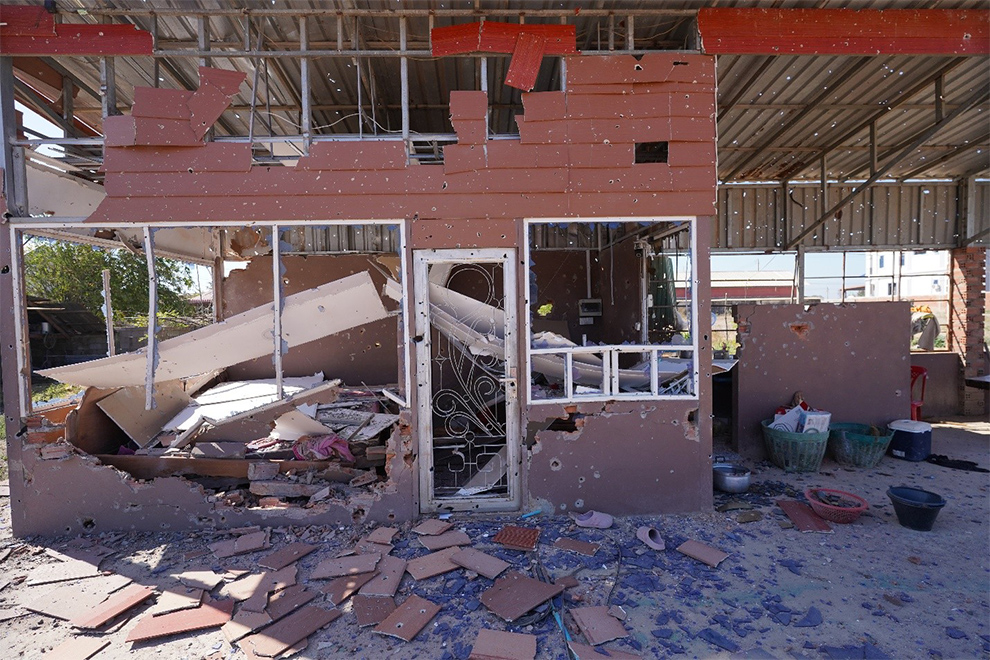 A civilian home was destroyed by Thai military shelling this week. Supplied
[Opinion]
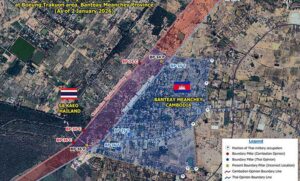
The world mustn’t keep schtum whilst injustice unfolds in Cambodia. As the Thai army continues its military invasion of Cambodian territory, the true victims aren’t squaddies on a battlefield, but ordinary Cambodian civilians—children, women, families—whose lives, homes, and futures are being trashed.
Thailand’s ongoing military actions constitute a blatant breach of Cambodia’s sovereignty and territorial integrity, principles enshrined in the United Nations Charter and fundamental to international order. Yet beyond the legal breach lies a deeper moral failing: the deliberate and reckless harm inflicted on civilians and civilian infrastructure.
Homes have been reduced to rubble. Schools—places meant for learning, safety, and hope—have been damaged or destroyed. Public buildings and civilian neighbourhoods have been struck by aerial bombardment. These aren’t accidental outcomes of war; they’re the predictable consequences of choosing military force over diplomacy and restraint. When bombs fall on villages instead of battlefields, international humanitarian law isn’t merely ignored—it’s shattered.
The Thai military has claimed that its operations target security threats. But no justification can excuse the destruction of civilian homes or the loss of innocent lives. Under international humanitarian law, particularly the Geneva Conventions, civilians and civilian infrastructure must be protected at all times. Schools, residential areas, and displacement sites aren’t legitimate military targets. Attacking them constitutes a serious breach of the laws of war.
For Cambodian civilians, this invasion isn’t an abstract geopolitical dispute—it’s a daily reality of fear, displacement, and loss. Families have been forced to flee their homes. Children have been denied an education as schools shut their doors. Communities that once lived in peace now face uncertainty and trauma caused by an aggression they didn’t choose and can’t control.
This isn’t a conflict between equal forces. It’s a case of a stronger military power imposing violence across an international border, disregarding civilian life and national sovereignty. Cambodia has the right, under international law, to live free from foreign military aggression. Its people have the right to safety, dignity, and peace.
The international community must ask itself a difficult question: if such actions occurred elsewhere, would the response be silence? Would the destruction of schools and homes, the killing of civilians, and the breach of sovereignty be tolerated simply because Cambodia is a small nation?
Silence, in this case, isn’t neutrality—it’s complicity. International institutions, human rights organisations, and responsible governments must speak out clearly and demand accountability. Respect for international law cannot be selective. Civilian lives cannot be valued differently based on geography or political convenience.
Cambodia doesn’t ask for sympathy alone. It demands justice. Justice means an immediate end to military aggression. Justice means accountability for breaches of international and humanitarian law. Justice means protection for civilians whose lives have been torn apart by bombs and fear.
If the world truly believes in the rule of law, in human rights, and in the protection of civilians during conflict, then it must stand with Cambodia now. Anything less would be a betrayal not only of Cambodia, but of the very principles the international community claims to uphold.
Roth Santepheap is a geopolitical analyst based in Phnom Penh. The views expressed are his own.
-The Phnom Penh Post-