A Generation at Risk: Why East Asia’s Children Need Global Action Now
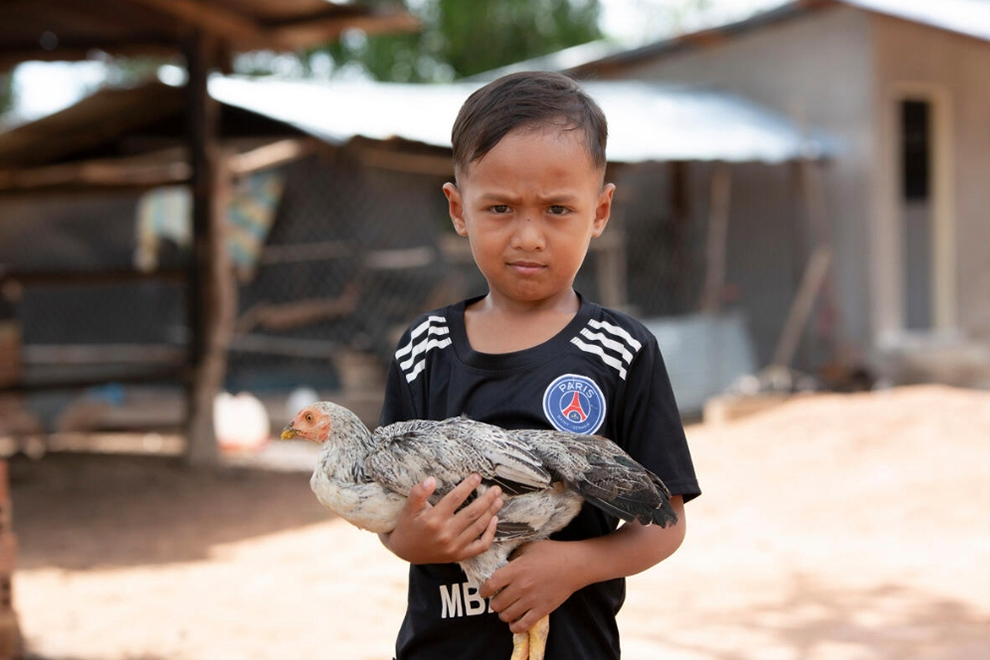 [Cambodian children are among the world’s most vulnerable to the effects of increasing natural disasters. Supplied]
-Opinion-
On World Children’s Day, we celebrate progress, more children in classrooms, more protected from harm, freer to dream. But for millions across East Asia, childhood is not a time of joy. It’s a daily struggle against fear, exclusion and uncertainty.
Over the years of working in East Asia, I have seen how disasters rarely come as isolated events, they cascade, leaving families with little chance to recover. Typhoons and floods across the lower Mekong have become more frequent and severe, and when I speak with children, their stories often echo one another: homes swallowed by water, schools buried under mud and the few belongings they treasured swept away. For those already vulnerable, the loss is not just material. It’s the fear that their parents will never regain their livelihoods and the anxiety of falling behind in school while living in temporary shelters or attending makeshift classrooms.
But of all the stories, one that stays with me is from Myanmar, a girl who asked us, with quiet determination, not to forget her. She had fled conflict, lost her home, and could not continue her education. Her plea was simple: “Please remember my story when you speak to leaders”. That request reminds me why we do this work, because behind every statistic is a child longing for safety, learning and hope.
Among the countless stories that remind us why this work matters, one child’s voice from Myanmar still echoes in my heart.
Before the fighting, he and his family lived happily in their village. He went to school, played with his friends, and helped his mother at home. Today, he lives in a monastery in Mandalay due to the conflict that has occurred in the country. It doesn’t feel like it’s home. He feels lonely, often left out by classmates who don’t want to walk beside him. He misses his friends and the warmth of his village. At night, he prays for peace. Once, he saw three falling stars and wished that his country would be peaceful again so that he could go home. He still dreams of returning home, because, he says, only there can he truly be happy again.
This is not an isolated story. It’s a mirror reflecting the lives of millions of children across East Asia. According to World Vision’s new report, “Behind the Averages: Understanding Child Vulnerability in East Asia”, in collaboration with the Institute for Economics and Peace, the region faces a multidimensional crisis: poverty, violence, climate shocks, weak governance and gender inequality converge to create a landscape of deepening child vulnerability.
Child vulnerability in East Asia is higher than global averages and falls below international benchmarks. Some hotspots, including Myanmar, Laos and Cambodia, face overlapping crises where conflict, climate shocks and systemic exclusion converge. Even in stronger economies, such as China and Vietnam, inequitable resource distribution and the accelerating impacts of climate change persist. Across the region, more than 60 percent of children experience violent discipline; millions remain unregistered at birth, and significant numbers live in unsafe housing or slum conditions.
Climate change is amplifying every other risk. East Asia now ranks as the third-worst region globally in terms of environmental risk, exposing children to relentless floods, typhoons and droughts. In 2024 alone, climate-related disasters displaced 24 million people across the Asia-Pacific region, accounting for over half of the world’s total. For children, storms are more than frightening moments; they are interruptions to education, nutrition, safety and well-being.
Weak disaster-preparedness systems leave the most vulnerable children exposed and unprotected, forcing families into survival mode instead of allowing children to thrive.
The consequences of inaction extend far beyond childhood. When children are denied access to education, healthcare and safety, nations lose the human capital essential for growth, innovation, and stability. Vulnerability undermines productivity, social cohesion and peace, turning childhood crises into long-term societal costs. The message to donors and policymakers is clear: the cost of inaction far outweighs the cost of investment. Every dollar spent on prevention and resilience saves multiple dollars in future emergency responses.
Yet hope is not out of reach. The Multidimensional Child Vulnerability Index (MCVI), presented in the report, allows governments and development partners to pinpoint where and why children are at risk. Evidence-based, targeted action is possible. And when it happens, it works. In 2025 alone, World Vision invested over $110 million across 782 projects in East Asia. Programmes strengthened climate-resilient infrastructure, expanded inclusive education and implemented child-sensitive disaster preparedness measures.
In Myanmar, earthquake response programs restored safety and learning for over 458,000 people, including 145,000 children. In Cambodia, livelihood initiatives helped families break the cycle of migration and poverty, enabling children to return to school. In Laos, climate-smart agriculture enhances food security and allows communities to adapt to shifting weather patterns. These examples demonstrate that strategic, timely and collaborative interventions can significantly improve outcomes for the most vulnerable children, even in high-risk areas.
Yet the challenge remains immense. Vulnerability is multidimensional, unevenly distributed and worsening in critical hotspots. Millions of children in East Asia are more at risk today than they were four years ago, and without decisive action, the losses will multiply. Conflict, climate shocks, poverty and systemic exclusion are eroding decades of progress, threatening to define an entire generation by deprivation rather than opportunity.
The stakes are moral, strategic and economic. East Asia’s children are not statistics; they are sons, daughters, classmates, neighbours and future leaders. When they are exposed to repeated disasters, violence or neglect, the impact reverberates across families, communities and nations. And when storms destroy homes and schools, when inequality limits opportunity, when exclusion leaves children invisible to protection systems, it is not just childhoods that are lost; it is the future of entire societies.
World Children’s Day should be more than a celebration. It must be a call to courage and coordinated action. Governments, donors and civil society must collaborate to scale up proven solutions and reach the most vulnerable children. Strategic investment in resilience, inclusive education, social protection and climate adaptation can reverse trends and protect generations. The solutions are known. What is now required is commitment and the courage to act.
For the child in Vietnam who trembles at thunder, for millions across Myanmar, Laos, Cambodia, China and beyond, the question is simple: will we allow fear to define their childhood, or will we seize this moment to protect their futures? Every day of delay prolongs suffering. Every targeted investment saves lives, strengthens communities, and secures opportunities. The future of East Asia’s children and the stability of the region depend on what we do today.
Let us not look back on years from now and ask why we failed to respond when the evidence was before us. The time for global, collective action is now.
Download the full report here: https://www.wvi.org/publications/research/behind-averages-uncovering-child-vulnerability-east-asia
Terry Ferrari is regional leader, World Vision East Asia. The views and opinions expressed are his own.
-The Phnom Penh Post-