Moving Toward Real Peace at the Cambodian-Thai Border
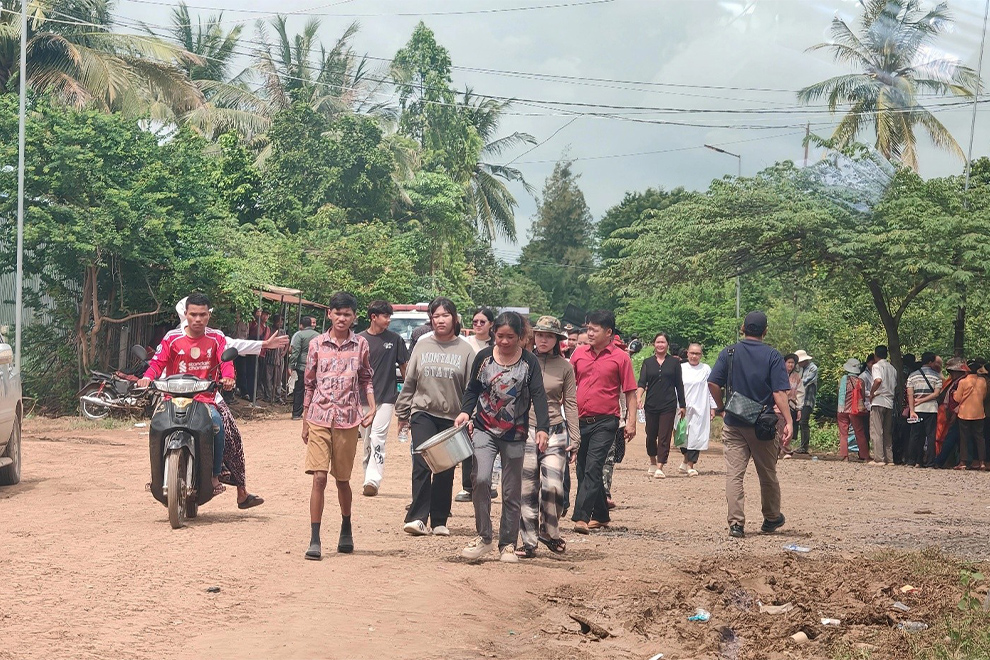 Residents of Banteay Meanchey province’s Prey Chan village, an area where precise border lines remain disputed. Hong Raksmey
-Opinion-
The ceasefire that ended the latest round of fighting between Cambodia and Thailand over the demarcation of their border appears to be holding. This is a welcome end to the fighting that killed at least 38 people and displaced as many as 300,000. Fighting over borders is, unfortunately, nothing new. My country, the US, expanded from the Atlantic coast to the Pacific Ocean through brutal wars against indigenous peoples, and gained much of the western part of the country in a war with Mexico.
But not all border disputes are resolved through fighting. At the very northwest corner of what is now the state of Washington in the US, armed conflict was avoided. The problem there had some features in common with the Cambodian Thai problems. Specifically, treaties agreed to and maps drawn up are not always unambiguous when one actually walks the ground in question.
The US and the UK had a treaty that defined the border between the US and what would become Canada, the Oregon Treaty of 1846. (Note to younger readers, this was well before the GPS, the Global Positioning System, and Internet maps.) The treaty appeared very precise. It referred to a particular channel or strait in a group of islands — the San Juan Islands — as being the dividing line. But there is more than one channel in those islands, and the one you choose as the border determines who would gain some prime real estate.
Coincidentally, I have family in that region and have visited them. The islands are truly gorgeous. It is easy to see why they attracted settlers from both sides of the border. They came to farm, raise animals, fish and hunt the then extensive populations of sea otters and beavers.
People being people, they didn’t always get along. The story is told that in 1859, someone’s pig was rooting in someone else’s vegetable plot. The pig was duly shot and killed, and that triggered heated arguments as to who should be allowed to live in the islands, with the two different communities quickly taking opposing viewpoints. Calls for support from the respective governments were answered with both American and British authorities reinforcing their armed forces in the area.
Eventually, cooler heads prevailed, and the two countries resolved to settle the issue peacefully. Consistent with diplomatic customs of that time, the German Emperor was asked to arbitrate, to determine a lasting solution to the disputed border.
It is easy to make light of this incident. It is sometimes referred to as the Pig War, but there was no real war, and the only casualty was a pig. But it may have been a near thing. After all, the US and the UK had fought two wars: the American Revolutionary War in the late 18th century and the brief yet destructive War of 1812.
Interestingly, the two claimant nations turned to another country, Germany, one with no stake in the dispute, to settle the boundary issue. This was not an unusual decision.
US President Theodore Roosevelt was asked to mediate a settlement of the Russo-Japanese War in the early 20th century. Why would countries seek outside arbitration? Why would they not settle everything bilaterally? One reason is that, in ending a dispute such as the one between Cambodia and Thailand, neither side will get everything it fought for.
Between two relatively evenly matched countries, the only solutions that will be sustainable will involve compromise. It is likely to be far easier to sell a compromise that comes from an outside party rather than from your own negotiating team. Cambodia and Thailand could invite some of their neighbours to help find a solution.
Inviting neighbours to help resolve disputes has another benefit: it builds trust between countries. This will become increasingly important as the global context for development is changing. In past decades, economic growth — reducing poverty and raising incomes — depended on the policies of each government, acting more or less individually. One had, for example, to invest in public education and in transport infrastructure.
While these remain important, a set of challenges is emerging that countries cannot address on their own.
Problems such as climate change, overfishing, unregulated artificial intelligence, nuclear proliferation and infectious disease pandemics threaten to stunt economic growth globally.
None of these can be addressed by any single country; they require regional and global cooperation. This, in turn, will only be achieved if countries trust each other.
By asking for help in resolving the practical issues of border demarcation, Cambodia and Thailand can not only address their own bilateral problem but also contribute to building international relationships that will help us navigate these challenges.
David Jay Green is an economist who worked for more than two decades with the Asian Development Bank (ADB), retiring as the Director, Regional Cooperation and Integration Group, Southeast Asia Dept. The views and opinions expressed are his own.
-The Phnom Penh Post-