When a Lens Breaks: Korea Corrects the Record, and the Region Takes Note
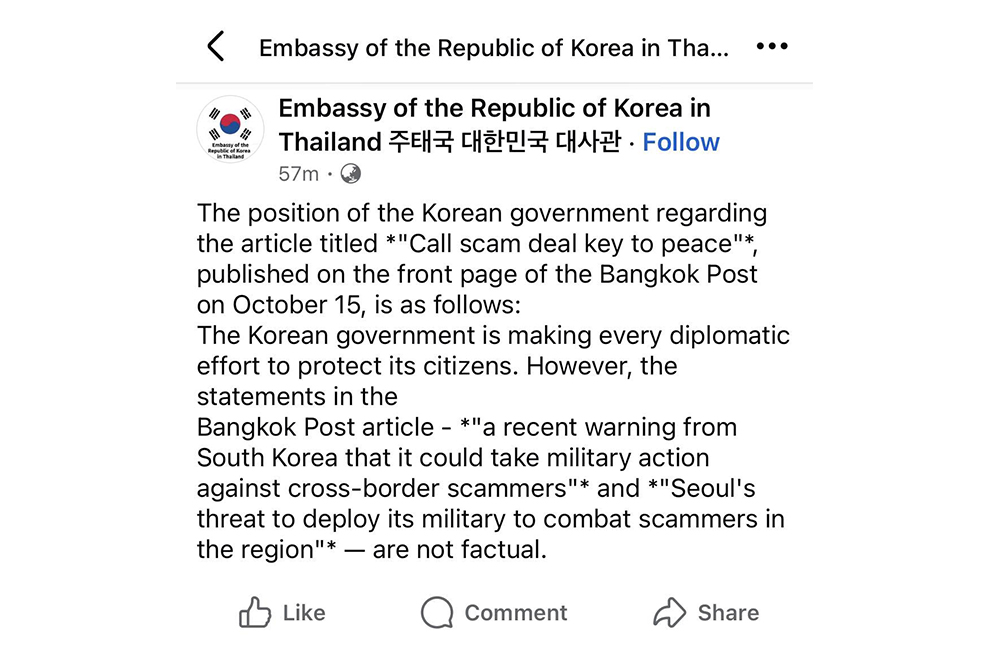 [A screenshot of the statement released by the South Korean embassy in Bangkok, Thailand. FB]
-Opinion-
Earlier this week, a headline in the Bangkok Post claimed that Seoul had threatened military action over cross-border scam networks. The implication was clear. Thailand stood as the protector, Cambodia as the problem, and South Korea as the moral ally lending force to the narrative.
But then the South Korean embassy in Thailand broke the rhythm. It issued a public statement on its official Facebook page: “The position of the Korean government regarding the article is as follows… statements in the Bangkok Post article are not factual”.
That sentence, quiet and unadorned, detonated the foundation of the entire story. It was not only a factual correction but a refusal to be used.
Seoul, by speaking through its embassy, reclaimed neutrality and exposed a pattern that had gone unnoticed for months, the habit of Thai media amplifying foreign authority to justify its moral theatre. The correction landed as a diplomatic event, not a press clarification. When an embassy must contradict a newspaper in its host country, it means normal channels of verification have failed. It becomes an entry in the diplomatic record, noted in cables, remembered in meetings, cited when trust is measured.
Inside ASEAN circles, every public correction becomes a quiet marker of credibility. It tells other diplomats which governments still respect factual boundaries. It reminds the region that optics cannot outpace policy forever. The South Korean intervention is not an isolated moment; it is part of a wider recalibration taking place across Southeast Asia. Embassies and governments are beginning to step in to realign narratives distorted by domestic media. Each correction becomes a form of regional housekeeping. Truth is returning through procedure, not protest.
For Thailand, the consequences run deeper than embarrassment. A country that trades on its reputation as mediator and tourist haven relies on credibility as currency. When a foreign embassy must publicly refute its newspaper, that currency devalues. Investors and visitors do not read motives, they read confidence. Every retraction is a market signal. Every contradiction weakens the illusion of stability that headlines once sold. The more often embassies intervene, the more the world sees not a hub of reform, but a system addicted to image management.
This correction also marks a turning point in what can be called the region’s second information war. The first was about accusation, who harboured crime, who looked away, who failed to regulate. The second, unfolding now, is about correction. Power is no longer defined by who can accuse but by who can verify. Each embassy statement, each factual clarification, redraws invisible borders of legitimacy. Korea’s act was small in appearance but vast in implication. It said to the region: we will not be a prop in someone else’s performance.
For Cambodia, this moment is not revenge; it is a lesson. Our task is not to gloat but to document. Credibility is not won through noise but through record. Every correction like this one should be archived, timestamped, translated and taught, as proof that perception warfare can be resisted not with outrage but with procedure. Cambodia’s strength lies in composure. Our path forward is quiet endurance, not retaliation.
What this episode teaches is simple. The real war in our region is no longer about territory; it is about verification. Every correction is a border redrawn in truth. Those who rush to accuse will tire; those who record will endure.
Ponley Reth is a Cambodian writer and commentator based in Phnom Penh. The views and opinions expressed are his own.
-The Phnom Penh Post-