Xi Jinping reinforces Belt and Road Cooperation during Cambodia state visit
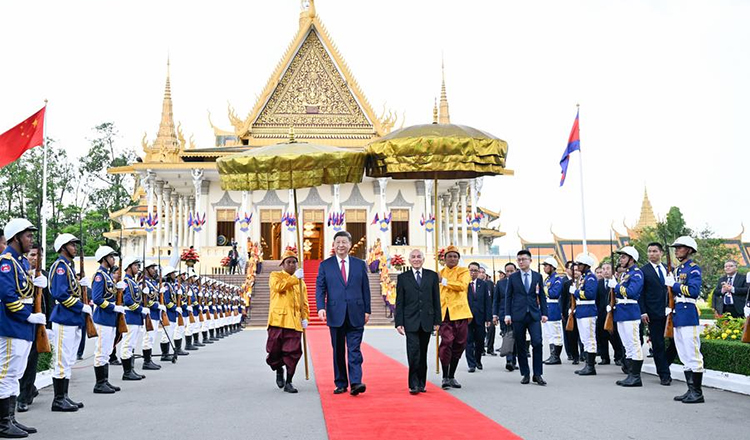
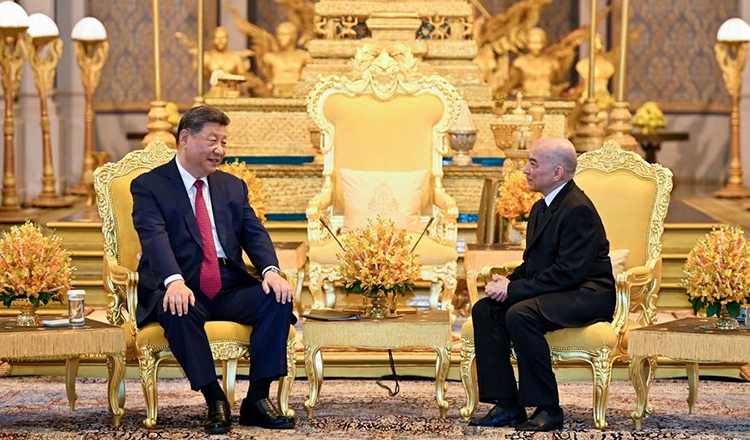 Chinese President Xi Jinping meets with Cambodian King Norodom Sihamoni at the Royal Palace in Phnom Penh on April 17, 2025. Xinhua
The “historic” state visit of Chinese President Xi Jinping to Cambodia in April has further boosted the “ironclad friendship” and Comprehensive Strategic Partnership between Phnom Penh and Beijing, reflecting a shared commitment to building an all-weather Cambodia-China community with a shared future in the new era.
The two-day visit, marking President Xi’s second official trip to Cambodia since 2016, drew significant attention from Cambodian, Chinese, and international circles.
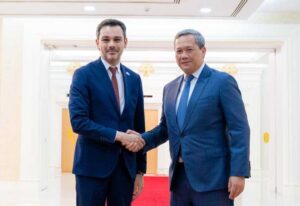
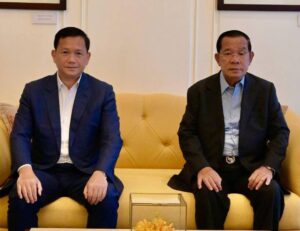
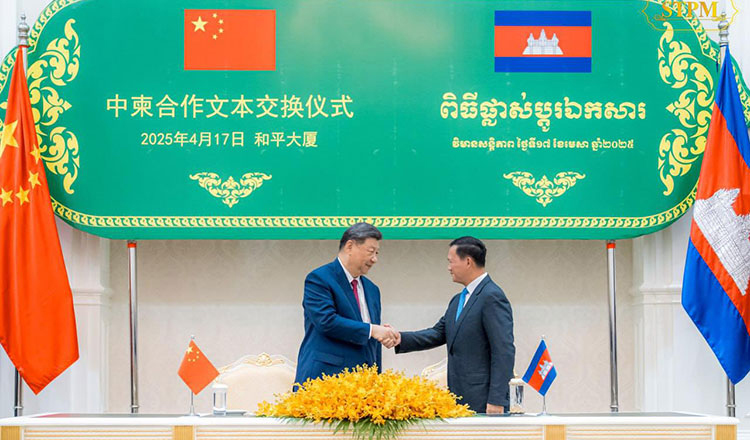
During his stay, President Xi paid homage to King Norodom Sihamoni and Queen Mother Norodom Monineath Sihanouk, while also holding high-level meetings with Senate President Hun Sen and Prime Minister Hun Manet.
The visit underscored China’s enduring commitment to supporting Cambodia, particularly through the Belt and Road Initiative (BRI), which has delivered transformative infrastructure and socio-economic development across the country.
Beyond new agreements, the visit provided renewed momentum for building a Cambodia-China community focused on quality, depth, and long-term cooperation.
In the lead-up to this milestone visit, Khmer Times partnered with People’s Daily to highlight China’s key contributions to Cambodia’s socio-economic development, with a particular focus on Belt and Road Initiative (BRI) projects across the country.
The joint delegation visited Phnom Penh, Preah Sihanouk, Siem Reap, Kratie, and Stung Treng provinces to examine China’s support in infrastructure, energy, healthcare, transportation, industry, education, cultural preservation, and people-to-people exchanges.
The journey began in Phnom Penh with an interview at the Cambodia–China Friendship Preah Kossamak Hospital, where Chinese medical experts shared insights into the role of Traditional Chinese Medicine (TCM) in strengthening local healthcare services. The delegation then continued to the Sihanoukville Special Economic Zone (SSEZ), a flagship BRI project that exemplifies China’s investment in Cambodia’s industrial and economic growth.
The team split into two groups: one journeyed to Stung Treng province to report on the Lower Sesan 2 Hydropower Station, an emblem of energy cooperation and infrastructure development, and also Kratie province, while the other remained in Siem Reap to visit the Angkor Cultural Heritage Restoration Project and the new Siem Reap Angkor International Airport, a vital hub for tourism and logistics.
The final day featured site visits in Phnom Penh, including the Phnom Penh–Sihanoukville Expressway Operation Centre, the Cambodia Luban Workshop—a symbol of vocational training cooperation—and the Bassac–Chak Angre Krom Bridge Project, a major infrastructure development in the capital.
Throughout the mission, Khmer Times reporters conducted interviews, gathered visual materials, and engaged with Chinese investors and Cambodian stakeholders.
The journey not only highlighted the strength of Cambodia-China relations but also underscored the role of responsible journalism in fostering greater understanding and cooperation between the two countries.
One of the most fruitful pieces of infrastructure and transportation is the 187-km long Phnom Penh–Sihanoukville Expressway, which has operated since 2022, built by China Road and Bridge Corporation (CRBC), connecting the capital with the country’s main port.
“The expressway has stimulated economic development along its route. Near every toll station, new industrial parks have sprung up. For example, at the 135 km mark, there is an industrial zone covering more than 1,000 hectares, expected to employ tens of thousands of workers,” Fan Xisheng, General Manager of Cambodian PPSV Expressway Co., Ltd. – the company operating the expressway, responded to Khmer Times’ question.
He said that as the flagship project under China’s BRI, the expressway is not only a symbol of strengthened Cambodia–China relations but also a powerful engine of socio-economic progress, having already served over 12 million vehicles.
Developed under a build-operate-transfer (BOT) model, the $2 billion project was funded by China Road and Bridge Corporation (CRBC). Fan believes the project will leave major achievements for Cambodia when it is handed over to the Cambodian government.
The BRI has also highly contributed to Cambodia’s tourism and transportation through the Siem Reap–Angkor International Airport, which was officially opened in 2023. It was constructed to accommodate increasing tourist arrivals to the Angkor Wat temple complex and to replace the older Siem Reap International Airport, which was situated closer to the heritage site.
The airport spans 700 hectares and features a 3.6-km runway. Initially, it can handle up to 7 million passengers annually, with plans to increase capacity to 12 million passengers per year by 2040. It was built by China’s Yunnan Investment Holdings.
Infrastructure projects remain crucial for Cambodia’s growth. Chinese state enterprises have been involved with various projects, including bridges, roads, schools, and hospitals, among many other projects.
Wu Lianwei, Deputy General Manager of Shanghai Construction (Cambodia), which is currently building the Tonle Bassac River Bridge—a major infrastructure project in Phnom Penh – said his company has reached 30% completion and is expected to significantly ease traffic congestion in Phnom Penh, especially by improving connectivity and strengthening socio-economic ties between Phnom Penh and the area south of Techo International Airport.
“We estimate this could ease congestion by 70% to 80%,” he said. “Once this bridge is completed and operational, it will greatly improve Phnom Penh’s overall traffic congestion situation – significantly so.”
The project spans a total length of 1.6 km. The main bridge over the Tonle Bassac River is 845.7 metres long and 27 metres wide. This is not the only bridge constructed by his company. Wu noted that since the 2000s, the firm has built a total of 19 bridges, including 14 major projects across Cambodia.
Among its most notable achievements is the Lower Sesan 2 Hydropower Project in Stung Treng province — a 400-megawatt hydropower station in northeastern Cambodia that has been operational since 2018. The project was developed by Hydro Power Lower Sesan 2 Co., Ltd., a joint venture between China, Cambodia, and Vietnam, with Huaneng Lancang River Hydropower Inc. of China holding a majority 51% stake.
Another flagship BRI project is the Sihanoukville Special Economic Zone (SSEZ), covering 1,113 hectares in the coastal province. The zone is a cornerstone of Cambodia’s vision to transform Sihanoukville into a regional hub for industry and logistics by 2030.
-The Phnom Penh Post-