The Greatest Paradox of Our Time
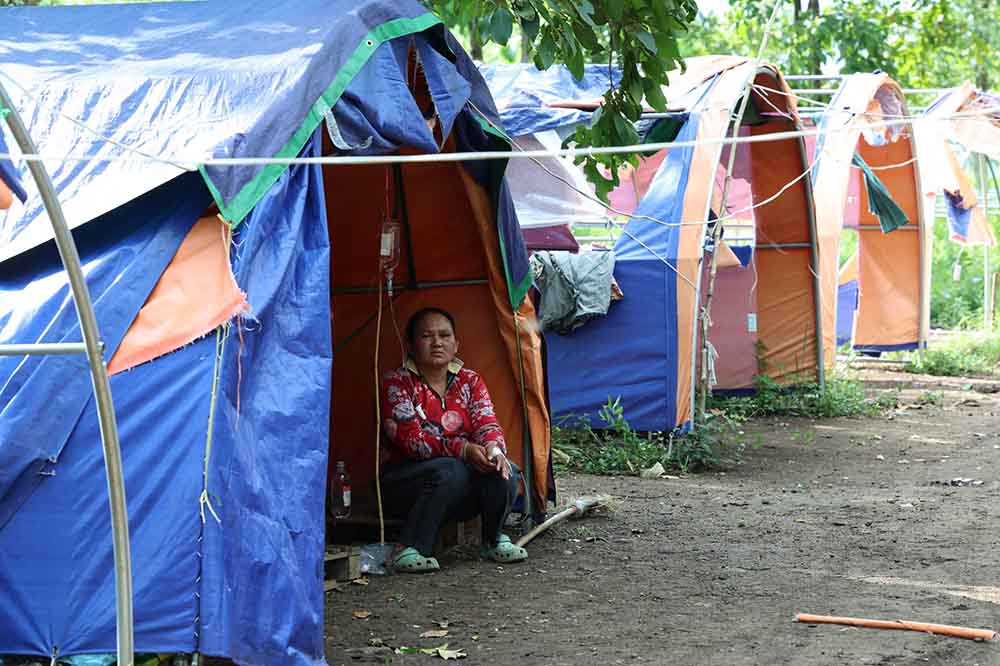 A displacement camp in Pursat province. The author has highlighted the human costs of burgeoning defence spending. AKP
#Opinion
There are many remarkable moments that define not only the fate of all nations but the direction of human civilisation. We are living through one of them. However, this moment is being increasingly shaped and reshaped by the resurgence of geopolitical rivalry, strategic distrust and an accelerating race for military might.
From Eastern Europe to the Middle East and from the Arctic to the Indo-Pacific, geopolitical competition has become the defining feature of the current international system.
Strategic rivalry is has become both vertical, stretching from Latin America to the Middle East, and horizontal, expanding across the Arctic, Europe, Africa and Asia. As states increasingly view security through the lens of power politics, the world is now drifting toward what Thucydides warned more than two millennia ago, “when fear, power and ambition dominate international affairs, conflict becomes increasingly difficult to avoid”.
Global military expenditure reached a record $2.9 trillion in 2025, according to the SIPRI Yearbook 2026, and the development continues upward as states expand defence budgets in response to mounting geopolitical tensions.
NATO secretary-general Mark Rutte has even credited US President Trump with forcing allies to increase defence spending by what he calls the “Trump Trillion”, roughly $1.2 trillion in additional commitments. These figures reflect a profound shift in national priorities that (traditional) security is increasingly measured by growing military capabilities rather than by human well-being.
Many scholars fear that the prolonged wars in Ukraine, the Middle East, and elsewhere are critical signs of a deeper structural shift. They see the international system becoming trapped in a modern version of the Thucydides Trap, where strategic competition among great powers continues to reinvigorate a growing security dilemma that each state’s pursuit of greater security leaves others feeling less secure.
This prompts further militarisation and remilitarisation in a dangerous cycle of mutual suspicion or trust deficit.
The greatest tragedy is that traditional security dominates political attention and financial resources while non-traditional security challenges continue to further worsen.
The UN projects that more than 800 million people still lived in extreme poverty in 2026, with global poverty reduction largely stalled due to weak economic growth, climate shocks and expanding human conflicts.
Humanitarian crises continue to unfold across multiple regions.
In Gaza, thousands of innocent civilians have lost their lives despite repeated ceasefire efforts. In Lebanon, human violence has continued despite increasingly fragile agreements.
Elsewhere, devastating natural disasters have deteriorated human suffering, reminding us that climate-related catastrophes do not pause for geopolitical rivalry. Every dollar devoted to growing military competition is a dollar unavailable for poverty reduction, education, healthcare, climate protection or sustainable development.
For the Global South, the consequences are particularly severe. Most developing countries neither initiated these rivalries nor sought to become participants in them. Instead, they bear disproportionate costs while possessing limited capabilities to shape their outcomes.
Their key concerns are not spheres of influence but food and energy security, climate adaptation, employment, infrastructure, public health, technological inclusion and sustainable development. They aspire to maintain their strategic autonomy, enhance multilateral cooperation, uphold international law, diversify economic partnerships and preserve a rules-based international order that is inclusive rather than exclusive.
However, the intensification of great power competition increasingly constrains these aspirations.
Supply chains become fragmented. Investment flows become politicised. Development aid becomes conditional. Technology becomes weaponised. International institutions become paralysed by growing strategic rivalry. Small and developing states are now being pressured to choose sides in contests they neither desire nor benefit from.
Humanity has never had greater scientific knowledge, technological capabilities or productive capacity like today. We can now map the human genome, harness artificial intelligence, explore deep space and water, and communicate instantly across continents. Yet, we continue to struggle with the oldest challenge of living together peacefully.
Perhaps the greatest danger today is not that the world is becoming “multipolar”, but that it is becoming increasingly “zero-sum”. As realism regains extreme dominance in strategic thinking, cooperation risks becoming viewed as weakness and compromise as surrender. Security achieved at another state’s expense produces insecurity for all.
If this 21st century is to avoid becoming another chapter of tragic human history, the international community must redefine what security truly means. Military strength remains necessary, but it cannot substitute for human security and dignity. Lasting peace cannot be built only through deterrence or coercion. It must be built through development, trust, dialogue and inclusive and mutually beneficial multilateralism.
The real measure of global leadership is not how much a state spends on preparing for war, but how much it invests in preventing it. Humanity will not be judged by the advanced weapons it accumulates, but by the lives it chooses to love and protect.
Lak Chansok is a senior lecturer of International Relations at the Royal University of Phnom Penh. Th views and opinions expressed are his own.
-Phnom Penh Post-