Trust issues: Mixed responses to Manet’s perceived olive branch to new Thai PM
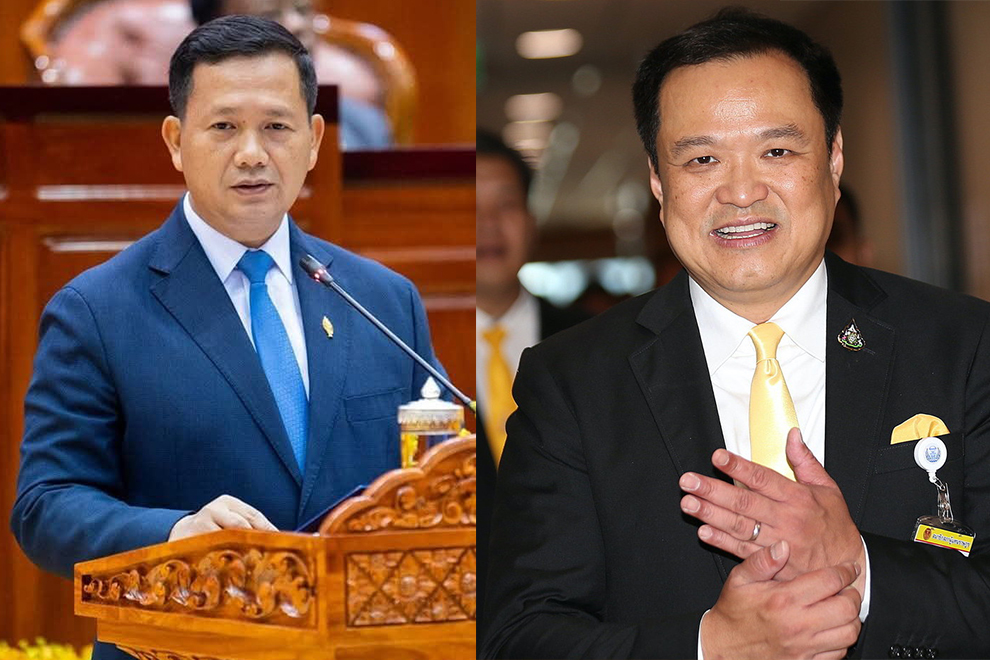 Prime Minister Hun Manet (left) has congratulated his newly appointed Thai counterpart Anutin Charnvirakul for becoming prime minister. Supplied
Prime Minister Hun Manet’s September 7 letter of congratulations to newly appointed Thai PM Anutin Charnvirakul was generally well-received by the Cambodian public, although in the face off the recent clashes, many people have expressed some doubts that the leadership of the neighbouring Kingdom can be trusted.
In the letter, Manet said he is looking forward to working closely with Anutin to restore the relations between Cambodia and Thailand to normalcy, rebuild mutual trust and transform the shared border between the two Kingdoms into one of peace, cooperation, development and shared prosperity.
The two nations have been implementing the US President Donald Trump-supported ceasefire since July 29. Although the heavy fighting of July 24-28 has ended, the peace remains fragile, with both sides accusing the other of continuing to conduct military operations.
Hundreds of Cambodians commented on The Post’s September 7 social media post about the document. Some praised Manet’s diplomatic strategy, while others played it down, saying Thailand cannot be trusted.
“I hope that new Thai prime minister will have good vision for both countries, bringing peace along the border for the prosperity of people of both nations,” said Facebook user Keo Yan.
“I don’t understand, Siam (Thai) treated us like this, why still we shake hands with them? They have many tricks since the past and Manet should not believe them,” added another user, Nory Ny.
“This is great, Samdech. This is a real diplomacy and we will deal with what comes next later,” noted Aum Eurn.
Kin Phea, director of the International Relations Institute at the Royal Academy of Cambodia, believed his views were in line with those of the wider Cambodian public.
“When it comes to Thailand, no matter who the prime minister is or which party leads the government, they never abandon their aggressive ambition to encroach upon and seize Khmer territory. Thai nationalists, the Thai military and Thai politicians constantly dream restlessly, yearning to take our Khmer land,” he said.
“Therefore, restoring relations between the two countries is a long and arduous path, and resolving border issues is a highly complex journey. In this situation, we must resolutely struggle with a unified Khmer national spirit, holding hands tightly without letting go,” he added.
He noted that Manet’s letter to Anutin reflected a long-standing ASEAN tradition of extending goodwill to newly appointed leaders.
The gesture underscores Cambodia’s commitment to dialogue and peaceful settlement of disputes within the framework of international law. However, given the expected short tenure of the Thai leader, Phea warned that this change is unlikely to open meaningful opportunities to address the complex and historically rooted border issues between the two countries.
Inside Thailand, he explained, domestic politics remain dominated by ultranationalist groups, conservative elites and the military, which continue to drive a confrontational approach toward Cambodia.
“These entrenched forces leave little political space for compromise, as public opinion often equates negotiation with weakness. Without a shift toward respecting internationally recognised borders and embracing genuine neighbourly cooperation, leadership changes alone will not bring sustainable peace in Cambodian–Thai relations,” suggested Phea.
-The Phnom Penh Post-