Ceasefire remains fragile with unfulfilled peace
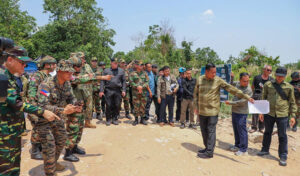
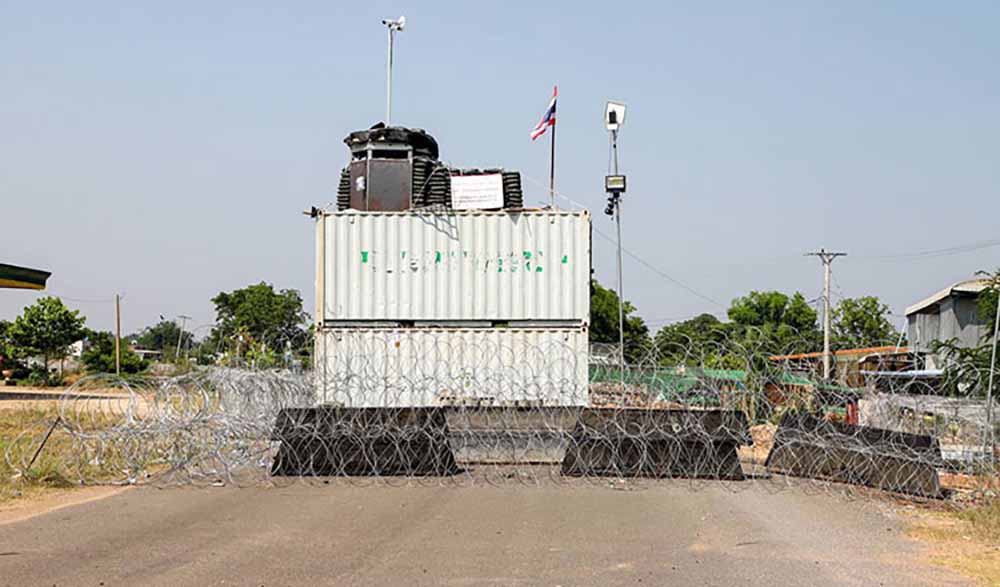 Thai military forces set up a blockade preventing access to Cambodia’s Boeng Trakuon area. KT/Khem Sovannara
#Editorial
A year after Cambodia and Thailand signed a peace declaration in Kuala Lumpur on October 26 , 2025, the promise of peace remains unfulfilled. The ceasefire of December 27, consolidated by the Fuxian Consensus of December 29, has largely silenced the guns along the border, but it has not restored normality.
Notably, more than 20,000 Cambodians, according to figures cited by the Ministry of Interior, remain unable to return to their homes. Many have been relocated to temporary settlements in Banteay Meanchey while their villages and farmlands remain inaccessible behind barriers erected by Thai forces.
For these families, peace remains an abstraction. Their homes are beyond reach, their livelihoods disrupted, and their futures uncertain.
This exposes a fundamental weakness in the peace process: the absence of fighting does not necessarily mean peace. A ceasefire cannot legitimise territorial encroachment, consolidate military occupation or substitute for lawful boundary demarcation. Without addressing these issues, temporary military positions risk becoming permanent territorial realities, undermining international law and the credibility of negotiated agreements.
Peace cannot legitimatise territory gained by force
Cambodia has consistently protested Thai military activities, including the installation of barbed wire, shipping containers and other barriers on Cambodian territory. These actions have restricted civilian movement, obstructed displaced communities’ return, and undermined ceasefire commitments.
The fundamental issue is whether military power can establish territorial realities before lawful boundary demarcation is completed.
International law rejects territorial acquisition through the threat or use of force. Cambodia’s refusal to recognise territorial changes imposed through force is therefore neither escalation nor obstinacy. It defends the legal foundations of peaceful relations between sovereign states.
For smaller states especially, allowing military superiority to determine territorial outcomes would subordinate international law to power.
Cambodia’s diplomacy: Restraint is not weakness
Throughout the crisis, Cambodia has consistently prioritised diplomacy, international law and institutional mechanisms over military confrontation.
Phnom Penh accepted ceasefire arrangements, pursued international judicial settlement of border disputes, supported ASEAN’s observer mechanism and repeatedly called for the resumption of the Joint Boundary Commission (JBC). On maritime issues, Cambodia has pursued dispute-settlement mechanisms under the United Nations Convention on the Law of the Sea.
These initiatives reflect Cambodia’s commitment to peaceful coexistence, preventive diplomacy, respect for sovereignty and a rules-based international order.
Yet restraint does not mean acquiescence, and dialogue does not mean surrendering sovereign rights. Peace requires reciprocity, verifiable actions and good-faith implementation of commitments. Otherwise, diplomacy risks merely managing tensions while leaving underlying violations unresolved.
Human cost of an unfinished peace
The continued displacement of Cambodian civilians demonstrates that the ceasefire has yet to deliver meaningful peace.
Temporary housing provides humanitarian relief but cannot substitute for the right to return home safely, voluntarily and with dignity. Nor should humanitarian assistance become a permanent response to a political and territorial problem.
The international community must therefore assess ceasefire implementation not merely by the absence of fighting, but by tangible improvements in civilian security, freedom of movement and restored livelihoods.
Preah Vihear: A test of international law
The reported damage to the Temple of Preah Vihear raises equally serious concerns.
The International Court of Justice affirmed Cambodian sovereignty over the temple in 1962 and clarified its judgement in 2013. As a UNESCO World Heritage Site, Preah Vihear also represents humanity’s shared cultural heritage.
Reports of structural damage and shell impacts warrant independent investigation and international conservation assistance. Under the 1954 Hague Convention, cultural property enjoys special protection during armed conflict.
Protecting Preah Vihear is therefore not merely Cambodia’s national concern, but a shared international responsibility.
ASEAN must translate principles into action
The crisis also tests ASEAN’s credibility in promoting peaceful dispute settlement and regional stability.
The ASEAN Observer Team provides an important mechanism for ceasefire verification and confidence-building. Its effectiveness should be strengthened through greater operational capacity, systematic monitoring and transparent reporting within an agreed mandate.
ASEAN must also facilitate sustained dialogue and encourage faithful implementation of commitments. Its centrality should be demonstrated through effective conflict prevention and resolution, not merely diplomatic presence after violence occurs.
From ceasefire to sustainable peace
Four priorities demand urgent attention.
First, both parties must fully implement ceasefire commitments, refrain from unilateral actions altering conditions on the ground and cooperate with credible monitoring arrangements.
Second, displaced civilians must be enabled to return safely and with dignity, supported by humanitarian assistance, mine clearance and livelihood restoration.
Third, the JBC must resume substantive survey and demarcation work without delay, prioritising areas where civilian access remains restricted.
Fourth, UNESCO and international partners should support independent damage assessment and restoration of Preah Vihear.
These measures translate existing legal obligations and diplomatic commitments into tangible progress.
Peace must be more than silence
The dispute carries implications beyond Cambodia and Thailand. Amid intensifying geopolitical rivalry and weakening respect for international norms, it raises a fundamental question: can international law protect smaller states against unilateral uses of force?
Cambodia seeks peaceful coexistence with Thailand, consistent with its foreign policy of being a friend to all and an enemy to none. But good-neighbourly relations must rest on mutual respect for sovereignty, territorial integrity and international law.
Ultimately, peace will not be measured by days without gunfire or diplomatic declarations, but by whether displaced families return home, livelihoods are restored and boundary disputes are peacefully resolved.
A ceasefire is an essential beginning, but it is not a border settlement. Peace that freezes territorial encroachment remains fragile; peace grounded in sovereignty, justice and international law can endure.
For thousands of displaced Cambodian families, peace must become more than a promise on paper. It must become a reality on the ground.
-Khmer Times-