One Year After the Kuala Lumpur Peace Accord: Sovereign Defence, the AOT’s Unfinished Mandate, and the Right of Return for Cambodia’s Displaced
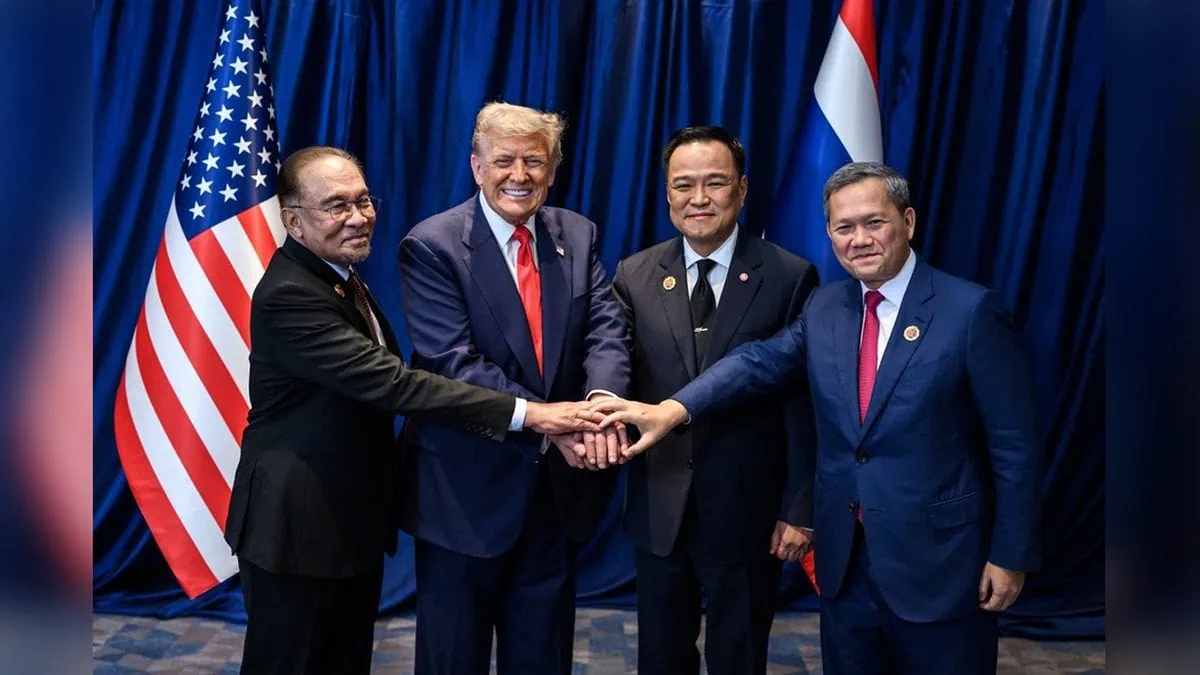 From left: Malaysian Prime Minister Anwar Ibrahim, US President Donald Trump, Thai Prime Minister Anutin Chanvirakul and Prime Minister Hun Manet during the signing of the KL accords in Malaysia. White House
One year ago, on October 26, 2025, Cambodia and Thailand signed the Kuala Lumpur Joint Declaration, marking an important diplomatic effort to de-escalate border tensions and manage a longstanding dispute peacefully. For Cambodia, its significance lies not merely in securing commitments from Thailand, but in protecting territorial integrity and restoring normal life to affected border communities.
The first anniversary raises a fundamental question: has the peace process delivered the security and humanitarian relief it promised?
The Royal Government of Cambodia deserves recognition for pursuing diplomatic engagement, defending the country’s territorial interests and working through regional mechanisms to contain tensions. The establishment of the ASEAN Observer Team (AOT) was an important step towards monitoring and verifying implementation of the ceasefire. Its personnel operate in a sensitive environment where impartial observation and effective communication can help prevent incidents from escalating.
Nevertheless, a peace agreement must be judged by its implementation, not simply its signature. The absence of sustained fighting is important, but lasting peace also requires progress towards restoring civilian livelihoods, addressing alleged violations, and resolving outstanding border issues peacefully.
One year after Kuala Lumpur, the unfinished business is both territorial and humanitarian.
The Commitments: From Kuala Lumpur to Civilian Return
The Joint Declaration of October 26, 2025 reaffirmed commitments to de-escalation, respect for international law and peaceful dispute resolution. It also established the AOT framework and recognised existing bilateral mechanisms, including the General Border Committee (GBC) and Joint Boundary Commission (JBC).
The Joint Statement of the Third Special GBC Meeting, signed on December 27, 2025, subsequently established more detailed operational commitments. Paragraphs 1 and 2 address the ceasefire and the maintenance of existing troop deployments without further movement towards the other side’s positions. Paragraph 3 provides that the arrangements do not prejudice the international boundary or its demarcation.
Most importantly, paragraph 4 commits both parties to allow civilians residing in affected border areas to return at the earliest opportunity, without obstruction and in safety and dignity, to their homes and normal livelihoods on their respective sides.
Paragraph 12 recognises the AOT’s role and provides for strengthening its verification function in consultation with the ASEAN Chair and the AOT itself.
These commitments provide a basis for demanding practical progress. However, they must be interpreted according to their actual wording and the AOT’s Terms of Reference. The AOT’s verification role should not be confused with judicial authority to determine sovereignty or enforcement powers that have not been expressly conferred.
The 2000 Memorandum of Understanding on the Survey and Demarcation of Land Boundary also remains relevant. Together with subsequent agreements, it provides a framework for addressing boundary questions through established bilateral procedures. Neither a ceasefire line nor the temporary maintenance of military positions should, by itself, be treated as a final determination of sovereignty.
The objective must be to prevent temporary security arrangements from prejudicing the boundary settlement while ensuring that civilians do not remain displaced indefinitely.
Ground Realities: Displacement and the Risk of Entrenched Disputes
The central humanitarian question is straightforward: can affected Cambodian families safely return to their homes, cultivate their farmland and resume normal livelihoods?
Cambodia has alleged that Thai military personnel have maintained positions in areas claimed by Cambodia, erected barriers or fortifications, and restricted civilian access. Such allegations require independent verification of the precise locations, applicable boundary arrangements and conduct concerned. They should not automatically be treated as established legal findings.
Restricted access can have severe consequences. Families may lose harvests, income and access to property while remaining dependent on temporary assistance. These hardships demand urgent attention, regardless of whether the underlying territorial dispute has been finally resolved.
Where civilians are prevented from returning to areas on their own side, the parties should identify the obstacles and take practical steps to address them. Where the boundary remains disputed, interim arrangements should be pursued through agreed mechanisms without prejudicing either side’s legal position.
Physical installations and prolonged military presence may raise serious concerns if they contravene agreed arrangements or aggravate the dispute. A fence, observation post or period of physical control does not automatically transfer sovereignty or establish lawful title. Its legal significance depends on the evidence, location, applicable agreements and broader legal context.
The International Court of Justice’s 1962 judgment in the Temple of Preah Vihear case and its 2013 interpretation judgment remain important authorities within their defined territorial and legal scope. They should not be presented as having settled every separate section of the Cambodia–Thailand boundary.
Humanitarian demining must likewise remain focused on civilian protection. Both countries’ obligations under the Ottawa Convention and their agreed coordination arrangements should guide operations. Mine clearance should protect civilians, involve appropriate technical coordination, and avoid unnecessary obstacles to safe access.
The AOT: A Valuable Presence That Must Deliver Results
The AOT can improve communication, document incidents, support de-escalation, and provide a more reliable basis for responding to developments on the ground. Its effectiveness depends on cooperation, access, operational clarity, and timely communication of verified findings.
The public has a legitimate interest in understanding whether the agreed measures are being implemented. Operational confidentiality may be necessary to protect personnel and preserve diplomatic channels, but it should not prevent meaningful accountability. Equally, the absence of comprehensive public reporting does not, by itself, prove that the AOT has failed or that either party has obstructed its work.
A stronger approach would establish regular compliance assessments distinguishing verified incidents from allegations, identifying unresolved issues and recording corrective measures. Public summaries should be issued where operational considerations permit, while sensitive information remains protected.
Where observers cannot inspect a relevant location, the reason should be documented and alternative verification methods considered. Unresolved access disputes should be referred through agreed coordination mechanisms.
The AOT is not a supranational enforcement authority and should not replace the JBC or determine territorial sovereignty. Its value lies in credible verification, timely communication and preventing miscalculation. Its agreed mandate must be implemented effectively.
Peace cannot be measured by the silence of weapons alone. A ceasefire that reduces immediate military danger but leaves families unable to return, without a credible process for resolving their situation, remains incomplete.
Four Priorities for the Second Year
First, strengthen compliance reporting. Cambodia and Thailand should support regular assessments covering verified incidents, access restrictions, alleged fortifications and corrective action. Reports should distinguish established facts from unresolved allegations and provide sufficient transparency to build public confidence.
Second, establish monitored civilian-return arrangements. The parties should identify affected communities, document homes and farmland, assess security risks and establish practical procedures for safe return. Where appropriate, agreed access routes should be monitored consistently with the AOT’s mandate, without prejudicing the boundary dispute.
Third, ensure coordinated humanitarian demining. The Cambodian and Thai authorities should follow agreed procedures, coordinate with relevant technical and local authorities, and facilitate observation within the AOT’s mandate. Mine clearance must protect civilians and avoid unnecessary misunderstandings or restrictions.
Fourth, strengthen escalation procedures. Incidents that cannot be resolved locally should be referred promptly through relevant border coordination units, the GBC, and, where appropriate, the JBC. The ASEAN Chair and relevant ASEAN institutions should be engaged in accordance with applicable agreements and the ASEAN Charter. If existing arrangements prove insufficient, the parties should negotiate improvements rather than assume that additional powers already exist.
These measures are practical and consistent with the principle that border disputes must be resolved peacefully.
Sovereignty Must Be Accompanied by Human Dignity
The Royal Government of Cambodia has a legitimate responsibility to protect territorial integrity and pursue the safe return of displaced citizens through peaceful and lawful means. All parties must honour their commitments, avoid provocative conduct and refrain from unilateral actions that could aggravate the dispute.
Principle 28 of the UN Guiding Principles on Internal Displacement calls on competent authorities to establish conditions and provide means for displaced persons to return voluntarily, in safety and dignity, or to resettle voluntarily elsewhere. Its precise legal application depends on the circumstances, but its humanitarian objective is clear.
No family should remain indefinitely in uncertainty because diplomatic and boundary mechanisms move too slowly. Equally, civilians should not be encouraged to enter dangerous or disputed areas without adequate safety arrangements. The priority is a lawful, secure and sustainable return — not unilateral action that risks renewed confrontation.
As Cambodia and Thailand enter the second year after Kuala Lumpur, progress should be measured by concrete results: fewer incidents, reliable verification, effective cooperation on demining, restored civilian livelihoods and meaningful movement towards resolving outstanding boundary questions.
The AOT has an important role, but its effectiveness depends on cooperation and implementation of its agreed mandate. ASEAN’s credibility likewise depends on helping its members manage disputes responsibly and honour their commitments.
Sovereignty is not secured by rhetoric alone. It is protected through law, responsible diplomacy, verifiable conduct and the ability of citizens to live safely on their own land.
One year after the Kuala Lumpur declaration, Cambodia’s displaced communities deserve more than assurances. They deserve a credible process, transparent progress and the earliest safe and dignified return consistent with the agreements. That is an essential test of whether the peace process can deliver the stability, security and mutual respect it was designed to achieve.
Long Panhavuth is founder and attorney-at-law at Pan & Associates Lawfirm. The views and opinions expressed are his own.
-Phnom Penh Post-