‘Two Cambodias’; UN rights envoy urges government to change course
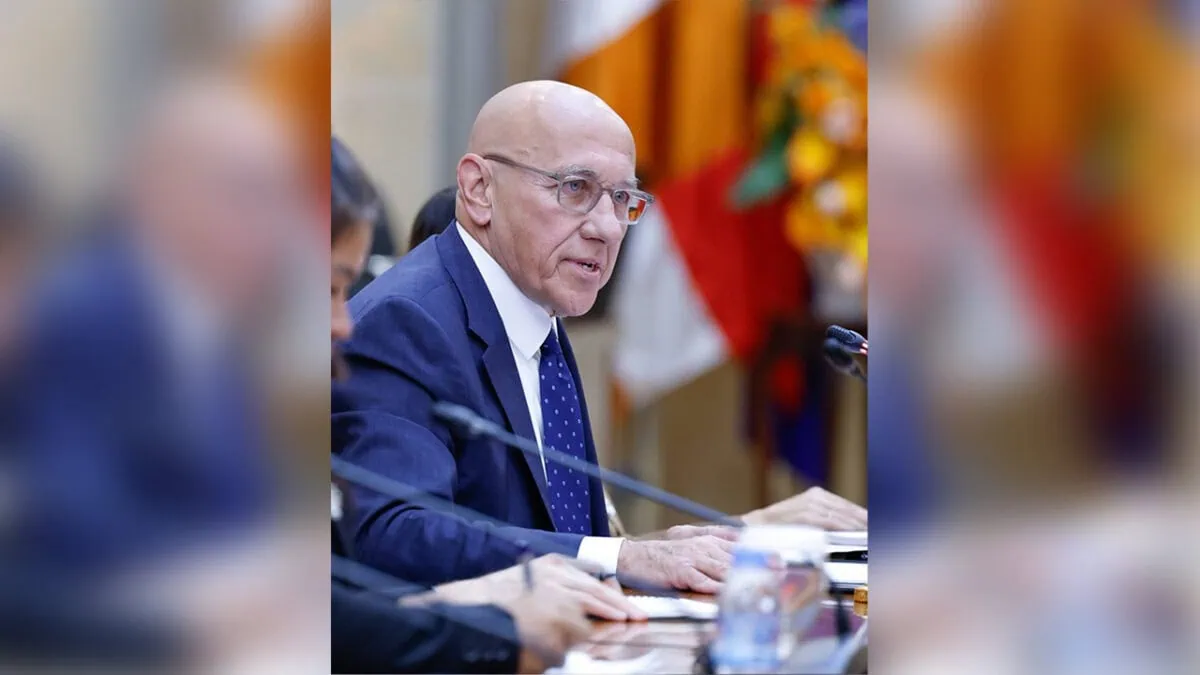 UN special rapporteur Thomas H. Andrews has called for civilians displaced by last year’s conflict to be allowed to return home, while also warning of serious human rights restrictions. AKP
UN special rapporteur on the situation of human rights in Cambodia Thomas H. Andrews has described Cambodia as a country divided between two contrasting realities — one that publicly commits to human rights and the rule of law, and another where fundamental freedoms are “restricted” and people are “detained for exercising their rights”.
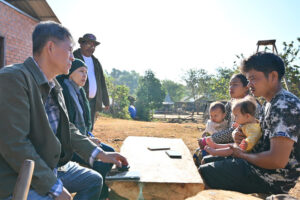
During his time in the Kingdom, Andrews visited several temporary settlements and spoke to some of the almost 20,000 Cambodian civilians who remain displaced by last year’s border conflict. He called for them to be allowed to return home, as stipulated in the Joint Declaration which accompanied the December 27, 2025, ceasefire agreement.
He also highlighted what he called restricted fundamental freedoms.
In a September 25 report to the UN Human Rights Council, Andrews noted that Cambodia has repeatedly affirmed its commitment to human rights, ratified eight of nine core human rights treaties and supported 84 per cent of recommendations made during its latest Universal Periodic Review.
He also noted the government’s cooperation with UN human rights mechanisms and his own access to officials, civil society groups and detention facilities during his July visit.
But he warned that a second Cambodia exists alongside this record — one in which freedom of expression and civic space are severely restricted, repressive laws are applied against political opponents, and human rights defenders, activists and journalists are detained.
“Viewed through a human rights prism, there are two Cambodias,” Andrews wrote, contrasting the country’s international commitments with what he described as continuing domestic rights violations.
The special rapporteur said he had examined cases of alleged arbitrary arrest and detention and believed that more than 100 people may have been detained for exercising fundamental freedoms, with credible independent reporting suggesting the number has roughly tripled since the beginning of 2024.
He also raised concerns about trials, saying defendants have sometimes been convicted without evidence being presented for key elements of alleged offences.
He further highlighted restrictions affecting civil society organisations, trade unions and independent media.
The report says fear of criminal prosecution or reprisals has contributed to widespread self-censorship, while the Law on Associations and Non-Governmental Organizations has been used in ways that restrict civic activities. Independent unions have also faced lengthy delays or rejection of registration, while journalists have reported pressure, legal threats and restrictions that limit their ability to report freely.
“Cambodia is at a crossroads,” Andrews said, warning that the government must decide whether to advance respect for human rights or move toward “greater repression”.
The report acknowledged Cambodia’s socioeconomic progress, however.
He noted major reductions in poverty, improvements in life expectancy, education, electricity, water and sanitation, while noting that several serious challenges remain, including household indebtedness, lending issue, land-grabbing, forced eviction, deforestation and climate change.
Andrews called on the government to release people detained for exercising their rights, remove restrictions imposed after their release and undertake judicial reforms to guarantee fair trials and judicial independence. His remarks also mentioned the cases of opposition figures Kem Sokha and Rong Chhun.
He also recommended reducing pretrial detention, expanding alternatives to imprisonment and addressing overcrowding in prisons. The report suggested that courts should issue written and public judgments explaining the factual and legal basis of their decisions.
Andrews urged Cambodia to reform or repeal laws that he says are inconsistent with international human rights standards. He also called for proposed cybercrime, cybersecurity and “fake news” legislation to comply fully with international standards.
“Where there is political will, there is a way,” Andrews wrote, pointing to the government’s recent crackdown on cyberscam operations as evidence that significant changes can occur when the necessary political will exists.
He concluded by urging the government to use its existing international human rights commitments as a foundation for concrete action, saying meaningful reform would improve the rights, dignity and quality of life of Cambodians.
“The hope for Cambodia resides in its people and the leaders and organisations that are committed to building a future in which human rights are respected,” Andrews said.
Government spokesperson Pen Bona responded, insisting that the government respects all relevant conventions on human rights.
“Regarding freedom of expression, I would like to clarify that the Royal Government fully respects and implements the Constitution of Cambodia and the International Covenant on Civil and Political Rights, as well as the Universal Declaration of Human Rights,” he said.
He highlighted Article 41 of the constitution, which states that Khmer citizens shall have freedom of expression, freedom of the press, freedom of publication and freedom of assembly. However, no one should abuse these rights to affect the honour of others, morality, public order or national security, he warned.
On the issue of press freedom, he raised Article 19(3) of the International Covenant on Civil and Political Rights, which states that the exercise of the rights carries with it special duties and responsibilities.
“It may therefore be subject to certain restrictions, but these shall only be such as are provided by law and are necessary: (a) For respect of the rights or reputations of others; (b) For the protection of national security or of public order, or of public health or morals,” he said, citing he article.
He also pointed out to Article 29(2) of the Universal Declaration of Human Rights which states that the exercise of rights and freedom has its limitations as determined by law for the purpose of securing due recognition and respect for the rights and freedoms of others, just requirements of morality, public order and the general welfare of a democratic society.
“In Cambodia, more than 17 million citizens express their views every day and extensively through various means, especially on social media. They encounter no problems at all, except for a small number of people who violate the law and infringe upon the rights of others under the pretext of freedom of expression,” he claimed.
“Therefore, what is important is to express opinions with dignity, in respect of the law, and in respect of the rights of others, which is the core of democracy practiced throughout the world,” he added.
-Phnom Penh Post-