A New Chapter of Cambodia-Japan Relations in Defence Ties and a Free and Open Indo-Pacific
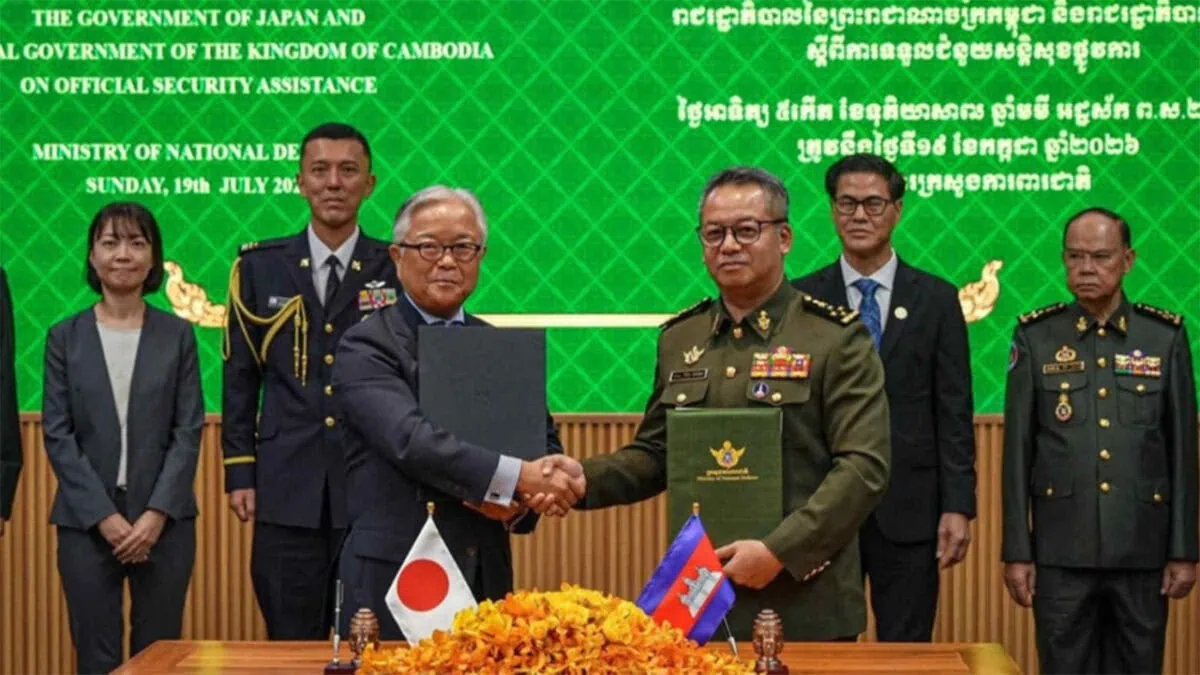 Japanese and Cambodian officials meet to sign the Official Security Assistance agreement. Keito Nakaoka
This modest yet symbolically significant step marks a qualitative shift in bilateral defence cooperation and advances Japan’s Free and Open Indo-Pacific (FOIP) vision in a strategically important corner of Southeast Asia.
OSA, launched in 2023, is a Japanese grant-aid framework that supplies equipment, materials, and related infrastructure support to the armed forces of partner countries. Its goals are to strengthen recipients’ security and deterrence capabilities, deepen security cooperation with like-minded nations, foster a favourable security environment for Japan, and contribute to regional and international peace.
Cambodia becomes the latest ASEAN recipient — reports describe it as the fifth in the grouping — following earlier packages such as coastal surveillance radars for the Philippines and disaster-response equipment for Thailand.
Japan’s Ministry of Foreign Affairs underscored Cambodia’s importance in the official statement: the country sits at the core of the Southern Economic Corridor in the Mekong region and is a Comprehensive Strategic Partner of Japan. Its development, Tokyo noted, is vital for stability and prosperity not only in ASEAN but across the wider region.
The assistance is expected to enhance Cambodia’s security capabilities while promoting bilateral security cooperation and contributing to regional peace and stability. Critically, the communications equipment is designed to create synergy with an existing exchange program between Japan’s Ground Self-Defense Force and the Royal Cambodian Army. The aim is to help establish Cambodia’s first military communications school.
Ambassador Ueno, who was concluding his tenure at the time, described the agreement as evidence that security cooperation had entered “a new stage”. He linked the provision of patrol boats to a shared interest in freedom of navigation. Earlier milestones, including the docking of two Japan Maritime Self-Defense Force vessels at the modernised Ream Naval Base in April 2025 —reportedly the first foreign vessels to do so after the base’s upgrade — had already signalled growing comfort with practical defence engagement.
The OSA package builds directly on that foundation.
The timing and context matter. Japan and Cambodia elevated their relationship to a Comprehensive Strategic Partnership in 2023, the 70th anniversary of diplomatic ties. Economic cooperation, development assistance through JICA, people-to-people exchanges and cultural initiatives have long formed the backbone of the “heart-to-heart” relationship. Defence and security had lagged behind but accelerated under the partnership framework.
The OSA decision was reportedly referenced in high-level talks during then-Prime Minister Ishiba’s engagement with Cambodian leaders. It arrives as Cambodia continues to maintain close political, economic and security ties with China while pursuing what some observers call an “additive” or multi-aligned foreign policy. Japan’s approach emphasises capacity-building rather than exclusive alignment, offering equipment and training that strengthen Cambodia’s own institutions.
From Tokyo’s perspective, the package advances FOIP objectives. A more capable Cambodian navy contributes to maritime domain awareness and freedom of navigation in waters that form part of vital sea lanes. Improved army communications enhance command-and-control, supporting both national defence and potential contributions to regional stability mechanisms. Japan has also provided practical support related to the Cambodia-Thailand border situation, including equipment for ASEAN observer teams, reinforcing its preference for peaceful, rules-based dispute resolution.
For Cambodia, the assistance supports modernisation of the Royal Cambodian Armed Forces at a relatively low cost and without the political complications sometimes associated with larger-power arms transfers. The communications school, in particular, represents an institutional investment with long-term value. Patrol boats improve coastal and riverine security capabilities relevant to both sovereignty and non-traditional threats.
In an era of expanding defence budgets and multi-partner engagement — Cambodia has also deepened ties with other countries in recent years — Japanese support fits a pattern of diversified partnerships.
The scale of the package remains limited. Half a billion yen is modest compared with major infrastructure loans or China’s broader economic footprint. Yet its significance lies less in dollar value than in the precedent and the institutional links it creates. OSA is designed not only to transfer hardware but to open channels for ongoing dialogue, training, and confidence-building. Ambassador Ueno’s comments after the signing suggested that further concrete cooperation would be explored jointly.
Looking ahead, this first OSA project could serve as a foundation for expanded security dialogue, more frequent military exchanges and additional capacity-building initiatives. It complements Japan’s wider engagement in the Mekong region and its emphasis on ASEAN centrality.
For Cambodia, it offers another avenue to strengthen national capabilities while navigating great-power dynamics. For the region, it illustrates how middle-power diplomacy — focused on practical assistance, institutional development, and shared principles of openness and stability — can still shape security architecture even amid intensifying strategic competition.
The July 2026 agreement is therefore more than a one-off grant. It represents a tangible expression of the Comprehensive Strategic Partnership in the security domain and a concrete contribution to the Free and Open Indo-Pacific.
By helping Cambodia enhance its own security tools and by embedding cooperative practices between the two armed forces, Japan and Cambodia have opened a new chapter — one that prioritises capability, dialogue and regional stability over zero-sum rivalry. As both sides implement the package and explore follow-on measures, the real test will be whether this modest beginning matures into sustained, mutually beneficial defence cooperation that strengthens the rules-based order both countries publicly endorse.
Dr. Seun Sam is a policy analyst at the Royal Academy of Cambodia. The views and opinions expressed are his own.
-Phnom Penh Post-