An open response to Thai Ambassador Cherdchai Chaivaivid at the Un General Assembly
Dear Ambassador Cherdchai Chaivaivid,
You spoke before the UN General Assembly on September 28, declaring that Cambodians who remain in areas originally established as temporary shelters in the 1970s have failed to return home and that their continued presence amounts to an encroachment on Thai territory.
The international community deserves more than a single version of this history. It deserves the facts, the historical context and the voices of the people who lived through these events.
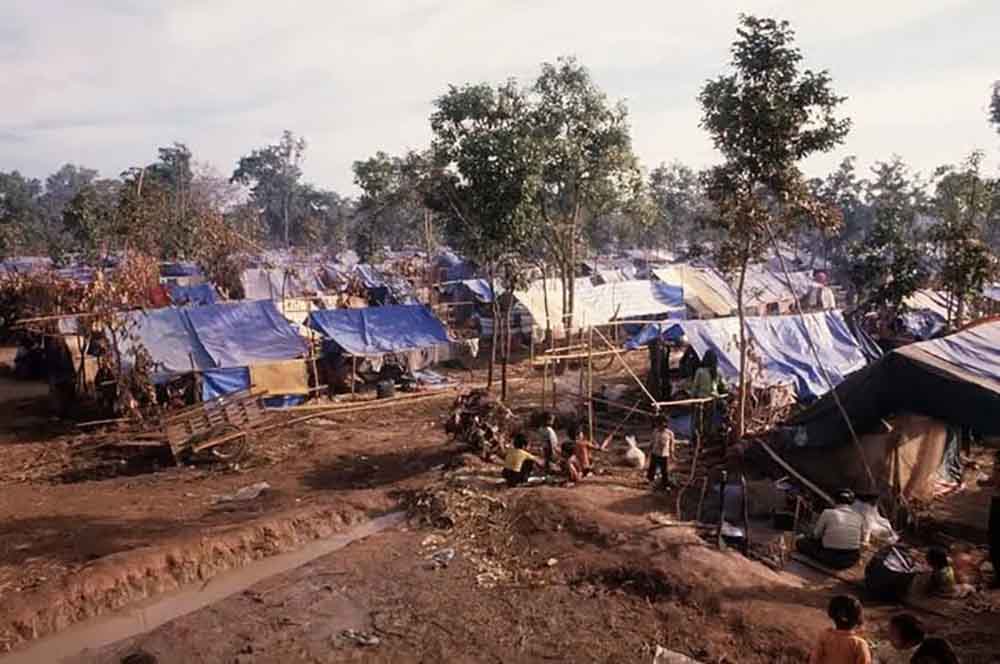
Cambodia’s refugee crisis did not begin because Cambodians simply decided to occupy another country’s territory. It emerged from war, political violence, displacement and insecurity following the collapse of the Khmer Rouge regime in 1979.
Thousands of Cambodian civilians fled towards the Thai border in search of safety. The scale of the crisis was so severe that it became an international humanitarian emergency, drawing assistance from UN agencies, the International Committee of the Red Cross and numerous international and local organisations.
US government records, for example, document First Lady Rosalynn Carter’s visit to Thailand in November 1979, when she witnessed the conditions faced by Cambodian and other Indochinese refugees, including children suffering from malaria and malnutrition.
That history matters. The camps were not simply settlements that appeared without cause.
Thailand’s role must be examined honestly
Thailand provided refuge and humanitarian assistance, and that contribution should be acknowledged. But acknowledging it does not mean that every action taken by Thai authorities during the refugee crisis should escape scrutiny.
In 1979, US diplomatic records and congressional documents described the forced return of Cambodian refugees and the dangers faced by people pushed back into areas containing mines and other hazards. Thailand later changed its policy towards accepting Cambodian refugees for temporary asylum.
The historical record therefore contains both humanitarian assistance and serious controversies over the protection of refugees.
If Thailand wants the international community to examine the past, it should be willing to examine the entire record, including the parts that are uncomfortable.
The camps were also part of the Cold War
Another essential part of the story is the geopolitical struggle surrounding Cambodia during the 1980s.
Cambodia became caught in a regional conflict involving Vietnam, China, the Soviet Union, Thailand, the United States and competing Cambodian political and military factions. The refugee camps and settlements along the Thai border consequently acquired significance beyond their humanitarian purpose.
Former UN High Commissioner for Refugees Sadako Ogata described how geopolitical considerations influenced the treatment of Indochinese refugees and how some international actors supported Cambodian resistance factions along the Thai border as a counterweight to the Vietnamese-backed government in Phnom Penh.
This does not mean that refugees should be portrayed as combatants. Nor did every camp serve the same purpose.
It does mean that the history cannot be understood solely through the humanitarian label of “temporary shelter”. Security concerns, political interests and humanitarian needs existed alongside one another, while ordinary Cambodian families often had little control over the forces shaping their lives.
That context is essential when discussing how and why Cambodian communities came to live along the border.
Were the camps simply temporary shelters?
The word “temporary” also requires context.
Some Cambodian refugees remained in camps for years. Khao-I-Dang, established in 1979, eventually sheltered nearly 140,000 refugees at its peak and remained open until 1993. Along the border, displaced populations experienced insecurity, evacuations and changing conditions as the conflict continued.
For families who had lost homes, land and possessions, a camp could be the only place where they believed they could survive. The fact that a settlement was originally intended to be temporary does not, by itself, establish that every person there could safely return immediately.
But this point must also be applied carefully.
The existence of refugee camps decades ago does not automatically determine the legal status of people living in a particular border location today. That question requires present-day evidence.
The refugees did return
The signing of the 1991 Paris Peace Agreements fundamentally changed Cambodia’s political circumstances.
Beginning in March 1992, UNHCR supported the return of approximately 370,000 Cambodian refugees from the Thai border to areas of their choice in Cambodia, in time to participate in UN-supervised elections.
Their return demonstrates why the refugee story cannot simply be reduced to an accusation that people “failed to return home”. Their repatriation required a political settlement, international coordination, transportation, reintegration assistance and conditions in which people could rebuild their lives.
The refugee crisis was ultimately addressed through an international peace process, not simply through a demand that displaced people leave.
If Thailand has a territorial claim, let the evidence be examined
Ambassador, Thailand has a legitimate interest in protecting its territorial integrity. Cambodia has the same right.
But a territorial dispute cannot be resolved fairly through historical rhetoric alone.
If Thailand believes that particular Cambodian families or communities are living on Thai territory, it should identify the precise locations and present the relevant evidence: applicable boundary instruments, maps, historical records, the circumstances in which settlements were established and evidence concerning the present population.
Cambodia should likewise present its own legal position and evidence.
Neither the history of refugee camps nor the passage of time automatically determines sovereignty. Equally, that history should not be erased when examining how people came to live in a particular area.
Where a genuine boundary dispute exists, the parties should use appropriate bilateral mechanisms and peaceful procedures under international law. Where civilians face humanitarian difficulties, their safety and dignity should remain a priority.
The international community should be able to examine the evidence impartially rather than being asked to accept either government’s narrative without scrutiny.
Cambodia’s history deserves to be heard
Ambassador Cherdchai, you addressed representatives of the international community from the UN General Assembly podium. That carries an important responsibility.
The UN is not simply a place where governments defend national positions. It is also an institution through which the international community remembers humanitarian tragedies, examines evidence and seeks peaceful solutions to disputes.
Cambodians remember the years when their country was devastated, when families fled towards the border, when international organisations established relief operations and when the fate of refugees became entangled in Cold War politics.
That history cannot be reduced to a statement that people did not return home.
I am not asking Thailand to abandon its position. I am asking it to acknowledge the complete history and allow the evidence to be examined fairly.
If Thailand wishes to discuss the presence of Cambodians in former refugee areas, it should also explain the circumstances that created those areas, the role of international humanitarian organisations, the political and military realities of the Cold War and the subsequent international effort to return displaced people to Cambodia.
If the question is territorial sovereignty today, let the relevant legal instruments, maps and evidence be examined through peaceful and appropriate procedures.
If the question concerns people whose residence is disputed, let their individual circumstances be investigated with humanity and impartiality.
Above all, the suffering of ordinary people should not become a political instrument while their history is left unexplained.
Thailand may present its national position before the UN. Cambodian people have the same right to have their history heard.
A lasting peace between Cambodia and Thailand cannot be built on selective history, mutual accusations or competing national narratives. It requires historical honesty, respect for international law, protection of civilians and a willingness to examine the facts together.
The past must be acknowledged honestly if the two neighbouring nations are to build a more peaceful future.
Tesh Chanthorn
Tesh Chanthorn is a Cambodian citizen who longs for peace. The views and opinions expressed are his own.