The big wave of global transformation
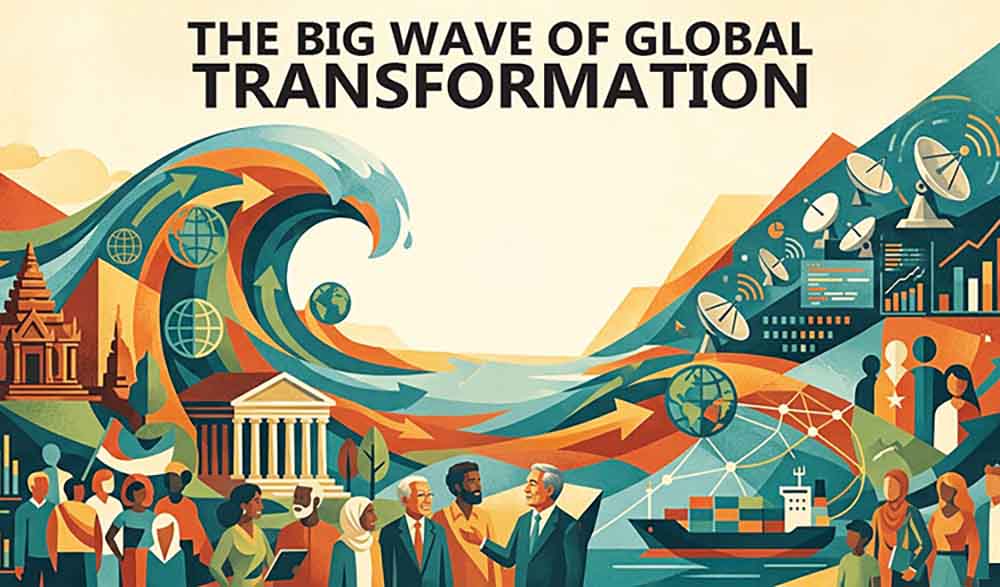 A montage representational image: Power is shifting, economic influence is being redistributed, and technology is reshaping the foundations of global strength as geopolitical competition, climate change, artificial intelligence, and transnational challenges test the international order. AI-GENERATED image
#opinion
The world is not merely experiencing another period of turbulence. We are living through the most consequential structural transformation of the international system
Power is shifting. Economic weight is being redistributed. Technology is changing the sources of national strength.
Geopolitical competition is intensifying. Trade, finance, supply chains and even technological standards are increasingly intertwined with national security.
At the same time, climate change, artificial intelligence, cyber threats, transnational crime and demographic pressures are creating challenges that no country can manage alone.
What we are witnessing is a big wave of global transformation.
The international order that emerged after the Second World War, and which evolved considerably after the end of the Cold War, is being tested by realities very different from those for which many of its institutions were designed.
The central question is therefore whether this transformation can be managed peacefully, inclusively and responsibly, and how we can navigate and adapt.
The first dimension of the transformation is the redistribution of global power.
For much of the post-Cold War era, international affairs were frequently described through the language of unipolarity. That description is obsolete. Economic and political influence is becoming distributed across a wider range of states and regions.
Some argue that the post-American order is giving way to a multipolar world. But, as Professor Amitav Acharya notes, today’s emerging order is fundamentally different from the multipolarity of the pre–World War II era.
Then, world politics was dominated by a small number of imperial great powers, while today power is dispersed among states, international and regional institutions, corporations, NGOs, social movements and other transnational actors.
Economic interdependence is also far deeper and more global, extending beyond trade into finance, production networks and supply chains, while international and regional institutions are far denser and more durable.
The nature of security challenges has also changed. Traditional interstate conflict is no longer the only—or even necessarily the principal—source of instability. Intrastate conflict, terrorism, climate change, pandemics, human trafficking, drugs, online scams, and other transnational threats increasingly shape national and international security. The twenty-first-century order is therefore not simply a return to old-style multipolarity, but a far more interconnected, institutionalised and complex form of global politics. He calls it a “multiplex world”.
The growing weight of Asia, the increased importance of emerging economies, the expansion of South-South economic relations and the stronger diplomatic voice of developing countries are changing the geometry of international relations.
This shift should not simply be understood as the “decline” of one group of countries and the “rise” of another. The transformation is more complex. New centres of economic, technological and political influence are emerging simultaneously.
Middle powers are becoming more active. Regional organisations are assuming greater importance. Countries of the Global South are seeking greater agency in shaping rules that affect their development and security.
The second transformation concerns globalisation itself.
For several decades, economic interdependence was largely discussed as a source of efficiency and prosperity. Today, governments increasingly view the same interdependence through the lens of resilience, vulnerability and national security.
Supply chains can become strategic assets. Technology can become an instrument of competition. Energy dependence can create vulnerability. Financial networks can provide leverage. Export controls, sanctions, industrial policies and tariffs increasingly occupy the space where economics and geopolitics intersect.
The IMF describes this new environment as one in which geoeconomic considerations have moved to the centre of international relations.
Greater efforts by countries to reduce strategic dependence may improve resilience individually, but taken too far they can generate a cycle of fragmentation that ultimately leaves the international economy poorer and less efficient.
The WTO has likewise warned that geopolitical rivalry, government intervention, technological change and shifts in economic power are putting unprecedented pressure on the multilateral trading system. It describes global trade cooperation as being at a critical juncture.
This creates one of the central dilemmas of our age: countries want the benefits of global economic integration while simultaneously seeking protection from the vulnerabilities that integration can create.
The emerging model of globalisation will therefore probably look different from the previous one. It may involve greater diversification, more regional production networks, stronger emphasis on resilience and strategic autonomy, and more competition over critical technologies and resources.
The challenge will be preventing legitimate efforts to strengthen resilience from accelerating into destructive fragmentation.
A third transformation is technological revolution.
Artificial intelligence, advanced computing, robotics, digital platforms and cyber capabilities are reshaping productivity, security and political influence, making technological capacity an increasingly important source of national power.
This transformation also raises urgent questions of governance: who sets the rules for AI, how developing countries can avoid a widening digital divide, and how innovation can be advanced without undermining security or social cohesion.
Chheang Vannarith is Chairman of the National Assembly Advisory Council. The views expressed in this article are his own.
-Khmer Times-