Where Was Thailand’s Respect for International Law?
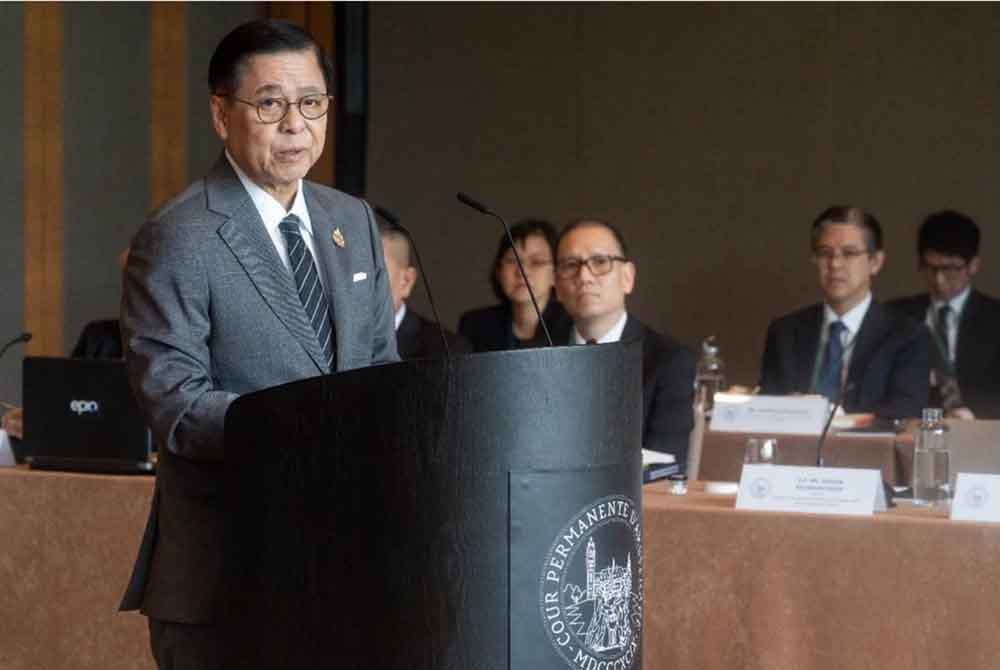 Thai foreign minister Sihasak Phuangketkeow addresses the UNCLOS conciliation committee on September 15. Supplied
#Opinion
A response to Thai foreign minister Sihasak Phuangketkeow.
When Thai foreign minister Sihasak Phuangketkeow asked, “Where was Cambodia’s respect for international law?” during the first meeting of the Thailand-Cambodia Conciliation Commission under the UN Convention on the Law of the Sea (UNCLOS) in Singapore today, September 15, I believe Cambodia has every right to ask a reciprocal question:
Where was Thailand’s respect for international law when Cambodian territory, cultural heritage and civilian communities were suffering the consequences of armed conflict?
Thailand and Cambodia have now brought their maritime dispute before an international conciliation process. That is precisely where both countries should place their differences before international law, evidence and independent observation rather than competing political narratives. The UNCLOS process began in Singapore on September 15 and is intended to provide a peaceful mechanism for addressing the maritime dispute.
But international law cannot be remembered only when it is convenient.
Cambodians have witnessed the consequences of military confrontation along their border. Questions remain about the damage caused to historic sites and surrounding areas, including the area around the Preah Vihear Temple, as well as Ta Krabei and Tamone temples. Recent reporting from media outlets says that Tamone, Ta Krabei and Khnar temples in Oddar Meanchey suffered extensive damage during the conflict.
Preah Vihear is not simply a piece of disputed territory. It is a UNESCO World Heritage site and a symbol of Cambodia’s ancient civilisation. The International Court of Justice ruled in 1962 that the Temple of Preah Vihear is situated in territory under the sovereignty of Cambodia, and in 2013 the Court clarified the scope of the area around the temple belonging to Cambodia.
The question therefore should not be reduced to which side claims to be the victim.
The question should be: What happened, where did it happen, who caused the damage, and what does international law require from both sides?
If artillery, rockets or other weapons struck Cambodian territory, the locations of impact can be documented. Craters can be measured. Damaged buildings can be photographed and mapped. Fragments of ammunition can be collected and examined. Satellite imagery can establish changes before and after military operations. Independent international observers can interview affected communities and inspect the physical evidence.
And there is another painful legacy that Cambodia knows all too well: unexploded ordnance.
If unexploded ammunition or remnants of cluster munitions remain in Cambodian territory, they do not disappear simply because the fighting has stopped. They remain a danger to farmers, children, returning families and communities attempting to rebuild their lives.
Therefore, instead of asking only, “Where was Cambodia’s respect for international law?”, I would respectfully ask Foreign Minister Sihasak:
Where was the protection of Cambodian civilians under international humanitarian law?
Where was the protection of Cambodia’s cultural heritage?
Where was the obligation to distinguish between military targets and civilian objects?
Where was the obligation to prevent unnecessary suffering and damage?
And perhaps most importantly:
How many Cambodian families are still unable to return safely to their homes because of the consequences of the fighting?
These are not questions that should be answered by political rhetoric.
They should be answered by evidence.
If Thailand believes Cambodia has violated international law, Cambodia should be prepared to face an impartial investigation. But the same standard must apply to Thailand. An international investigation should examine alleged violations by both sides, without fear or favour.
International law cannot be a weapon used against one’s neighbour while its application to one’s own conduct is avoided.
The people living along the border do not want another war. They want to return home. They want their farms back. They want their schools, temples and communities rebuilt. They want to walk across their own land without fear of mines or unexploded ammunition.
And the families who remain displaced should not become forgotten statistics.
Thailand and Cambodia will remain neighbours. Their peoples will continue to share history, culture, trade and geography long after today’s politicians have left office.
That is why the answer to this crisis should not be another cycle of accusation and counter-accusation.
Let international observers come.
Let the evidence be collected.
Let the damaged sites be documented.
Let unexploded ordnance be identified and safely removed.
Let displaced civilians be heard.
Let satellite imagery, military records, photographs, forensic evidence and independent witnesses speak for themselves.
And above all, let international law apply equally to everyone.
If Thailand sincerely asks where Cambodia’s respect for international law was, Cambodia should answer:
Here — before the international community, before the evidence, and before the law.
But Cambodia can also ask Thailand
Are you prepared to stand before the same law, under the same scrutiny, with the same openness to independent investigation?
That is the real test of respect for international law.
Tesh Chanthorn is a Cambodian citizen who longs for peace. The views and opinions expressed are his own.
-Phnom Penh Post-