Hun Manet urges patience as Cambodia seeks to reclaim occupied territory
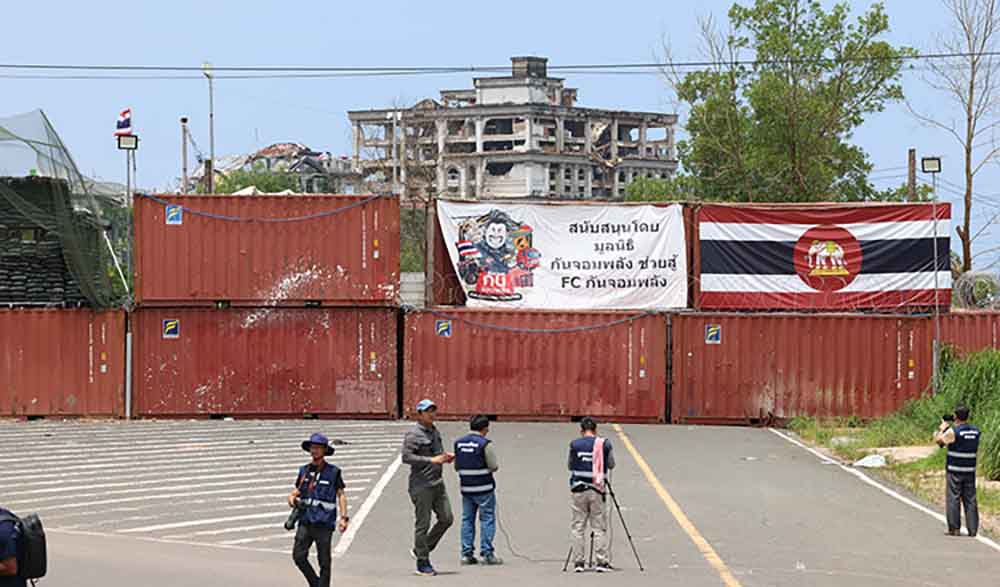
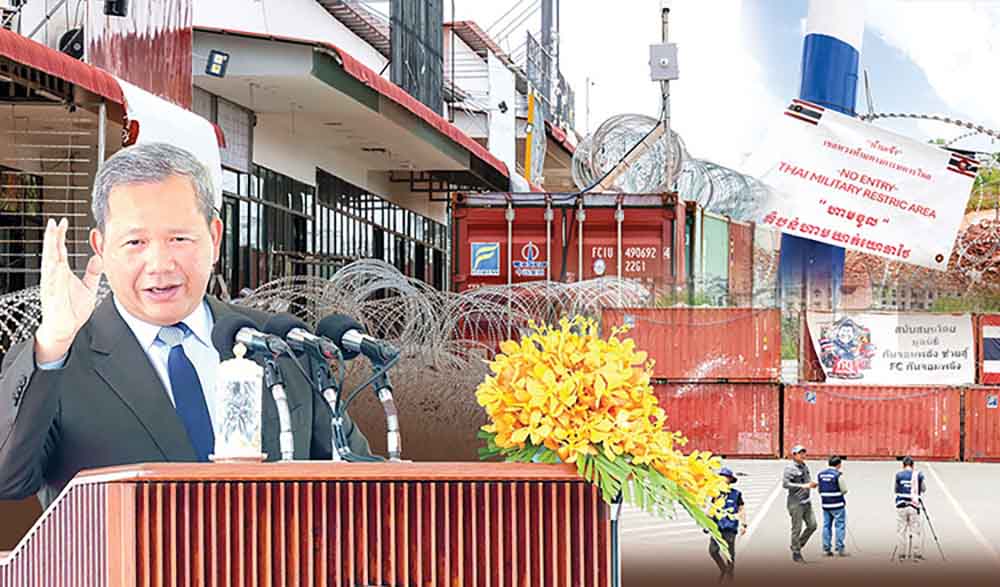 Montage shows Prime Minister Hun Manet against a backdrop of illegal Thai barricades and the flag of Thailand on Cambodian territory in the Thma Da area of Veal Veng district, Pursat province amid a ceasefire. KT/Khem Sovannara
Synopsis: The Prime Minister defends the government’s reliance on diplomacy and international legal mechanisms to resolve border dispute with Thailand, stating that temporary loss of control over land does not equal a surrender of sovereignty.
Prime Minister Hun Manet acknowledged that Cambodia lost control over some areas following fighting with Thai forces but insisted the country has not lost the territories themselves, urging citizens to endure temporary hardships while the government pursues legal and diplomatic solutions.
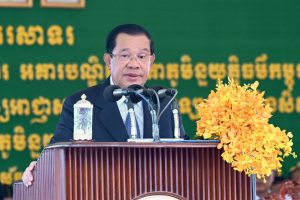
Speaking at the inauguration of the Queen Mother Hospital on Tuesday, Mr Hun Manet addressed criticism that the government was neglecting territorial issues. He said the claims overlooked continuous efforts to defend national interests.
“Some people say that the government spends its days attending inaugurations and does not think about the territory. But we think about it every day. We have never forgotten the territorial issue, not even for a second,” he said.
He said Cambodian troops remain stationed along the front line to protect the nation and prepare to defend national land.
“Our troops are still standing at the front line to prevent and protect the nation. They have not abandoned anything. Our commanders who are stationed there are prepared to fight. There has never been a moment when they have surrendered territory to anyone,” he said.
Mr Hun Manet drew a distinction between losing control over areas after armed clashes and formally losing territory.
“Yes, we have lost control in some areas after the fighting. But ask whether there is any place where our soldiers and police did not die or suffer injuries. Did we surrender those places? Did the government order them to surrender? No,” he said.
He stated that Cambodia has not signed any agreement transferring land to Thailand, noting that a formal loss of territory requires an agreement approved and signed by the government.
“If we say that we have lost territory, then the government would have to sign and agree to give it away. We have not signed such an agreement,” he said.
He rejected claims that ceasefire arrangements resulted in giving up land, explaining that the agreements aimed to halt fighting rather than determine borders.
“The agreement to stop fighting was not an agreement to give land to anyone. It was an agreement to stop the fighting at the positions where the two sides were located,” he said.
Mr Hun Manet said stopping the fighting prevented endless clashes caused by suspicion and confrontation. He added that the border is determined by the Joint Boundary Commission (JBC) based on existing treaties.
Mr Hun Manet said stopping the fighting prevented endless clashes caused by suspicion and confrontation. He added that the border is determined by the Joint Boundary Commission (JBC) based on existing treaties.
“The border line is not determined by this agreement. The border line must be determined by the JBC, which has to conduct measurements according to the existing treaties,” he said.
The Prime Minister said Cambodia has not agreed to a new border line, explaining that field work involves locating existing border markers.
“There is no new border line to be made. When officials go to the field, they are not going there to establish new border markers. They are going there to find the locations of the markers,” he said.
He noted that if the markers are found to be inconsistent with treaties, they must be moved.
Mr Hun Manet said legal solutions would take time but said the government chose this approach to prevent further bloodshed. He urged citizens to weigh temporary hardships against the consequences of renewed armed conflict.
“Some people say, ‘This will take too long.’ Then what do you want us to do? Do you want us to fight again?” he asked.
Cambodia should not rush into conflict while diplomatic, legal and international mechanisms remain available, he said.
“As long as we still have the capacity to resolve the issue, the door for negotiations remains open. We can use the law, diplomacy, the military, friendly agreements and the JBC. We still have opportunities, and I ask our people to understand this,” he said.
Thai forces raise the flag of Thailand on occupied Cambodian territory in in the Thma Da area of Veal Veng district. KT/Khem Sovannara
Mr Hun Manet pointed to the war in Ukraine as an example of the consequences of prolonged military confrontation.
“I choose the peaceful solution first because in other countries, more than a million people have died (in wars). We see soldiers being captured. We see people being conscripted at increasingly older ages, and foreign mercenaries being brought in from both sides,” he said.
He said the government’s responsibility is to resolve the dispute without creating a cycle of war affecting future generations. He added that recent fighting caused suffering, displacement and disruption to border livelihoods, making the ceasefire necessary to allow civilians to move to safer areas.
“It was to allow our people to take a breath. They had suffered and lost their homes, but at least they were able to come to places where they were safe from shelling,” he said.
Mr Hun Manet said the conflict affected Cambodia’s economy, tourism and development, adding that declines in visitor numbers were linked to war imagery and security concerns surrounding online scam operations.
“This is why we have to fight these problems and resolve them in a short period, because they affect the people,” he said.
Mr Hun Manet said Cambodia will continue using all available mechanisms to protect its territory, citing the past return of 18 detained Cambodian soldiers through international engagement rather than military action.
“It could have been resolved in two days, but it took 151 days. Some people even thought the government had forgotten them and that the lives of eight or 10 soldiers had no value,” he said. “But we did not forget. At every international forum, with the United Nations, human rights organisations and the International Red Cross, we raised the issue and discussed it.”
He said the government engaged foreign leaders and international institutions to resolve the matter.
“We did not send troops to fight and retrieve them. We used methods of resolution. It took a long time, but we accomplished the mission, and they returned to their families,” he said, adding that peaceful methods deliver results through patience.
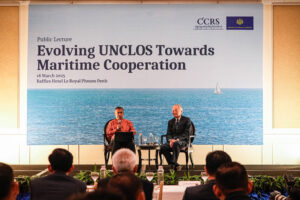
Turning to the maritime dispute with Thailand, Mr Hun Manet said pursuing compulsory dispute resolution under the United Nations Convention on the Law of the Sea (UNCLOS) was part of a considered strategy after Thailand withdrew from a memorandum of understanding.
“When Thailand withdrew from the MOU, we had no choice but to go to the compulsory dispute-resolution mechanism,” he said.
He said a legal team led by Deputy Prime Minister Prak Sokhonn prepared for the proceedings.
“Our legal team worked tirelessly for months to prepare for this. Deputy Prime Minister Prak Sokhonn led the team, and they held meetings without rest to prepare every detail,” he said.
He dismissed criticism that legal action was ineffective, stating the government has principles and goals developed over years.
“Some people look at one issue and do not understand it, then criticise the leaders. But the government has its principles, its stages and its goals,” he said.
He stressed that Cambodia retains the right to defend its interests through all avenues.
“We reserve the right to use all means and all mechanisms available to resolve the issue. Whether through law, diplomacy, bilateral mechanisms, regional mechanisms or international mechanisms, we will use what we can to try to bring our legitimate territory back to us,” he said.
Mr Hun Manet urged Cambodians to remain patient.
“It may take time, but we have not forgotten. We will continue to resolve our territorial issues peacefully and through the law.
-Khmer Times-
Photo:
– Montage shows Prime Minister Hun Manet against a backdrop of illegal Thai barricades and the flag of Thailand on Cambodian territory in the Thma Da area of Veal Veng district, Pursat province amid a ceasefire. KT/Khem Sovannara
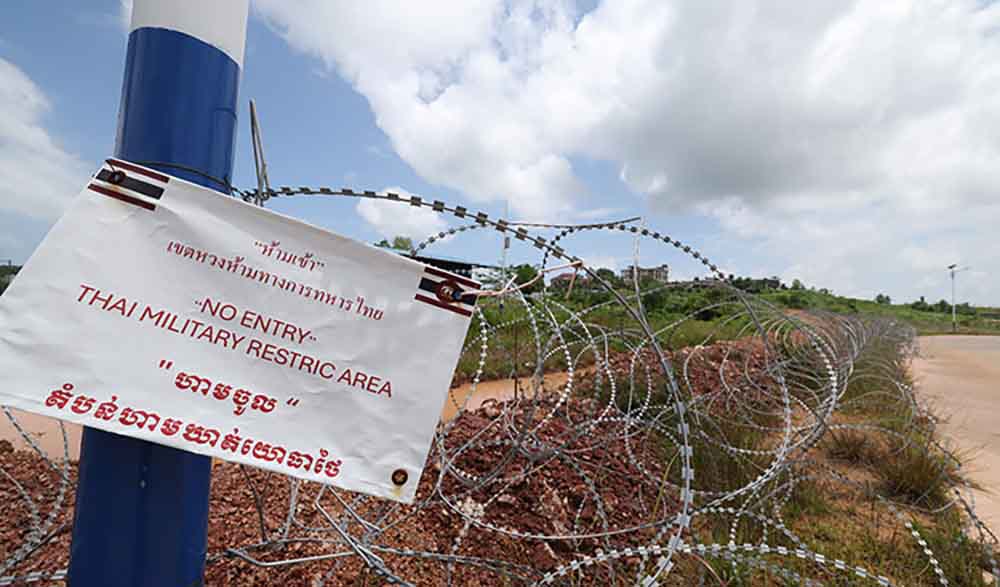
– MAIN PIC: The Thai military illegally blockades Cambodian territory in the Thma Da area of Veal Veng district amid a ceasefire. KT/Khem Sovannara
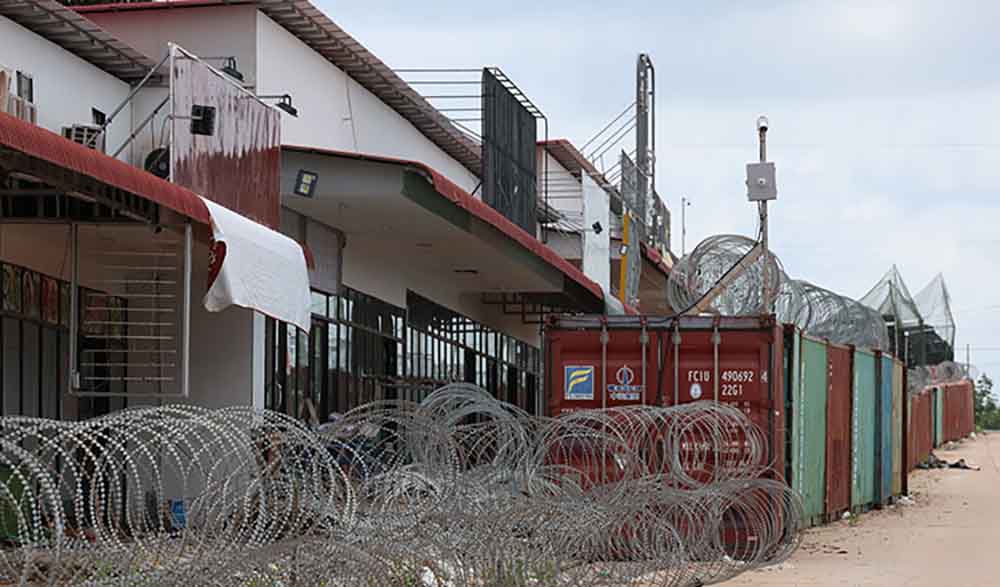
– Houses and shops on Cambodian land are fenced off with barbed wire and containers by the Thai army. KT/Khem Sovannara
– Thai forces raise the flag of Thailand on occupied Cambodian territory in in the Thma Da area of Veal Veng district. KT/Khem Sovannara