Türkiye Should Build Cambodia’s Healthcare Referral Network, Not a Capital Clinic
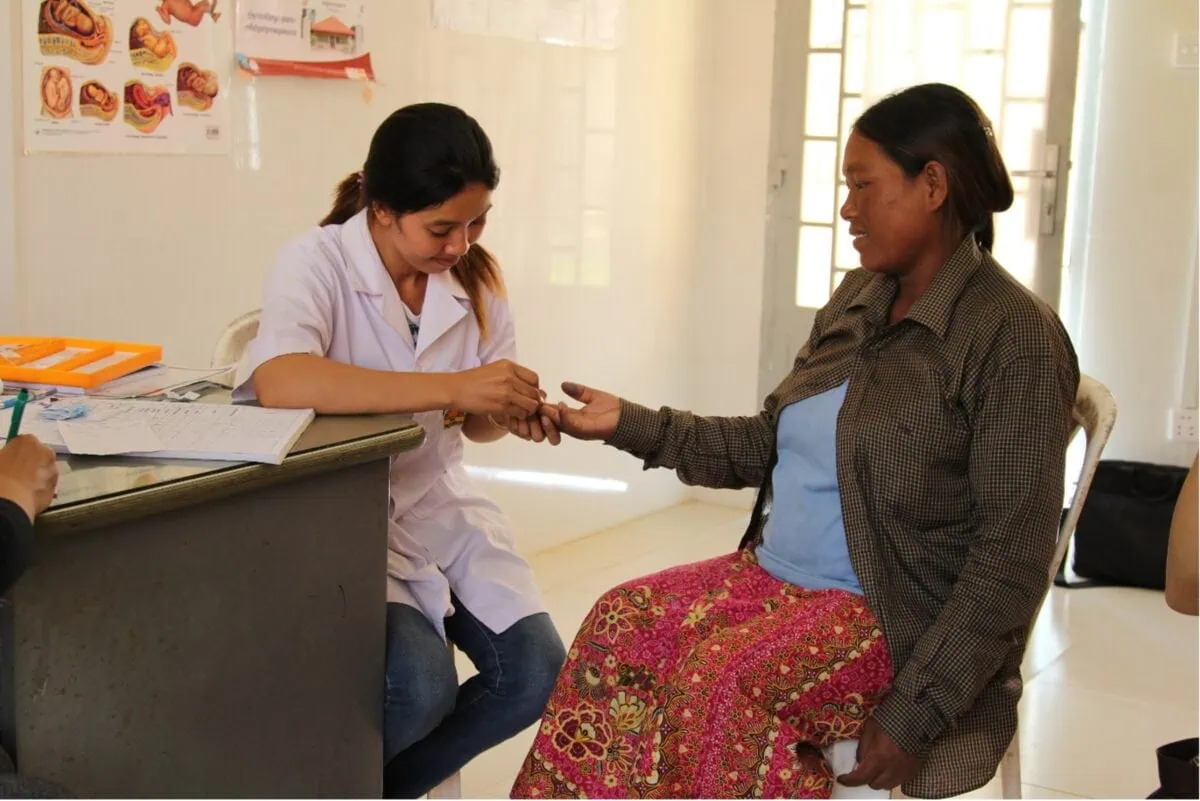 A Midwife tests a pregnant woman for malaria at the Promoy health center, Pursat province. Kharn Lina CAP-Malaria Cambodia
That should be the organising principle for health cooperation with Türkiye. The politically easiest project would be a new specialist clinic or hospital in Phnom Penh: visible, easy to inaugurate and useful to patients who can reach it. It would also leave the central problem largely untouched. Türkiye would add more value by helping Cambodia build a provincial referral chain, with local training, specialist support and reliable transfers and follow-up, than by placing another high-profile facility in the capital.
Phnom Penh already shows why a capital-centred project could backfire. The city contains only 14.7 per cent of Cambodia’s population but half of its doctors; its density of doctors, nurses and midwives is more than three times the average across other provinces. A new urban centre would compete for the same nurses, biomedical technicians and specialists that district hospitals need. It could expand tertiary care while making provincial facilities even more dependent on referrals they struggle to complete.
Cambodia is not neglecting bricks and mortar. Its Health Strategic Plan 2025-2034 seeks universal health coverage, while the country’s workforce plan calls for sufficient, competent and more equitably distributed staff. The current Health Equity and Quality Improvement Project also covers renovations of 78 health centres, 16 referral hospitals and two provincial hospitals. This does not mean infrastructure is sufficient. It means an external partner should ask what stops renovated facilities from functioning as a system. The harder gap is what happens between buildings: supervision, communication, maintenance and clear clinical responsibility.
Türkiye already has relationships to build on. In January 2025, TİKA and Doctors Worldwide Türkiye screened 2,446 people in Ou Reang Ov, Ponhea Kraek, Kandal and Pursat and trained local health professionals. Repeating the mission with a larger visiting team would produce another week of activity. Turning those contacts into continuous support would change how care is delivered after the visitors leave.
A two-year pilot in Pursat and Tboung Khmum could link one provincial hospital in each province to selected district referral hospitals and health centres. Training should take place at work, around the cases local teams actually see: triage, emergency stabilisation, maternal and child health, chronic disease and referral decisions. Turkish and Cambodian clinicians could review difficult cases each month, but Cambodian clinicians should become the trainers. Overseas fellowships have value; they do not change routine care across a district unless supervision, curricula and career incentives travel home with the participant.
Telemedicine belongs inside that referral chain, not beside it. Türkiye has regulated remote health services since 2022 and has experience integrating teleradiology, e-prescriptions and personal records through e-Nabız. That makes Türkiye a credible technical partner, not the owner of Cambodia’s digital system. Any teleconsultation tool should fit Cambodia’s DHIS2 architecture, follow Cambodian clinical protocols and leave patient data under Cambodian control. A proprietary platform that cannot interoperate would replace geographical isolation with technological dependence.
The referral process is mundane, which is precisely why showcase projects neglect it. A health centre must know which hospital will accept a patient, whom to call before transfer, what stabilisation is required, how transport will be arranged and who returns the care plan for local follow-up. The national information system should track rejected referrals, transfer times, outcomes and whether receiving hospitals send care plans back. Without those steps, a video consultation may only confirm that a sick patient still faces an uncertain journey.
Equipment procurement needs the same discipline. World Bank data show electricity interruptions at 54 per cent of health centres and 43 per cent of referral hospitals; only 13 per cent of health centres and 2 per cent of referral hospitals reported all required equipment functioning. Turkish-supported purchases should therefore include consumables, calibration, repair contracts, local spare parts and training for Cambodian biomedical technicians. Suppliers receiving public backing could have part of their payment tied to uptime. A donated ultrasound machine that fails after its warranty expires is not capacity-building.
A teaching hospital in Phnom Penh is not inherently a mistake. Cambodia needs advanced care, and a capital institution could anchor specialist training. But it should be the top node of a provincial system, not the whole bilateral offer. Its contract should require teleconsultation hours for provincial facilities, transparent referral criteria, rotations by trainers outside the capital and published data on cases managed safely closer to home.
The political mechanism already exists. Health was included in the joint minutes of the fourth Türkiye-Cambodia Joint Economic Commission in November 2025, and TİKA had completed 23 development projects in Cambodia by the end of 2024. The commission should establish a provincial health working group led by Cambodia’s Ministry of Health, with a service map, budget and timetable rather than another broad memorandum.
Before either government commits money to a showcase facility, it should fund the provincial pilot and publish four measures: referral times, provincial staff retention, equipment uptime and the share of patients treated safely within their province. The decision on a capital hospital should follow those results. If a health worker in Pursat or Tboung Khmum still cannot secure specialist advice, an accepted transfer and a returned care plan, a new building in Phnom Penh would make cooperation more visible without making Cambodian care more accessible.
Mehmet Enes Beşer is a researcher with a focus on ASEAN. His work examines Türkiye’s relations with Southeast Asian countries, particularly in the fields of economic development, industrial cooperation and foreign policy. The views and opinions expressed are his own.
-Phnom Penh Post-