It will take up to three decades to undo the damage inflicted on Preah Vihear Temple by Thai forces
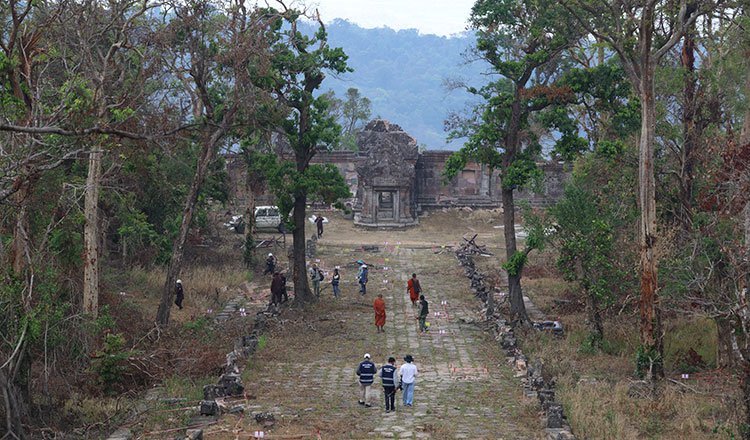 Heavy artillery fire from the Thai military has ruined Preah Vihear Temple, a UNESCO World Heritage Site. KT/Khem Sovannara
#National
Synopsis: Restoring the World Heritage Site will be a long and costly undertaking. Authorities have identified 562 damage points, with some sections at risk of collapse, requiring urgent stabilisation, as well as unexploded ordnance that must be cleared before work can begin.
Cambodia faces a decades-long, multimillion-dollar effort to restore Preah Vihear Temple following its destruction in 2025 after two rounds of Thai military assault. Work to stabilise the sections in danger of collapse is expected to take up to a decade and full restoration could take up to 30 years, according to the National Authority for Preah Vihear (NAPV).
Khmer Times journalists were recently granted access to the temple, where they observed the extensive damage inflicted by Thai shelling. Walls and roofs bore clear signs of impact, with holes puncturing the stone structures, while sections of the ancient architecture from Gopura I to Gopura V—linked by long, stone-paved causeways—have been reduced to rubble.
NAPV Director-General Kong Puthika said restoration efforts will be carried out in two main phases: stabilisation and full restoration.
“The restoration of Preah Vihear Temple is an urgent priority for the National Authority for Preah Vihear as well as for the government, in order to protect this World Heritage site,” he said at a Monday media forum on “Destruction of the Preah Vihear Temple, a World Heritage Site”, organised by the Club of Cambodian Journalists.
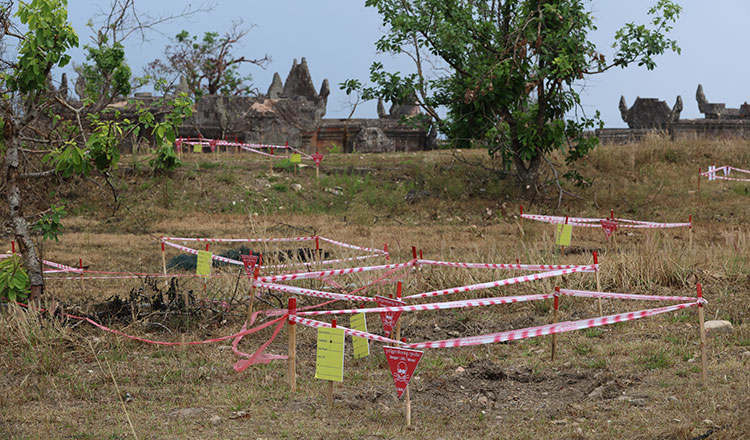
Some sections are at risk of collapse, prompting experts to develop an immediate rescue and stabilisation plan. The assessment was presented during the forum at the Culture and Fine Arts Ministry.
According to the report, the temple infrastructure was heavily damaged during two periods of military aggression, on July 24–28 and December 7–27 last year. Authorities said the ancient temple was hit by indiscriminate bombardment and airstrikes.
“For Preah Vihear Temple, we made efforts to preserve it for 20 years, from 2006 to 2025. However, the destruction in 2025 devastated what we had worked hard to conserve over the years, and even caused damage beyond what existed prior to conservation,” Puthika added.
During a visit to the site last month, Culture and Fine Arts Minister Phoeurng Sackona said the damage done to Preah Vihear Temple during the 2025 armed conflict was “hundreds of times greater” than earlier estimates.
Puthika noted that the scale of damage is extensive, with initial stabilisation work alone expected to take between five and 10 years to prevent further deterioration before full repairs can begin.
“The damage is extensive and cannot be quantified. Based on our assessment, it may take between five to 10 years just to restore and stabilise the structure to prevent further deterioration. As for conservation and further repairs, that is a separate matter, which will need to be carried out progressively in the coming years,” he said.
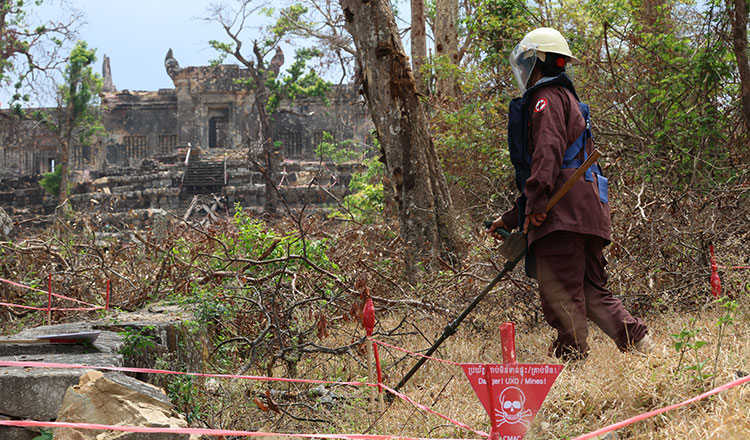
Full restoration “could take significantly longer, estimating a timeframe of up to 30 years to fully restore the temple’s structural integrity”.
“Reconstruction will require significant time and financial resources,” he added.
“The clearance of unexploded ordnance must be carried out to ensure safe access for conservation teams to perform their work. It may take between 20 to 30 years to fully restore Preah Vihear Temple to a stable condition.”
The cost of restoration is expected to be substantial, potentially amounting to tens of millions of dollars, according to preliminary estimates.
Beyond financial and technical challenges, Puthika said peace remains the most critical factor for the success of the restoration process. He said even before the recent destruction, planned conservation work alone was estimated to require a budget of $70 million, with support from China, India and the US.
Cambodia is working with the International Coordinating Committee (ICC) for Preah Vihear to seek additional support and technical expertise to protect the historic site from further risk of collapse.
The ICC-Preah Vihear is a permanent international mechanism established in 2014 to coordinate conservation and sustainable development at the UNESCO World Heritage site. Co-chaired by China and India, the committee brings together international experts and partners to support Cambodia in technical, financial and conservation efforts.
The 11th-century Hindu temple is one of Cambodia’s most significant cultural and religious landmarks, making its preservation a national priority.
Authorities have identified 562 points of damage at Preah Vihear Temple with urgent stabilisation efforts being prepared to prevent further deterioration.
NAPV Deputy Director-General Pheng Sam Oeun said on Monday that key structural components, including walls, roofing and the main body of the temple, were severely damaged.
Authorities described the situation as a major cultural loss. Cambodia has formally reported the damage to UNESCO. Documentation shows that the first round of damage in July affected 142 locations, while a second wave in December caused an additional 420 points of damage.
Oeun said further reports have been submitted as part of efforts to secure international support and technical assistance for the preservation of the historic site.
During the Thai military aggression in December, UNESCO had expressed strong concern over the renewed tensions between Cambodia and Thailand, including in the vicinity of Preah Vihear Temple, and called for urgent protection of the region’s cultural heritage in all its forms.
UNESCO reminded all parties of their obligations and commitment to respect international law, notably the 1954 Hague Convention for the Protection of Cultural Property in the Event of Armed Conflict and the 1972 Convention concerning the Protection of the World Cultural and Natural Heritage.
It said it will continue to monitor the situation of cultural heritage in the region, with a view to ensuring its protection, the statement read, adding that, to that end, UNESCO has communicated to all parties concerned the geographical coordinates of sites on the World Heritage List as well as those of national significance to avoid any potential damage.
“UNESCO stands ready to provide the necessary technical assistance to ensure the protection of cultural property and implement any necessary safeguarding measures as soon as conditions allow,” it said.
To address the damage, the ICC-Preah Vihear held a plenary session in Siem Reap last month, chaired by Sackona, with China and India as co-chairs.
Ahead of the meeting, experts assessed damage at Preah Vihear and reviewed conservation work at Koh Ker Temple. They recommended urgent measures, including structural stabilisation, documentation and safety improvements at multiple sites.
Experts called for immediate intervention in heavily damaged areas, particularly from Peuy Tady to the Dragon Bridge at Gopura 5, and inspection of facilities at the base of the temple.
The International Court of Justice (ICJ) ruled in 1962 that the Temple of Preah Vihear is on Cambodian territory and ordered Thailand to withdraw any military or police forces stationed there, as well as to return any objects removed from the temple.
Following armed clashes between Cambodian and Thai forces between 2008 and 2011 near the temple area, Cambodia requested the ICJ to clarify the scope of the 1962 ruling. In its 2013 interpretation judgment, the court reaffirmed that Cambodia holds sovereignty over the entire promontory of Preah Vihear and that Thailand must withdraw from the area.
-Khmer Times-